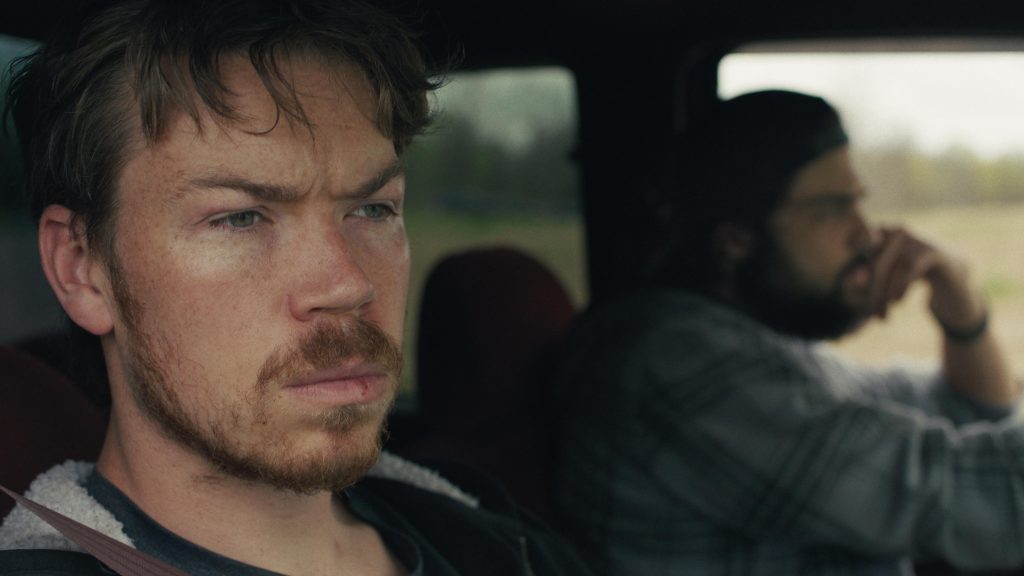
Union County (2026) is written & directed by Adam Meeks. It stars Will Poulter, Noah Centineo, Elise Kibler, Emily Meade, Annette Deao, Sylvie Mix, Danny Wolohan, Kevin P. Braig, AJ Hunt, Gemma Nelms, Nicole Stubbs, and Brandon Terrell. The film follows Cody Parsons (Poulter), an opiate addict in rural Ohio who’s assigned to a court-mandated drug rehabilitation program alongside his former foster brother, Jack (Centineo). As Cody fights to stay sober amidst countless temptations and tragedies, he begins to realize that this may be his last chance to lead a meaningful life.
As this quiet, grounded character, Will Poulter delivers what’s easily one of the year’s best performances. The lack of complex dialogue forces him to communicate physically, and though his performance is the definition of subtle, he somehow conveys even Cody’s most complex emotions. Poulter seems to understand that with a closed-off, emotionally distant character like Cody, a well-placed stoic/blank response can say more than a monologue. This results in a performance in which Poulter lets his emotions constantly build, so when he loosens the gasket just a tiny bit, even the smallest moments have the potential to make the viewer cry. Visually, he also just seems perfect for the part. His lack of traditional movie-star good looks help to sell this character as a believable, average midwest dude.
Cody’s loving, but also toxic, relationship with Jack, his former foster brother, is a real highlight of the film. Poulter and Centineo have palpable fraternal chemistry that’s consistently compelling. Despite the fact that Jack and Cody are clearly a hindrance for one another in terms of recovery, they’re also each other’s closest family and only source of unconditional love. This complicates our feelings for Jack specifically, who could’ve easily been a character to resent considering the way he constantly tempts Cody. It’s made clear that this is not his intention, but rather a consequence of his own tendency to relapse. Instead of simply painting Jack as a nefarious force of temptation, he presented as someone whose struggle with sobriety is even more dire than Cody’s, which ultimately breeds more sympathy for the character than contempt.
The story’s culmination is undeniably powerful, but also more predictable than I could’ve imagined. It hammers home the harsh realities of opioid addiction in a way that doesn’t pull any punches, resulting in a satisfying but unsurprising watch. My only other issue with the ending is that it tries to shoehorn in a warning related to the fentanyl epidemic, but it just feels out of place and oddly reminiscent of the final episode of Euphoria (2019-2026). Thankfully, this is overshadowed by the perfect decision to end the film by not giving the audience a clear answer as to whether Cody will maintain his sobriety or once again relapse. It reminds us that staying sober isn’t an easy road, and addiction will most likely follow an addict for the rest of their life. At the same time, it also reminds us that just because you slip up, that doesn’t mean you’ve failed. As long as you’re fighting, that’s what matters.
Overall, this is an effective film about the opioid epidemic and its victims. The documentary-style visuals and grounded performances help to consistently sell the story’s authenticity. Yes, it’s ultimately an extremely predictable tale, but it also feels worthwhile. In an odd way, the fact that it’s predictable helps further sell its inevitably tragic conclusion. We know what’s coming and can’t do a thing about it, which feels like twisting the dagger. For Poulter’s performance alone, this is one to watch. B


