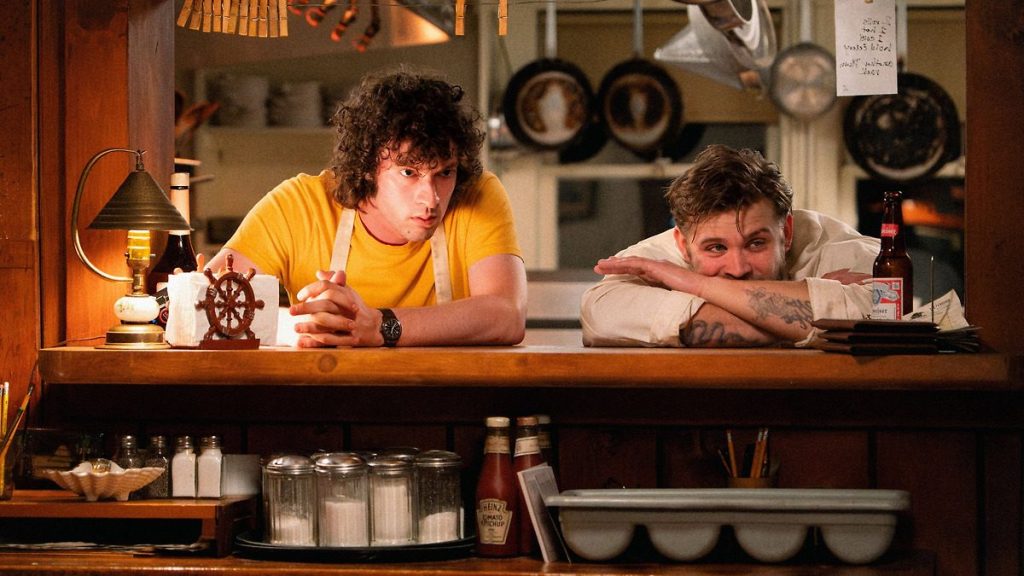
Tony (2026) is directed by Matt Johnson, who also wrote the film alongside Todd Bartels, Lou Howe, and Matthew Miller. It stars Dominic Sessa, Antonio Banderas, Emilia Jones, Leo Woodall, Stavros Halkias, Michael Jibrin, Monica Raymund, Rich Sommer, Dagmara Dominczyk, Liam Fitch, and Caroline Portu. The film follows a young Anthony Bourdain (Sessa), aka Tony, during his first summer after high school as he impulsively travels to Cape Cod to woo his crush, Nancy (Jones). This forces him to accept a job washing dishes at a modest seafood restaurant owned and operated by a skilled but jaded unnamed chef (Banderas). Throughout the summer, Tony is torn between his growing love of the culinary arts and the temptations of adult life embodied by his friendly but self-destructive co-worker, Sal (Woodall).
As a young, unknown, full of piss & vinegar Anthony Bourdain, Sessa once again shines–-proving his breakout role in The Holdovers (2023) wasn’t just a fluke. Because this is a pre-fame, pre-culinary-arts Anthony Bourdain, Sessa isn’t forced into doing a simple impression. Instead of trying to recreate Bourdain, he simply tries to evoke some of the man’s key values. Unlike Jaafar Jackson in Michael (Michael), Sessa isn’t just attempting to be a mime. It’s a risky choice, but it pays off because it highlights what was truly special about Bourdain and doesn’t waste its time on surface-level physical attributes. Nothing about how he looks, moves, or speaks screams Anthony Bourdain, but his unique and distinctly human worldview is unmistakable. Bourdain always seemed to see beauty in everything, whether it was a 5-star restaurant or the world’s grimiest, cheapest pizza place. He was keenly aware of life’s duality, and the story shows him coming to terms with it for the first time when he’s torn between his smooth-talking party-animal co-worker, Sal, and his unexpected culinary mentor, Chef.
This helps the viewer to better understand the source of both Anthony’s deep adoration of life and his lifelong bouts with depression. He seems to experience everything to the fullest, including the bad. This struggle gives the film some real stakes, especially once Tony realizes that he can’t, in fact, embrace both the life of a great chef and a sort of renegade journalist/writer. That’s eventually what he’d do as a traveling food critic, but only after decades of fully committing to the culinary craft. There are few tangible, real-world stakes, but it constantly feels like the character is fighting not just for his future, but for his soul.
Beyond being a strong, subtle character study, the film also works as a simple, fun summer hangout movie. If you know how Bourdain’s story ends, a certain dark cloud hangs over everything. However, the film smartly subverts the expectation that its story will inevitably end on a downer note. Bourdain shouldn’t be defined by the tragedy of his death, so it’s a relief that Matt Johnson & company are on that same wavelength. It’s a celebration of the man, not a eulogy, and the film is all the better because of it. It sort of works to reclaim/remind us of who Bourdain was, minus how things ended, which feels like a beautiful, meaningful choice.
Overall, Tony is a subtle yet effective character study that honors Bourdain’s unique legacy and doubles as a fun summer hangout film. It’s shot great; the performances are fantastic, and it doesn’t overstay its welcome. Matt Johnson has absolutely nailed it once again. So far, this is one of my favorite movies of the year. B+


