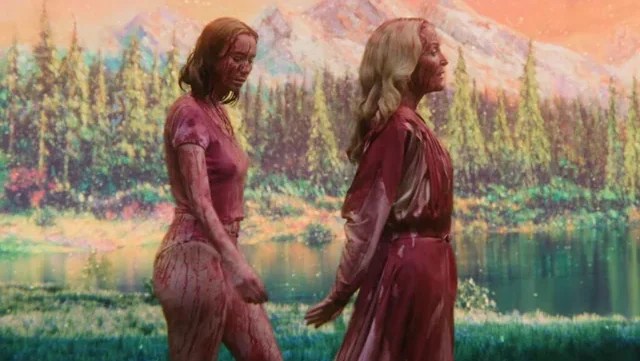
Teenage Sex and Death at Camp Miasma (2026) is written & directed by Jane Schoenbrun. It stars Hannah Einbinder, Gillian Anderson, Jasmin Savoy Brown, Sarah Sherman, Patrick Fischler, Zach Cherry, Kevin McDonald, Aren Buchholz, Jack Haven, Arthur Conti, Hunter Dillon, Florence Barrett, and Quintessa Swindell. The film follows Kris (Einbender), an up-and-coming queer filmmaker who’s hired to reboot/recontextualize a popular, long-running slasher franchise known for its villain, Little Death (Haven), and its less-than-inclusive undertones. Struggling with how to approach this reboot, Kris decides to meet with the franchise’s original star, Billy Preszley (Anderson). Upon her arrival at Preszley’s home, she quickly recognizes that it’s the exact same summer camp where the franchise’s original entry was filmed–-maintained as if frozen in time. As she and Billy form a quick romantic and artistic connection, Kris begins to learn that the legend of Little Death may be more real than she could’ve ever imagined.
As this kind of shy, nerdy, sexually repressed protagonist, Hannah Einbinder is a fantastic, consistently entertaining force. She easily balances the film’s constantly shifting tones, being equally believable as the intelligent, subdued film buff she is and the dim-witted, big-breasted final girl she dreams of being. Even if you can’t fully connect with the character’s struggle to fully embrace the ins & outs of her sexuality, it also works as a more general representation of an individual’s struggle to balance/come to terms with any clashing aspects of their identity.
The character only falls somewhat flat when Schoenbrun’s script attempts to draw parallels between her emerging sexuality and Little Death’s inevitable resurrection. Granted, this is very much a film asking to be analyzed with a depth that requires more than a single viewing, so maybe I just didn’t quite catch what it’s trying to say. It’s clear that Schoenbrun is trying to explore the idea of how the violent slasher movies we watch growing up influence aspects of our adult selves, specifically our sexuality. This is no doubt an interesting topic to explore, but the film never goes beyond simply introducing the idea. How do these kinds of things affect us? I’m not sure, and the script isn’t either, but at least it’s an interesting question.
All the double-edged innuendos are a tad silly. For example, it only made me roll my eyes when the script presented parallels between being stabbed and being sexually penetrated. Do I really need to be reminded that having an orgasm sounds similar to being murdered? All of this definitely made me grin, but it also felt like low-hanging fruit. This kind of abstract thematic storytelling eventually takes over completely in the third act, leading to a somewhat confusing and unsatisfying conclusion.
For at least the first half, the film plays as a slasher fan’s dream meta-commentary on the genre. The connections between slasher films and the queer community tie into the real-life legacy of classics such as Sleepaway Camp (1983), Friday the 13th (1980), and even The Burning (1981). The camp setting is like crack for slasher fans, but this film takes that nostalgia to the next level with its endlessly creative visuals/set design. For example, there’s a particularly impressive sequence that shows a montage of clips from all the previous entries in the Little Death movie franchise. As it moves from one entry to the next, we see VHS tapes of films piling up, giving the audience a nostalgic, tangible connection to this series despite never having actually seen it. This ecstatic nostalgia also extends to the score, which is peppered with a handful of unconventional needle drops that work a lot better than expected.
The film has a strong sense of humor, which often makes its sillier choices a tad more palatable. For example, there’s one particularly funny self-aware moment where Kris and Billy are watching the first Little Death movie, and Kris decides to chime in that “this part’s transphobic” and Billy immediately tells her to “shut up.” Not only is this a moment any overly-excited film buff has experienced, but it also spits right in the face of people who think the transgender community can’t take a joke/make fun of themselves. On a deeper level, it also speaks to the theme that modern film discourse often revolves around how the material relates to the real world, forgetting to analyze it on its own terms without those pressures. For example, when we talk about a film like Friday the 13th in 2026, the discussion typically revolves around what the movie means/is trying to say to modern audiences, which is odd considering it was never meant to speak to them in the first place. Although it makes far more sense for modern audiences to focus on the story itself, they’ve been trained not to. Thus, they search for meaning in something that was never meant to mean that much, especially to their particular generation.
Overall, this is an endlessly creative, original meta take on the slasher that, for the most part, successfully implements themes of queer identity. It’s definitely exploring some extremely niche subjects, but any non-bigoted audiences who appreciate the slasher genre are sure to get their money’s worth. Even if you can’t personally connect with the more straightforward themes of discovering one’s sexual identity, this is such dynamic, sharp filmmaking that it’s tough not to at least appreciate, if not outright enjoy. Both Gillian Anderson and Hannah Einbinder give arguably the best performances of their careers, making this mostly a win despite its handful of missteps. It’s not my favorite horror film of the year by far, but I wouldn’t be surprised if it’s a lot of people’s. B


