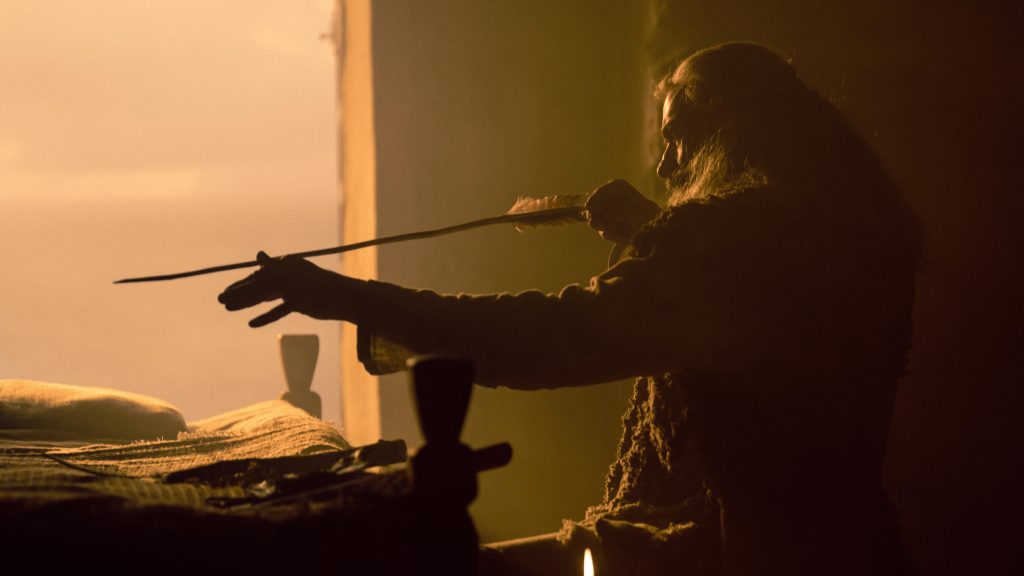
The Death of Robin Hood (2026) is written & directed by Michael Sarnoski. It stars Hugh Jackman, Jodie Comer, Bill Skarsgård, Murray Bartlett, Noah Jupe, Faith Delaney, Jade Croot, Katie Breen, Alfie Lawless, Clive Russell, Richie Wilson, Tabitha Smyth, Beau Thompson, and Asher De Silva. The film follows an aging, tormented version of Robin Hood (Jackman) who is determined to spend his final days in solitude. However, this quickly changes when he’s reunited with his former partner in crime/best friend, Little John (Skarsgård), who offers Robin the opportunity for one last battle and a death worthy of song. Despite planning to die, Robin barely survives the battle and is nursed back to health by a mysterious nun (Cormer) who might be connected to his past. As he heals at a remote monastery, Robin is forced to confront his many past misdeeds and, hopefully, find some form of redemption.
As this gruff, brutal, almost villainous version of the iconic character, Hugh Jackman unsurprisingly carries the film. It hasn’t been since Prisoners (2013) that I’ve seen him take on a role this dark, and although he’s not as good here as he is in that movie, he sells the character’s jaded aura.
Jodie Comer, Noah Jupe, and Bill Skarsgård all nail their various roles, but the standout is surprisingly Murray Bartlett as a wise Leper who resides at the monastery. The mystery behind his character is intriguing, but the eventual answers about him make for the film’s strongest scene. His scenes are heartbreaking and human, two tones that director Michael Sarnoski seems to have mastered.
The choice to make Robin Hood a merciless, violent killer is a big swing that doesn’t entirely work out. This is largely because the film tries to do way too much with his character. The film spends its extended first act beating the viewer over the head with the idea that Robin isn’t a nice guy, then spends the rest of the runtime struggling to decide whether it wants to redeem him or make him pay for his sins. In practice, it seeks to achieve both in equal measure, but it just ends up feeling overstuffed.
Sarnoski employs some of the tender emotional manipulation seen in his masterpiece, Pig (2021), but far less effectively. He seems determined to subvert the audience’s expectations, which only results in an anticlimactic experience. In Pig, this approach feels like a refreshing subversion, but here it comes across as forced. In other words, it feels like subversion without a purpose – subversion for subversion’s sake. This makes the overall experience unsatisfying as pure entertainment and also pushes the story in a disappointing thematic direction. Yes, someone simply admitting/owning up to their mistakes is a redemptive act, but not the kind that makes for the capstone of a meaningful/compelling arc.
Overall, this is a compelling watch, featuring a number of fantastic individual scenes that, unfortunately, never quite form a satisfying whole. Hugh Jackman is great in the lead role – no surprise there. The real surprise is actually the supporting cast, who mostly steal the show. This isn’t a bad movie by any means, but it’s a somewhat disappointing misfire. I’m still fully invested in following Sarnoski’s work, so hopefully he bounces back with his next project. C+


