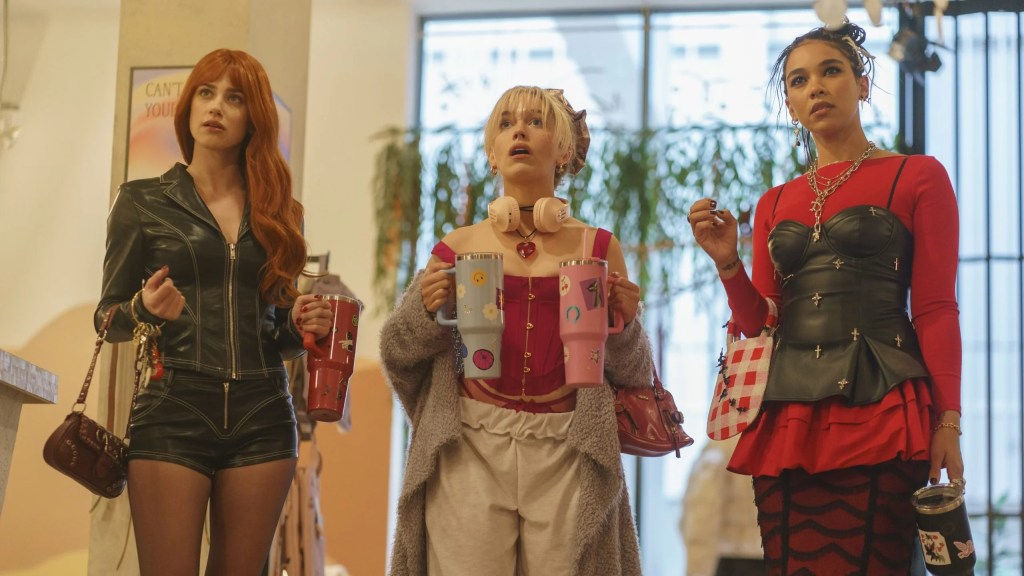
Forbidden Fruits (2026) is directed by Meredith Alloway, who also wrote the film alongside Lily Houghton. It stars Lili Reinhart, Lola Tung, Victoria Pedretti, Alexandra Shipp, Emma Chamberlain, Zack Thompson, Austin Ball, and Gabrielle Union. The film follows Apple (Reinhart), Cherry (Pedretti), and Fig (Shipp)—a trio of mall employees who are also a coven of powerful witches. When they decide to welcome mysterious newcomer Pumpkin (Tung) into their group, she begins to raise questions about their problematic friendships. As tensions brew, the girls are forced to confront dark secrets that could tear them apart.
The four main characters are well-cast, and the balanced script gives each of them the proper amount of focus. Each character has a distinct, recognizable personality, yet they never feel like one-dimensional archetypes. Reinhart brings the proper alpha energy as the group’s cutthroat leader, Apple, and Shipp is natural as Fig, the more accepting of the bunch. Lola Tung is likable as the mysterious newcomer, Pumpkin, but the standout of the group is easily Victoria Pedretti as Cherry, the promiscuous idiot archetype (though she turns out to have more layers than initially expected). The script does a decent job of selling these various personalities as believable friends while giving their dynamic an underlying tension that pulsates through each interaction. It’s clear that this cast is passionate about the material, and that translates to the screen.
This follows in the footsteps of/takes clear inspiration from coven films such as The Witches of Eastwick (1987), The Craft (1996), and Practical Magic (1998). Thankfully, it never feels like a ripoff of those films, just cut from the same cloth. Other than a mildly brutal climax, the horror elements are light by today’s standards, which is to be expected given the subgenre’s tendency to balance its darkness with a dose of whimsy. The film’s roots as a stage play make this a dialogue-heavy watch, resulting in a more challenging experience than I initially expected. It explores well-worn topics such as identity and trauma, but refreshingly also takes a look at the potential toxic side of female friendships. Fans of the subgenre will still get their desired number of girl power, ‘men can be so stupid’ moments, but these never feel silly, considering that the second half of the story is about deconstructing the more toxic aspects of this behavior.
Unfortunately, a large portion of this just didn’t work for me. I often found myself struggling to understand what certain elements/moments/characters were meant to represent, which then made me wonder if I was even supposed to be analyzing them so deeply in the first place. It’s clear that a lot of the subject matter is aimed at women, which likely made certain themes fly right over my head. These questions and confusions compounded until I found myself so frustrated that I simply had no desire to unpack the somewhat abstract elements of its ending. I’m clearly not the target audience, so there’s a chance I just don’t get it.
Overall, this is a decent entry in the sisterhood-of-witches subgenre, but it’s a bit too slow-paced and thematically muddled to have wide appeal. It’s a mixed bag at best from my perspective, but I can only speak to the male audience. Girls should have a closer connection to the themes and will most likely enjoy this much more than I did. I respect it, but don’t quite love it or even fully understand it. It has issues, but also some charm. Check it out if it seems like your thing; I see cult classic potential for the right people. C+


