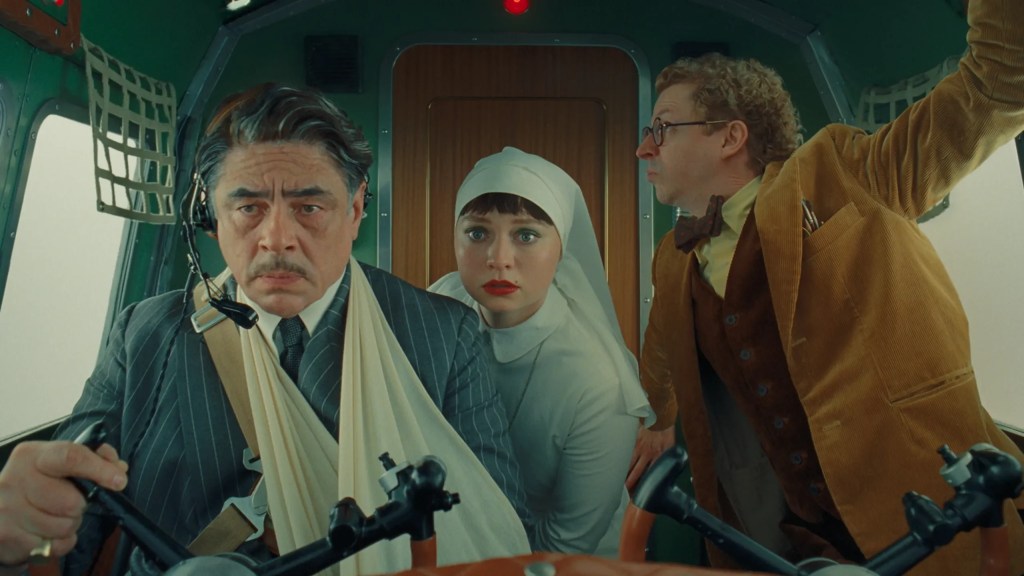
The Phoenician Scheme (2025) is written & directed by Wes Anderdson. It stars Benicio Del Toro, Mia Threapleton, Michael Cera, Willem Dafoe, Rupert Friend, Benedict Cumberbatch, Richard Ayoade, Jeffrey Wright, Scarlett Johansson, Bill Murray, Riz Ahmed, Tom Hanks, Bryan Cranston, Mathieu Amalric, Hope Davis, F. Murray Abraham, Steve Park, and Scott Sheperd. The film follows Zsa-zsa Korda (Toro), a hotshot businessman, who, after brushing shoulders with death yet again, decides it’s time to name an heir to his massive estate. For unknown reasons, Zsa-zsa chooses Liesl (Threapleton), his eldest daughter. Having been raised in a convent as a devoted nun, Liesl finds it challenging to connect with her father’s often amoral approach to business. Even so, she accepts her role as his heir, seeing it as an opportunity to better the world in any way she sees fit. As they embark on a new business enterprise involving Zsa-zsa’s estranged brother, Nubar (Cumberbatch), they quickly become the target of rival businesses, guerrilla freedom fighters, and even the United States government. This forces father and daughter to find common ground before they’re swallowed whole by the seedy underbelly of unchecked capitalism.
The large, all-star ensemble is as capable as one would expect, but they’re also confined to Anderson’s trademark off-beat tone. In other words, it never feels as if the actors have any agency in their performances. Every character speaks with the same monotone matter-of-factness, delivering long monologues straight to the camera as if they’re reading off a teleprompter. This fits certain characters better than others, but ultimately makes everyone feel a bit too similar. The inherent silliness of a Wes Anderson-created world allows for several goofy and unique characters. Still, they fail to stand out when everyone and everything around them is equally zany.
Anderson’s filmmaking, especially his command of mise en scène, is masterful as always. Unfortunately, this is the first film where his typical schtick is starting to feel stale. The movie looks great, and it’s consistently fun, but it doesn’t bring anything new to the table. Whether it’s the visuals or the themes of estranged family, it’s all stuff we’ve seen from Anderson throughout the vast majority of his filmography.
The film’s religious themes are also frustratingly basic. The far too religious character is forced to become less devout, while the non-religious character is forced to accept the presence of a higher power. They’re both on opposite poles of the argument, but are forced to meet each other in the middle. It’s an extremely safe stance to take, and therefore the definition of uninteresting. Really? Humans need to find common ground to agree? I never would’ve guessed.
Thankfully, despite my many issues, it’s tough to hate a movie that displays such command of the filmmaking process. It’s a fun, easy film to follow and has a wonderful sense of dry humor. It doesn’t break any new ground, which is slightly disappointing, but it delivers the goods for anyone who simply desires a quintessentially Wes Anderson experience.
Overall, this is a goofy and enjoyable experience that’s sure to please die-hard Wes Anderson fans, but will inevitably disappoint anyone who expects something new. Anderson is a great director, maybe even one of the absolute best, but he’s not a particularly impressive storyteller. He’s hesitant to explore new tones or themes, and The Phoenician Scheme proves it. Even so, you probably won’t see a better-looking movie released this year. That alone earns the film an apprehensive recommendation. B-

 The Movie Matt