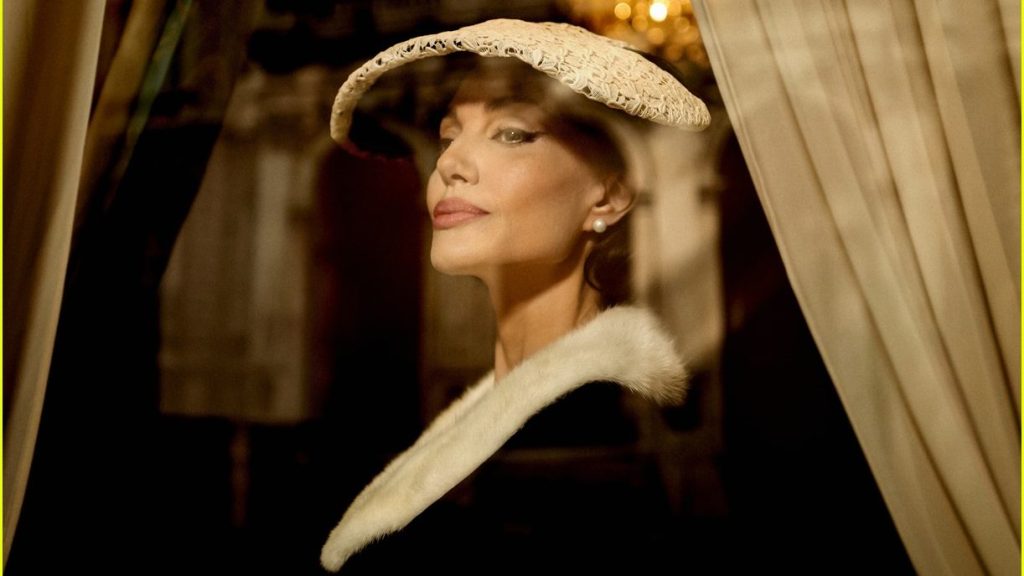
Maria (2024) is directed by Pablo Larrain and stars Angelina Jolie, Pierfrancesco Favino, Haluk Bilginer, Alba Rohrwacher, Kodi Smit-McPhee, Stephen Ashfield, Valeria Golino, Caspar Phillipson, Lydia Koniordou, and Vincent Macaigne. The film is set in 1970s Paris and focuses on the final days of the legendary opera singer, Maria Callas (Jolie). Riddled with depression due to the gradual loss of her singing voice, Maria soon develops a crippling addiction to a drug called Mandrax. Slowly losing her grip on reality, Maria imagines a man likewise named Mandrax (Smit-McPhee) – a famous reporter who arrives to interview her about her controversial career. Throughout the interview, the film flashes back to Maria’s traumatic upbringing in Nazi-occupied Greece as well as her passionate, decades-long affair with wealthy entrepreneur, Aristotle Onassis (Bilginer). During stretches of clarity, Maria makes a final charge to regain her voice, and by extension, her pride.
Similar to Pablo Larrain’s previous two films, Jackie (2016) and Spencer (2021), Maria explores one of history’s most intriguing female personalities during a very short/specific portion of their life. Although Larrian’s direction is uniquely effective in terms of drawing emotion from the viewer, his films would fail to stand out if they lacked strong central performances. Thankfully, Jolie delivers one of the stronger performances of 2024 that failed to nab an Oscar nomination. That being said, I don’t think the performance ever reaches the transformative heights of either Natalie Portman as Jackie Kennedy or Kristen Stewart as Princess Diana. I think this is because although Jolie is good, the character never feels like new territory for her as a performer. In other words, it feels like the role doesn’t allow her to take many risks. She’s great, it’s just not anything we haven’t seen before. On top of this, although I prefer that the film avoids including too many opera sequences, the few close-ups of Jolie singing feature some occasionally obvious lip-syncing. I’m not necessarily against a film taking the lip-synching route (especially when the music isn’t necessarily the point), but it’s something they should make a special point to get right. Otherwise, it just puts a sour taste in the viewer’s mouth.
The depiction of Marias’ psychological descent adds an element to the film that helps to distinguish its storytelling from its predecessors. Although it’s mostly clear to the viewer from sequence to sequence whether or not Maria is hallucinating, Larrain continuously throws in “blink and you’ll miss it” details that make them second-guess the reality of what they’re seeing. Thankfully, the otherwise irrationally abstract nature of Maria’s psychological struggles is balanced by the focus on how this behavior affects her servants – the closest thing she has to a family and the only people who are always there for her. When the film shifts to their perspectives, it provides a definitive version of how things are, not just how Maria imagines them.
Although this is from start to finish a compelling watch, it’s missing a clear/interesting theme or lesson as a result of Maria’s struggles. It’s essentially just the tragic story of a person who is loved on an unsustainable scale by both her lovers and fans, but then finds it impossible to adjust when that adoration is taken away. It’s effectively tragic, but also painfully unoriginal and predictable. At least it’s all very pretty to look at. It rightfully earns its sole Oscar nomination for Best Cinematography.
Overall, this is yet another top-notch character study from director Pablo Larrain that features a skilled veteran performance from Angelina Jolie. It’s a clear step down from the director’s previous work, but I think this is due to the script more than anything else. It lacks a bit of substance to praise as a classic, but I can’t see anyone who’s even slightly interested in the subject matter being disappointed with the experience. All things considered, I can’t wait to see what Larrain does next. B


