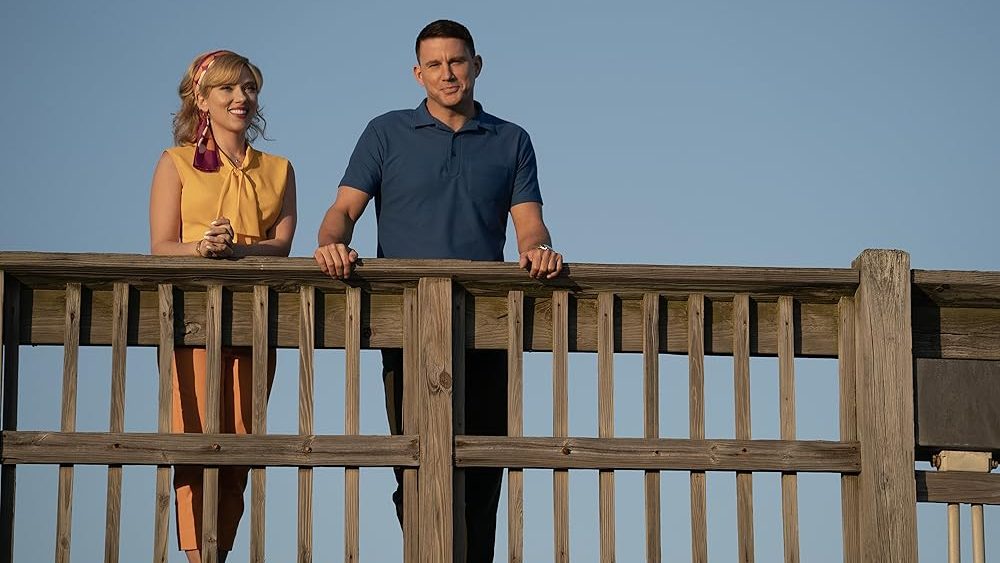
Fly Me to the Moon (2024) is directed by Greg Berlanti and stars Scarlett Johansson, Channing Tatum, Woody Harrelson, Ray Romano, Jim Rash, Anna Garcia, Donald Elise Watkins, Noah Robbins, and Christian Clemenson. The film takes place during the 1960s space race and follows Kelly Jones (Johansson), a hotshot marketing specialist who’s hired by the US government to help sell space travel to the general population. She soon clashes with the Apollo project’s lead engineer, Cole Davis (Tatum), over his “all business” attitude. Together, the two form a subtle yet flirtatious rivalry that brings out the best in one another and ultimately the Apollo project itself.
Johannson and Tatum don’t deliver anything particularly new with their respective performances. Johansson is charismatic as always and feels like a good fit for her character’s archetype, but it’s unfortunately a somewhat typical “strong woman in the 60s” character. Tatum once again proves to have great comedic energy, it’s just a shame that he feels miscast as supposedly “the best astronaut who never went to space.” His natural idiolect doesn’t particularly scream intelligence if I’m being honest. At the very least, the two’s romantic chemistry is stronger than I expected when considering how little the script develops their romance.
The supporting cast is nothing special, but it’s not really their fault. The film’s upbeat but safe tone along with a script that doesn’t seem interested in fleshing out its supporting characters leads to what feel like stock performances. Ray Romano is a fun addition, but other than that, I was underwhelmed with everyone else – Woody Harrelson especially. He plays an FBI agent who is so all over the place that he almost comes across as bipolar. It doesn’t help, as well, that Harrelson has a strangely inconsistent way of speaking that randomly shifts from his normal voice to something resembling a 50s cop. These supporting characters get a lot of screen time, but there’s never an understanding of how the characters feel about one another. In other words, there’s very little intrigue or conflict between anyone who isn’t one of the two leads. They don’t feel like characters, they feel like tools to flesh out the leads. The cherry on top is that a lot of these supposedly top-tier scientists act like complete bimbos who are easily manipulated and constantly make childlike mistakes. I know that intelligence can come in all forms, but in the context of a film, an outward aura of intelligence would help with authenticity.
The movie is at least 35 minutes too long and eventually feels like a punishing experience in the sense that it’s not particularly original and focuses on a real-life story we already know the ending to. This eliminates a huge portion of the intended tension during the third act which caused me to consistently look at my watch.
The main theme of pretending to be someone else vs. accepting who you are is one that has been explored countless times before and speaks to the film’s largest overarching issue which is that it plays things way too creatively safe in almost every aspect. On a technical level, it does everything well enough. It looks great and nicely captures the era, but that’s about the only thing that stands out. If this movie was a T-shirt, it’d be new, clean, and white. It can’t even take a side on the controversial topics it touches upon such as the theory that the moon landing was faked. The movie essentially says that we did it, but faked it just in case. That’s cool, I guess, but not a very compelling idea.
Overall, this is a boring, safe, overlong, yet offensive filmgoing experience. It’s not vaguely interested in delivering anything you haven’t seen before, but it is competently made. The natural energy of the two leads keeps things moving along even if the story itself is as forgettable as it gets. It won’t appeal much to history or comedy fans, but it should be serviceable for the typical 50+ year-old who likes their entertainment tame and inoffensive. C


