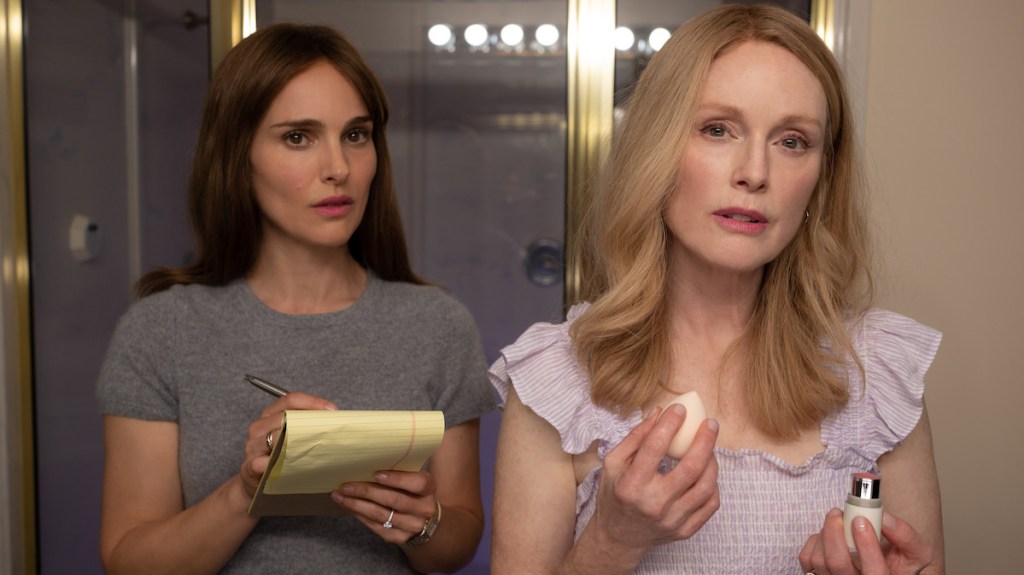
May December (2023) is directed by Todd Haynes and was released to Netflix on December 1st. The film stars Natalie Portman, Julianne Moore, and Charles Melton. May December follows Elizabeth (Portman), an actress who is on the verge of portraying Gracie, another actress who was involved in a famous scandal some 20 years ago. The scandal involved a then 34 year-old Gracie starting a sexual relationship with a then 13 year-old boy named Joe (Melton). Gracie goes to prison, fathers Joe’s child there, and is eventually released. Once they are both of age, Gracie and Joe tie the knot, claiming that their relationship has always and will always be based in true love. When Elizabeth arrives to stay with the family in order to research her role, she quickly realizes that getting to the root of Gracie’s true identity might be a bit more difficult than she was expecting. Lies, manipulation, and long buried truths eventually begin to come to the surface, leading both Gracie and Joe to relive their past in ways they never wanted (but probably need).
This is truly some of the better acting I’ve seen this year and that’s no surprise considering who the leads are. It feels fitting to cast Portman as an actress portraying another actress. She really does give off that sort of Ivy-League educated classical actress vibe. The performance also has a subtly nice edge to it. I’m used to seeing Portman play these sort of morally strong characters, and here what she does is a little more balanced. Moore gives one of her better performances, really fleshing out an extremely complicated character. We are initially introduced to her character in a way that presents her as a loving and responsible mother. Then this is quickly juxtaposed when the viewer is made aware of her previous scandal. Her character is so complex that it reaches that point of being mysterious. The pieces just don’t fit together. She’s loving, insecure, short-tempered, graceful, and sneakily intelligent. One really has a hard time telling whether the character is intentionally mysterious or just cripplingly insecure. Charles Melton as Joe was the most surprising performance here. He’s really able to hold his own next to Moore and Portman. The character is likewise surprisingly complex, first being presented as a potentially unfaithful husband and then as a young adult whose actions are driven by the fact that his youth was ripped away from him far too soon.
First off, it’s important to know that this is a pretty uncomfortable film. The subject matter, tension, and the subtle creepiness of Elizabeth’s obsession with Gracie all help to foster a massive amount of tension. Elizabeth’s attempts to completely transform into Gracie are unsettling even when taking into account the fact that she is an actress. Where is the line when portraying a real person in film? Like always, the public can become so obsessed with a particular celebrity that they forget they are a human being first and foremost.
Gracie is presented as being particularly insecure about the whole thing, but the film does the interesting thing of implying that this is because of Elizabeth’s presence, not that she’s an insecure person in general. She is also presented as always knowing exactly what she wants and what to do. There is a constant hypocrisy with Gracie, constantly being shown or described in conflicting ways. We as the audience feel that something is off, but this is easily explained away as Gracie just being “unique” or “eccentric.” This sort of plays into the theme of how humans have a tendency to underplay/hide the worst aspects of themselves. When we are forced to confront these aspects of ourselves unwillingly, it often leads us into a state of complete disarray. The paradox is, when one attempts to hide their true self in any way, other’s are oftentimes able to sense it. When they sense a secret, they want to know it and begin to dig. It almost implies that hiding something is just an act of fear, a procrastination of facing one’s past.
One of the big reasons I enjoyed the film was its exploration of moral gray areas. In a time when most films take such strong moral and philosophical stands, it was refreshing to see a film that is ok with not having all of the answers. The film asks the individual viewer to make determinations about these characters instead of beating you over the head with some obvious moral lesson. This is a film meant to challenge the viewers morals, thereby hopefully strengthening them. For example, our ideas of the couple’s gross and inappropriate relationship is immediately put to the test when we see how much the two love each other as adults. The whole thing is still uncomfortable, but it almost makes you second guess yourself. Should they never be together because of what happened in the past? Is there a time when it’s finally ok to forget and move one? Are they actually in love or do they just have nothing to compare it to? Should people just leave them alone?
SPOILER ALERT!!
Now, here we get to the interesting part of the review. By the third act, revelations begin to surface. It is revealed that Gracie had experienced a significant amount of trauma in her past, possibly being one of the main causes for her relationship with Joe. The film is then a pretty compelling exploration of the effects of grooming, sexual abuse, etc. What really surprised me though was that in one of the final scenes of the film, Gracie implies that she had been lying about almost everything throughout the course of the film (including abuse). It really is a gut-punch. This is balanced by the fact that she may just be lying about lying. We still can’t tell at that moment if she’s cripplingly insecure or just some kind of manipulative evil genius. This moment is an exciting way to end the film, but I couldn’t help but wonder what was then the point of everything that came before. If the film makes it so I retroactively distrust everything I witnessed, I almost feel as if it was a waste of time. Though, I expect this might be one of those films that becomes stronger with multiple viewings. But that in itself is a problem. This is a good movie, but not a particularly fun or rewatchable one. Although not understanding Gracie by the end is frustrating, that seems to be the point. By the end, no matter how deeply Elizabeth dug into Gracie’s life, it couldn’t help her performance. Because we don’t receive any confirmation about either of these character’s morals, we are forced to live with it. Just like real life. The film was based off of a similar situation that occurred in the 90’s. Just like that situation, we are left to speculate on the individual’s intentions, feelings, and actions.
The only character that comes out of this clean is Joe. This is fitting because he is truly the only victim in this story. His arc is him accepting that he was even a victim to begin with. When people see men as the victims of these kinds of situations, they traditionally underplay it. This is often because people see men as the aggressive ones in terms of sexuality. Though, Joe isn’t bothered by any of the sexual or romantic trauma that you might expect. He’s a victim precisely because his youth was all but ripped away from him, forced to be a parent when he should have been growing up.
SPOILER ALERT OVER!!
Overall, this is a really compelling film with masterful acting and directing. It often conveys complex ideas through simple visual motifs, making this a much more thematically dense film than I was expecting. Like I stated earlier, this isn’t a particularly fun or rewatchable film. The best way I would describe this film is “thought-provoking.” That really is where most of its pleasures originate from. The complex ideas and moral ambiguity could make someone think for hours. I’m just not sure if this is the type of subject matter one wants to think about for extended periods of time. B

 The Movie Matt