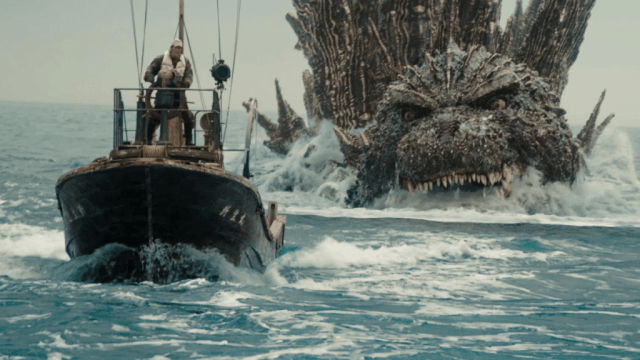
Godzilla Minus One (2023) is directed by Takashi Yamazaki and stars Ryunosuke Kamiki, Minami Hamabe, Yuki Yamada, Munetaka Aoki, Hidetaka Yoshioka, Sakura Ando, and Kuranosuke Sasaki. The film opens with a young Japanese kamikaze pilot (Kamiki) during the final days of the Second World War. Instead of fulfilling his duty, he falsely claims his fighter is having mechanical issues and commences to land at a nearby repair base. Soon after, a young Godzilla attacks the base, leaving almost everyone dead except the young pilot. When he returns home, he discovers that his family and friends are almost all dead as a result of wartime air raids. When a young lady and orphaned child begin living with the young pilot, an unconventional family dynamic is formed. Some time later, Godzilla returns, larger and more destructive than before. It is headed toward Tokyo and the only defense that Japan can provide are the remnants of its’ post-war military. The young kamikaze pilot is forced to overcome his pain and join the fight to save both his beloved country and newfound family from extinction.
The acting here across the board is effective. The only knock I can think of is the fact that some of the tendencies of Japanese performance might cause some American viewers to think everything is a bit overdramatic. If you’re versed in Japanese cinema, this is nothing new. It’s more of just something to be aware of as opposed to a criticism. That being said, the events that take place in this film do call for a significant amount of drama. It would feel a bit strange if people weren’t acting overly dramatic about their country being decimated for a second time. I feel that the events taking place warrant any drama that is attached. This overly dramatic nature may have been a problem if it wasn’t so well-balanced by the litany of truly catastrophic events. Like I talk about with so many films, balance is key. This happens to be one of Godzilla Minus One’s biggest strengths. The film early on spends its time establishing the main characters in ways where we truly care about them. We are invested in the promise of a brighter future for not only our main characters, but the country of Japan as a whole. This balance of hope for individuals as well as the collective really end up supporting one another. We care on multiple levels and therefore we care exponentially more in general. I was really expecting the film to be a lot darker in tone (which it still is) when taking into account the fact that the film takes place not long after World War II. The film really surprised me in the fact that it finds a fair amount of positivity in the survivors’ situation. Although they are once again defending their country and risking their lives, they are doing it of their own accord. There are no orders for suicidal missions or needlessly fighting long after the battle has been lost. This time, people are very much choosing to risk their lives, fighting for something they truly believe in. The film also often brings up the interesting idea that having something to live for and having something worth dying for are oftentimes one in the same. It implies that survival for one’s country can be just as honorable and important as dying for one’s country. In the context of post-World War II Japan, this element carries some hefty emotional weight.
The special effects here are used extremely well. Considering this film’s budget was 15 million dollars and The Marvels’ (2023) was 220 million dollars, I’m sitting here completely speechless. The film’s special effects do admittedly look a bit cheaper than The Marvels, but not 205 million dollars cheaper. Not even close. Maybe, at most, 10 million dollars cheaper. That being said, the special effects in Godzilla Minus One are nicely balanced by real locations and backdrops. Overall, this ends up delivering a much better visual experience than something that relies exclusively on CGI. And it’s cheaper! A lot cheaper! Though, you can tell they cut a few financial corners here and there through tricks such as sometimes showing Godzilla at night, underwater, etc. This inherent darkness helps to hide some of the lesser visual effects.
The film is mostly well-paced, keeping the action consistent and tense. The only lull the film experiences is in the second act. Though things do slow down, I felt it was a nice “calm before the storm situation.” It was necessary in order to not feel worn out by the extended action climax. We have some really nice stakes established in the film as well. Godzilla is menacing and destructive. This is not your typical American version of this character. It doesn’t have a heart deep down and would most likely team up with other monsters instead of fighting them. When Godzilla begins his destruction, you truly feel as if the human characters have absolutely zero chance of survival. When important characters are quickly dispatched, it feels devastating yet earned.
Overall, Godzilla Minus One is a throwback to not only the best Japanese Godzilla films, but also modern American disaster films from a director such as Roland Emmerich (Independence Day, The Day After Tomorrow, 2012). The cast of characters are fun across the board, the special effects are effective, and the stakes are palpable. Likewise, the film has a strong heart built from many strong emotional and thematic elements. The film flew by, and made me feel like I was twelve again. Though, if I was twelve, I’m not sure if I could appreciate the film’s more complex elements (the exact elements that elevate this above standard disaster movie fare). One thing is certain: Nobody does Godzilla better than the source. This film might have just single-handedly buried Warner’ version of Godzilla. If not, I hope Warner will learn a lesson or two. B+


