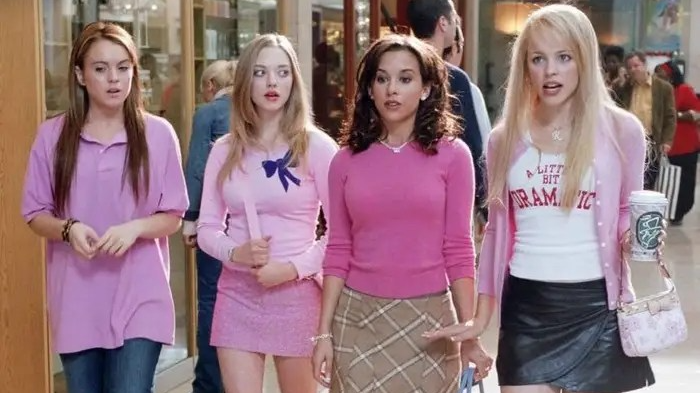
Mean Girls (2004) is directed by Mark Waters and stars Lindsay Lohan, Rachel McAdams, Lizzy Caplan, Tina Fey, Jonathan Bennett, Daniel Franzese, Lacey Chabert, Amanda Seyfried, Tim Meadows, and Amy Poehler.
The film follows Cady (Lohan), a homeschooled teenager who has spent most of her early life living in Africa. When her family decides to move back to the states, Cady must enroll in the local high school. The culture of U.S. high school immediately throws Cady for a loop. She doesn’t understand how things work and is even thrown off by the idea of “friends.” Cady’s fish-out-of-water persona eventually results in her being adopted by two polar opposite groups. One group is the strange but loyal art kids while the other group is the popular hot girls known as “the plastics.” They are led by seemingly nice, but truly devious queen bee, Regina Goerge (McAdams). Cady is initially more drawn to the art kids, recognizing that they are truly good friends. Though, they are not particularly popular in any sense of the word. When Cady is invited to begin eating lunch with The Plastics, Janis, the leader of the art kids, enlists Cady to enact a plan of revenge against Regina George and her cronies. Regina has victimized just about every person in the school, and it’s time for her fall. As Cady begins to infiltrate their group, she slowly becomes infatuated by the benefits of high school popularity. Slowly, Cady begins to develop into a mirror image of Regina George, disregarding her relationships with her true friends. The question is, will Cady realize her mistakes and reclaim her true friends before it’s too late?
Lohan is fantastic here as Cady. It really reminded me of why she was so popular during this period of time. She really does show a decent amount of range here. Her development from awkward homeschooler, to popular “mean girl,” and finally normal teenager was actually pretty convincing. The reasons she changes feel more natural in terms of a teenager attempting to find their place as opposed to random character shifts. McAdmas is absolutely iconic as Regina George. She finds this perfect mix of Drew Barrymore in Legally Blonde (2001) and William Zapka in The Karate Kid (1984). She is blonde, loves pink, and hates not being the center of attention. If she feels threatened in any small way, she will go to great lengths to not only get even, but to ruin that person’s life outright. She jumps between extreme pettiness and insecure breakdowns. It’s a riot to watch, but balanced by the fact that Regina feels slightly terrifying in her ability to act with such vengefulness. Regina’s fellow plastics played by Lacey Chabert and Amanda Seyfried are likewise hilarious. The former is the epitome of extreme insecurity. Chabert’s character is broken down by seemingly the most innocuous of comments. If there is even a 1% chance that what someone said could be taken as an insult, she will take it that way. It’s often hilarious in its absurdity. The latter played by Amanda Seyfried is the dumb one of the group. Like she stares off into the distance with wide eyes dumb. So dumb that her throughline in the film is that her boobs can predict when it is going to rain. Lizzy Chaplan and Daniel Franzese are strong as Cady’s art friends. Chaplan stands out in particular here as being well-cast. I think she really nails the energy and strength that the character required. Lastly, the classic comedy duo of Amy Poehler and Tina Fey are really fun in small roles. Fey, who likewise wrote the film, plays one of Cady’s teachers. She is often used as a device to make Cady question her actions throughout the film, playing the character straight. Amy Poehler on the other hand plays a character that is almost the polar (no pun intended) opposite of Tina Fey’s character. She plays Regina’s mother who is sort of just an older version of Regina. So similar that it dips its toe into cartoonish territory. She claims to be a “cool mom” while in reality being the most irresponsible parent on earth. At one point she walks into her daughter’s room and sees her getting frisky with her boyfriend. She seems unfazed and asks if they need a snack or “a rubber.”
The film archives a great balance of playing into teen movie tropes while at other times subverting those same tropes. The portrayal of American high school is very heightened here. It may cause some viewers to have the reaction of “high school is definitely not like that,” but I found that this heightened portrayal acts in service of the film’s satirical elements. It’s also balanced quite well with the more realistic/authentic elements that the film has to offer. The comedy here is admittedly goofy/cartoonish at times, but it never takes away from some of the more effective emotional elements. I think this is part because the lessons Cady learns throughout the film are universal. Almost all of us have had to learn these lessons about friends and popularity at one point or another, and that makes it really hit home. That being said, these aren’t necessarily basic explorations of these topics. The film takes its time to let these issues build nuance, which in turn makes them more effective. The film really does cover a lot of ground in terms of what American high school both succeeds at and fails miserably at. When the third act begins, the film raises some unexpectedly interesting questions about growing up. High school doesn’t last forever. Mean Girls isn’t the first movie to make this claim and most likely won’t be the last. Though, to me, it is one of the more effective examples. The romance element here never feels totally convincing, but when I think about it, most high school relationships aren’t. In that sort of roundabout way, it worked for me. The film’s biggest strength is that it is consistently funny throughout. This is achieved by not relying on one type of comedy. The jokes come from unexpected places. For example, it can switch between intelligent satire and cheap physical gags at the drop of a hat. Instead of making things feel inconsistent, it succeeds in keeping the audience guessing. When one recurring joke becomes stale, a fresh one pops in to take its place. This variety is likewise achieved through the large cast of characters, even the smallest roles having notable gags or nuances that are all funny in different ways. It feels like this comes from an era of comedy where nothing was off-limits. Granted, this is still PG-13 fare, so I don’t think there is much here that wouldn’t slide today. It just has this sort of comedic freedom that I haven’t seen in movies recently.
Overall, Mean Girls is a truly hilarious comedy from an era that seems to have passed by. It actually makes me quite interested to see how Tina Fey will update the story for modern audiences with her upcoming Mean Girls Musical. I just hope she maintains that sweet sense of comedic freedom that I love the original for. The characters/performances are iconic and the jokes consistently hit. My only issue here would be that the tone can be so zany at times that it almost feels a bit unbalanced. To me, Mean Girls is one of the better PG-13 teen comedies in existence. B+

 The Movie Matt