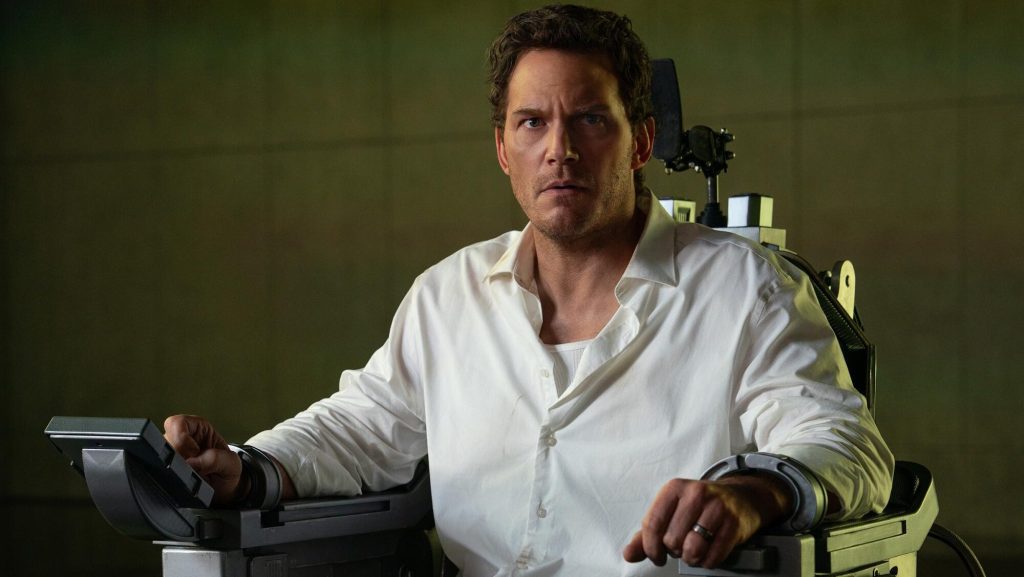
Mercy (2026) is directed by Timur Bekmambetov and written by Marco van Belle. It stars Chris Pratt, Rebecca Ferguson, Kali Reis, Kylie Rogers, Annabelle Wallis, Chris Sullivan, Jeff Pierre, Rafi Gavron, Kenneth Choi, Jamie McBride, Ross Gosla, Mark Daneri, and Haydn Dalton. The film follows Chris Raven (Pratt), a detective who’s wrongfully accused of murdering his wife (Wallis) and forced to prove his innocence to an AI judge (Ferguson) that he helped create/normalize. Given only 90 minutes to drop his probability of guilt below 92% with the help of the AI’s vast surveillance resources, Chris slowly realizes that his conviction is more than a simple mistake, and for whoever set him up, it’s personal. Against all odds, Chris attempts to prove his innocence so that his teenage daughter, Britt (Rogers), isn’t forced to deal with the loss of yet another parent.
This film has a boatload of problems, but the cast isn’t one of them. Everyone feels like a good fit for their role, and their performances are committed. They do their best to sell the script’s many undercooked and/or straight-up brainless plot points/developments. This results in an experience that’s a notch more engaging than the majority of films this stupid. If you feel like shutting off your brain or just looking at your phone, you might not even notice how dumb it truly is. This is no surprise, given that it was produced by Amazon, which often designs its original releases to cater to people who aren’t fully paying attention. If you are paying attention, you’re punished rather than rewarded. This makes the entire thing feel like a ruse, as if Amazon is trying to gaslight the viewer into thinking the film is much smarter than it is.
On the bright side, despite the “stuck in a chair” premise seeming a tad gimmicky, the film keeps the experience varied with a number of cutaways to supporting characters who help Chris get things done in the outside world. Unfortunately, everyone he contacts has a jarring, weirdly casual reaction to the fact that, overnight, Chris is put on trial for murder. They’re neither angry nor sympathetic, just indifferent. It’d be one thing if they were still processing the information and were confused, but they’re just emotionless. The only character who seemingly cares about Chris ends up being the mastermind behind it all, which is honestly absurd.
There’s an inconsistency in how characters react to what’s going on, but it pales in comparison to the shoddy explanation/execution of the AI’s supposedly unmatched intelligence. We’re told that, up until this point, the AI hasn’t made a single mistake, but seems to consistently disregard key pieces of evidence that support Chris’s innocence. The AI seems to know everything it has access to, but Chris is forced to use the same tools to prove his innocence. How does that make any sense? This is made infinitely worse when Chris not only proves his innocence but also proceeds to school the AI on simple lessons about human nature–information it apparently couldn’t find anywhere on the internet. This is so powerful, apparently, that it causes the entity to disregard its rigid programming (because it gains human emotions, I guess) and join Chris in his attempt to stop the real villain. This alone dismantles the idea that this AI is more intelligent than any human being, but it doesn’t end there. The AI constantly tells us that Chris’s likelihood of guilt is over 92%, even when it’s clear to anyone with half a brain that most of the evidence against him is circumstantial at best. Chris proceeds to deliver pieces of evidence that poke multiple holes in the case against him, but apparently it’s not enough to sow even 1% of doubt in the AI. What’s the point of having trials if even the guy who helped create it (who’s innocent, may I add) can’t sway its opinion with rock-solid evidence?
This gets continuously worse, eventually culminating with Chris uncovering the true perpetrator of his wife’s murder. We then see the AI and Chris watch as the real villain rushes to detonate a bomb, but for some absurd reason, this isn’t enough to push him below 92%. Seriously? They literally solve the case, but, illogically, the AI holds back on freeing him until the last second, seemingly only for the sake of manufacturing fake tension. Did I mention the climax also includes multiple frustrating, convenient moments, such as the villain’s attempt to detonate his bomb failing for reasons that are never explained? The button just doesn’t work. Believable, but lazy. The moment that makes me toss my hands up in frustration, however, is when we get the laughably cliché scene where Chris has the opportunity to shoot and kill the bad guy, but is stopped at the last second by his daughter, who claims that doing so “isn’t who he is.” This exact trope was spoofed beat-for-beat in the remake of The Toxic Avenger from last year, so I never expected it to be used in a film so soon, let alone ever again–or be executed with a straight face, for that matter.
Overall, this is a decent-looking film featuring some serviceable performances and an interesting premise. Unfortunately, that’s where my compliments to the film end. The further the story moves along, the more its many plot holes compound, resulting in an experience that comes across as insultingly idiotic. Despite the film receiving a theatrical release, make no mistake, it’s streaming service sludge of the worst caliber. Not to mention, it’s basically unapologetic about its pro-AI message despite nothing here selling you on the idea that its use is a positive thing, especially when the stakes are life and death. You’re not fooling anyone, Jeff Bezos. D

 The Movie Matt