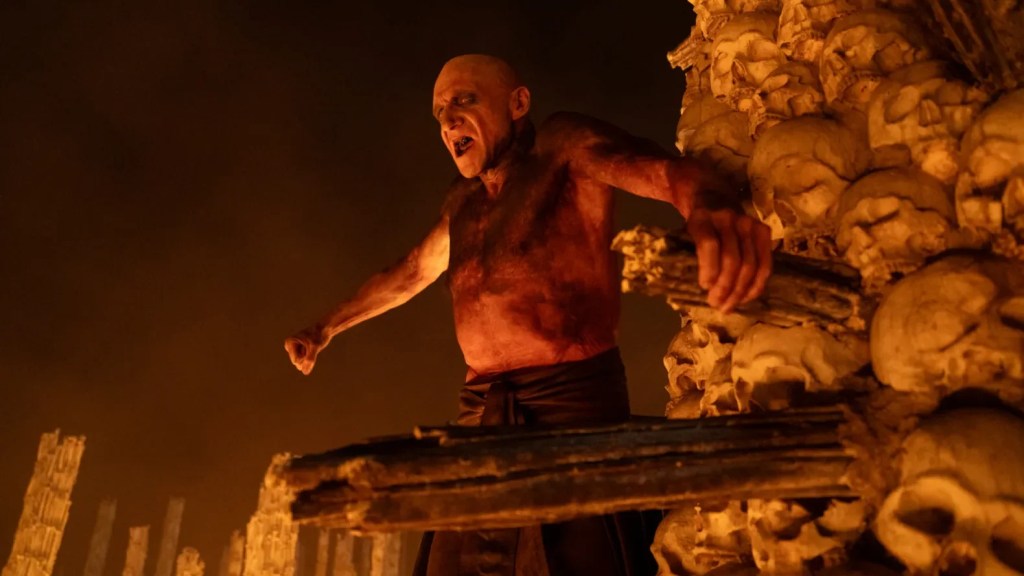
28 Years Later: The Bone Temple (2026) is directed by Nia DaCosta and written by Alex Garland. It stars Ralph Fiennes, Jack O’Connell, Alfie Williams, Erin Kellyman, Chi Lewis-Parry, Connor Newall, Emma Laird, Mirren Mack, Louis Ashbourne Serkis, Maura Bird, Ghazi Al Ruffai, Robert Rhodes, Sam Locke, Gordon Alexander, David Sterne, Elliot Benn, and Lynne Anne Rodgers. Following the events of 28 Days Later (2025), Spike (William) finds himself forced to join The Jimmy Gang, a violent group of survivors led by Jimmy Crystal (O’Connell), an unhinged man who claims to be the son of Satan. Meanwhile, Dr. Ian Kelson (Fiennes) continues tending to his bone temple, occasionally crossing paths with Sampson (Lewis-Parry), a nearby infected he believes still holds a spark of humanity. After various interactions and tests with his unlikely new companion, Kelson discovers something groundbreaking about the virus…
As the adult lead this time around, Ralph Fiennes is an absolute treat. Kelson is a well-written, original character, but Fiennes’ performance is what brings him to life. He successfully portrays a well-educated person who, like everyone else, is somewhat broken by the apocalypse. However, his high intelligence has allowed him to break without losing his humanity. The way he expresses this is completely unhinged, but he expresses it nonetheless. The story requires him to be funny, weird, sympathetic, and deeply spiritual despite being an atheist. This is a complex character who has to hit many different emotional notes, and Fiennes nails every single one. For example, there’s a certain Metallica-inspired dance number (yes, you read that right) that ends up being one of the film’s standout moments, and I’m skeptical a lesser actor could’ve made it work as well as he does.
Fiennes, however, isn’t the only actor who delivers a dynamite performance. Jack O’Connell follows up his villainous turn in Sinners (2025) with a performance/character that’s superior in nearly every way. As cult leader Jimmy Crystal, O’Connell is as charismatic and fun as he is sickeningly depraved. The simplicity with which he sees this violent world causes him to respond in kind—the perfect foil to Kelson. The character’s fun-loving energy makes him, in a certain sense, enjoyable to watch, but it also makes his sinister actions a lot more chilling. Despite what he says, he’s not a character who believes in what he preaches, and is fully aware that his antichrist claims are total bullshit. This makes his orders to torture their prisoners for Satan’s pleasure infinitely more messed up. In a world where violence never seems to end, he chooses to kill even when it’s unnecessary.
Williams is once again serviceable as Spike, but the character ultimately feels like an afterthought. For most of the film, he silently stares in horror at all of the Jimmy Gang’s various violent deeds. By the end, it’s unclear how the character changes from these experiences. Granted, this could all be addressed in the next installment, so it’s not something that ruins the experience. This is an intense series of events from beginning to end, so it makes logical sense that we don’t immediately see how it will affect/change the character. It’s just odd that Spike’s entire side of the story feels so stagnant. For example, we don’t even get a single scene catching up with his father, played by Aaron Taylor-Johnson. Last time we saw the character at the end of the first film, he was rushing off to find Spike by any means necessary. Seriously, not even a 5-minute subplot about him navigating the infected areas by himself? I guess this helps the film feel more focused than its predecessor, but it still feels strange to completely abandon what are clearly key plotlines for the entire middle chapter of a planned trilogy.
The film, like so many other zombie movies, focuses heavily on the idea that humans can be, and often are, more dangerous than the infected. That being said, Nia DaCosta’s approach to the trope is extremely intelligent and creatively executed. This helps prepare the viewer for the idea that curing the infected is possible, reminding us that their animalistic behavior isn’t far removed from that of non-infected humans like Jimmy. In fact, Sampson’s tendency to rip out a spine or two is a lot more humane than a lot of the crap Jimmy pulls. This exploration of curing the infection treads new ground for the genre, finally revealing this trilogy’s ultimate purpose. There was no way Danny Boyle and Alex Garland would’ve both returned to the genre if they didn’t have an original angle.
In terms of action, violence, tension, and scares, this film is relentless. From the opening scene, it forces the viewer to clench every muscle they have and not let up until the credits roll. It’s tough to scare a seasoned adult horror fan like me, but this was shocking in a way that made me uneasy about the human condition. It all feels real, which, if it were, would be absolutely horrifying. The nearly 2-hour runtime blasts by, leaving you giddy for the eventual sequel.
Overall, this is immediately my favorite sequel in recent memory, and solidifies Nia DaCosta as a horror director to keep an eye on. As a big Danny Boyle fan, I still have to admit that this improves upon his 28 Years Later in nearly every way. It’s tension-fueled from beginning to end and pushes the franchise in bold new directions while maintaining the majority of its defining elements. On top of all that, the lead performances from Ralph Fiennes and Jack O’Connell are some of the best this genre has to offer. It basically archives everything you’d want in a trilogy’s middle chapter. As long as you don’t mind strange creative choices, you’re sure to love this just like I did. Fair warning for those with weak stomachs, however, this is as brutal as it gets. A-

 The Movie Matt