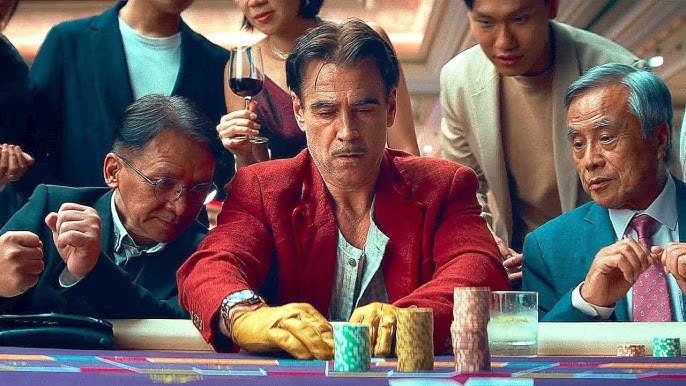
Based on the novel by Lawrence Osborne, Ballad of a Small Player (2025) is directed by Edward Berger and written by Rowan Joffe. It stars Colin Farrell, Tilda Swinton, Fala Chen, Margaret Cheung, Alex Jennings, Jason Tobin, Alan K. Chang, and Deanie Ip. The film follows Lord Doyle (Farrell), a man hiding out in Macau whose forced to lay everything on the line when his high-stakes gambling debts and criminal past begin to catch up with him. Just before throwing in the towel, he meets Dao Ming (Chen), a mysterious casino employee whose lack of hope inspires him to prove that miracles are, indeed, possible. Determined to make one last high-stakes run that’ll earn him enough money to pay off his and Dao Ming’s debts with a bit left over, Doyle lays everything on the line. The question is, can money fix this broken man, or just create a broken man with money?
I initially found myself off-put by Farrell’s bad English accent and awkward facial expressions, but it soon became clear that these quirks are intentional. Doyle is a man playing the identity of another man, but he’s not a professional, let alone talented, actor. Because we don’t realize the character is putting up a facade, Farrell’s choices initially feel unsatisfying. However, this all changes once the proper information is revealed, urging us to re-evaluate both the character and Farrell’s performance.
The general tone of the film, especially in moments displaying the gross excess of Doyle’s all-or-nothing lifestyle, adds a touch of Fear and Loathing in Las Vegas-style surrealism that forces Farrell to lean into the goofier side of his acting persona. These moments are zany and entertaining, but are often followed by scenes where we’re asked to take him and his situation very seriously. For example, it’s hard to get on board with his struggles when all he does in between gambling sessions is get blackout drunk, and then, like a caveman, gorge himself on champagne and lobster until he vomits. Thankfully, the character is generally so passionate and erratic that he’s entertaining enough to carry the film. He’s an addict whose life is all about chasing excess, making him compelling to watch as long as you don’t feel the need to judge him on a moral level.
You can easily criticize the film for ultimately rewarding Doyle for his addictive, self-destructive behavior. Still, I’d argue that storytelling isn’t always about punishing or rewarding characters for their actions; sometimes it’s just about teaching them a lesson/putting them through an arc that changes a fundamental aspect of who they are and/or what they believe. Yes, Doyle wins his money in the end, but he also learns a harsh lesson about life that makes him realize the money was never what truly mattered.
This change is highlighted by the not-so-subtle final scene in which Doyle burns the remainder of his winnings, and for the first time in the film, finally seems at peace/relieved. I can get past the moment’s lack of subtlety, but I can’t accept that it’s highly frustrating for the viewer, both logically and emotionally. Yes, it completes Doyle’s arc, but the character had already learned his lesson, so the act of burning the money just seems like overkill. It’s as if the writers were worried that if he kept the money, it wouldn’t feel like he truly learned his lesson, but the decision feels unnatural, illogical, and just plain stupid. Money isn’t the most important thing, but you still need some of it to sustain a healthy, happy life. This all comes immediately after a scene in which Doyle finally overcomes his addiction and refuses to gamble with the last of his winnings, only making it infinitely more frustrating. The joy of seeing this guy finally realize, “Yes, I’m satisfied. I have enough,” is then immediately undercut by his choice to light said money on fire. A gambling addiction is a quick way to burn money, but I’m pretty sure that literally burning it is even faster. It’s disappointing, pointlessly leaving the character, whom we’d just come to like, looking like an ungrateful idiot.
These dark explorations of gambling, excess, and addiction are incredibly messy, but the experience is often a lot of fun as an underdog gambler romp. Films in this subgenre are often too caught up in the dangers/consequences of gambling, as if there’s no scenario where it can just be a fun, exciting activity. Even when exploring its darker implications, excitement and fun are among the reasons it can be so addictive, so it’s essential not to consistently paint it as a definitely dark, immoral activity—especially while in the act. Berger realizes this, mainly focusing on the character’s big wins, presenting these moments in a way that urges us to cheer for Doyle’s success rather than be repulsed by his reckless behavior. This also makes it clear that the issue here isn’t necessarily gambling, but more so the dangers of lacking purpose, place, and identity. If an individual lacks internal fulfillment and/or identity, they’ll often try to fill that hole through external means, whatever they may be.
My other big issue here is a reveal toward the end that’s clearly intended to be a surprise, but is evident throughout most of the film. In fact, it’s so apparent that, until the intended reveal, I didn’t even realize that it was designed to be a secret. I honestly can’t believe they didn’t see how obvious this was in test screenings. Either I’m brilliant, or this is just a lazily executed twist. I’ve seen my test scores, so I’m going to go with the latter.
Overall, this is an entertaining, visually stimulating little gambling tale, though its script is occasionally frustrating and its off-kilter tone doesn’t always gel. Colin Farrell is a lot better here than expected. He adds some much-needed heart to his character, once again proving that he only gets better with age. Unfortunately, this is a significant step down from director Edward Berger’s previous effort, Conclave (2024). It’s clear that the script is to blame for most of its problems, so hopefully he’ll recognize this and adjust his approach for whatever he decides to do next. C+

 The Movie Matt