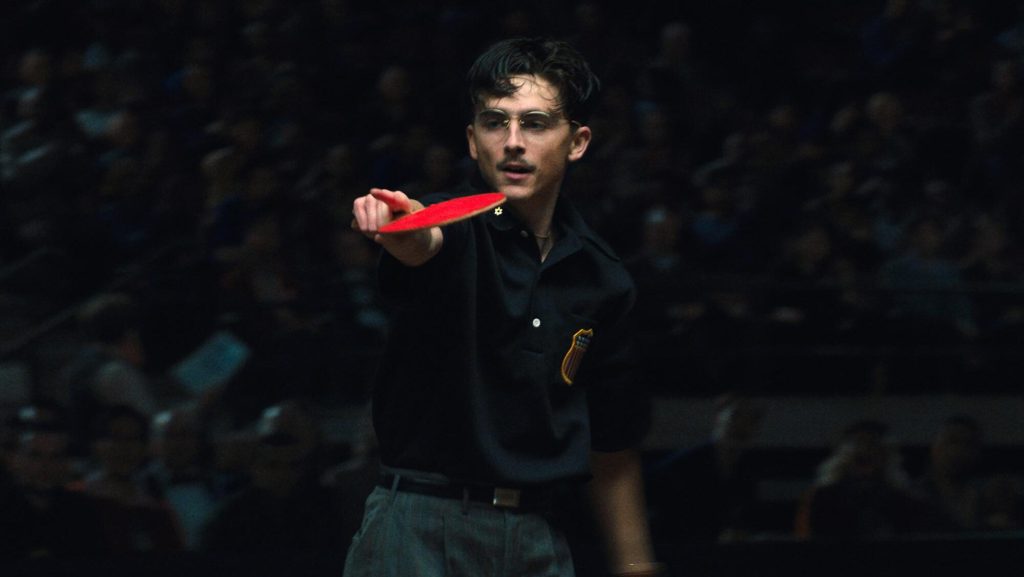
Marty Supereme (2025) is directed by Josh Safdie, who also wrote the film alongside Ronald Bronstein. It stars Timothee Chalamet, Odessa A’zion, Gwyneth Paltrow, Tyler the Creator, Kevin O’Leary, Luke Manley, Fran Drescher, Emory Cohen, Geza Rohig, Larry ‘Ratso’ Sloman, Ezra Mishkin, Fred Hechinger, Ralph Colucci, and Koto Kawaguchi. The film is set in 1950s NYC and follows young table tennis star Marty Mauser (Chalamet), aka Marty Supreme, as he embarks on an obsessive quest to prove he’s the best player in the world. After he suffers a loss in the world championships, Marty’s unhinged behavior leads to his being banned from next year’s competition. In an attempt to pay off his league fines, Marty enacts a series of money-making schemes that are either illegal or immoral, and usually both. As this behavior turns Marty’s loved ones against him, he only becomes more determined, eventually leaving a trail of destruction in his wake.
I’ve never witnessed a bad performance from Chalamet. That being said, I’d always felt that, because he picks such strong scripts, it creates the illusion that he’s a much more skilled actor than he actually is. However, his performance as Marty Mauser forces me to eat my words. I was initially worried that his casting was simply due to him being Hollywood’s biggest young star, but his thin physique and blind, almost psychotic determination fit this kind of scummy 1950s con man perfectly. Yes, nearly everything here is either equal to or better than his previous films, which only makes the fact that this performance stands out significantly more impressive. On paper, Marty is already an uncommonly complex and original protagonist, which would have more than enough to satisfy audiences. In combination with Chalamet’s unforgettable performance, he’s a character who’ll surely be referenced/remembered for years to come.
The focus here is almost entirely on Marty, but the large number of supporting characters all feel complex and original despite their minimal screen time. As Marty’s estranged girlfriend, Rachel, Odessa A’zion matches nearly every ounce of Chalamet’s wild intensity. The character’s willingness to accept her boyfriend’s psychologically abusive behavior can be occasionally frustrating, but it’s easy to sympathize with her once you realize the full extent of Marty’s manipulation. On top of this, the script also gives her proactive tasks to complete, highlighting her as an actual character rather than just a tool for showing the effects of Marty’s behavior on the people closest to him.
Gwyneth Paltrow, Tyler the Creator, Luke Manley, Emory Cohen, and a handful of others are all memorable in their various roles, but the surprise standout is actually the one cast member without any prior acting experience, Shark Tank’s Kevin O’Leary, aka Mr. Wonderful. As the story’s central antagonist, Milton Rockwell, he essentially just plays a slightly more villainous, authentic version of his iconic TV persona. Because of this, it’s tough to praise his acting because I’m not entirely sure he was actually doing any. However, Safdie and the casting department should pat themselves on the back. It’s such pinpoint casting that it makes the average Joe viewer think that even they could act in a Hollywood film if given the perfect role. The character is also the ideal foil for Marty. Milton is rich, has almost everything he wants, and if he wants more, he barely has to lift a finger. On the flip side, Marty is broke, generally dissatisfied with his life, and fails to succeed despite being one of the most blindly determined characters in film history.
Despite Marty being a narcissistic scumbag throughout the entirety of the film, he’s consistently faced with the reality that, although he’s clearly one of the best table tennis players on Earth, he lives within a system that doesn’t actually reward being the best as often as its pundits claim. Yeah, Marty’s not a respectable person in most ways, but there’s a feeling that his behavior is just the inevitable result of a system that tells people if they work hard enough, they can achieve anything. He’s an example of how this distinctly American mindset can conflict with and even completely dismantle a person’s moral compass. When it’s constantly implied that financial and professional accomplishment is the best way to measure a person’s worth, it’s easy to place your morals on the back burner. If professional success is apparently more important than morals, achieving it at any cost is easy to justify. Yeah, Marty is a mean guy, but he’s pretty clearly just the product of a flawed system that many Americans try to defend like it’s their firstborn child. This is even further highlighted by the 1950s NYC setting—an era and place many people associate with meritocracy and economic prosperity. This makes it clear that these problems aren’t new; They are and always have been a reality of the American experience. For example, regardless of how you feel about our current president, it’s tough to believe our country has a system based solely on merit when a historically controversial businessman/reality TV star is chosen as our leader instead of someone with at least some governing/political experience.
Although the ping-pong sequences are more tension-fueled than I ever could’ve imagined, it quickly becomes clear that the film is more of a dark crime odyssey exploring the destructive realities of Marty’s morally blind determination. This allows the film to buck nearly every cliche typically associated with underdog sports stories, often feeling more akin to a Scorsese crime film that just did a line of coke. However, just when you think you have the film pinned down as a typical crime story, it unexpectedly shifts back to embracing the sports genre. This is best exemplified in the climax, which, in concept, is just a regular table tennis match. The film trains the viewer to expect a violent, crime-heavy resolution for so long that you almost forget he actually has to play ping-pong at some point. This may sound disappointing, but the script somehow finds a way to bring Marty’s journey to an emotional climax that’s simultaneously funny, devastating, and oddly relieving. The moment the match ends, the character is reframed in the viewer’s mind as they realize that his behavior might’ve been something he felt like he had to do, not something he ever wanted or enjoyed. His journey consumes him entirely, and when that journey ends, the relief seems to make him realize that none of his actions were worth it.
Some viewers are sure to have a problem with Marty’s lack of morals, but there’s one particular reaction to the character with which I passionately disagree. As soon as the film cut to black, the idiot sitting behind me felt so confident in his opinion that “The script is awful; he doesn’t learn a single lesson,” he announced it to everyone in our packed theater. If it were up to me, I’d hand-deliver that guy an award for ‘dumbest film take of the year.” In the final scene, Marty experiences a shake-up in his life that, for the first time in the film, opens his eyes to what’s truly important. It’s actually been quite a while since I’ve seen a more effective, meaningful arc. Yes, it takes almost the entire film, but that’s kind of the point. I disagree so passionately with the nameless, faceless guy sitting behind me that I may now consider him my mortal enemy. Am I serious? *shrugs shoulders*
Overall, this is not only my favorite film directed by either or both of the Safdie brothers, but also my favorite film from the last 2+ years (since I’ve started writing reviews). It’s easily the best ping-pong movie I’ve ever seen (not that there are many. Sorry, Balls of Fury), and features what’s easily Timothee Chalamet’s strongest performance to date. This is pretty much the epitome of everything I go to the movies for—funny, intelligent, action-packed, soulful, unpredictable, gritty, oddly romantic, and relentlessly paced. In any given moment, it forces the viewer to feel whatever big emotion it conjures next, but it is equally satisfying on an intellectual level. Up to this point, I’ve refused to give any new-release film a perfect rating, hoping I’d eventually find one that exemplifies the category. It took about 2¼ years, but Marty Supreme is precisely the kind of movie I was waiting for. A

 The Movie Matt