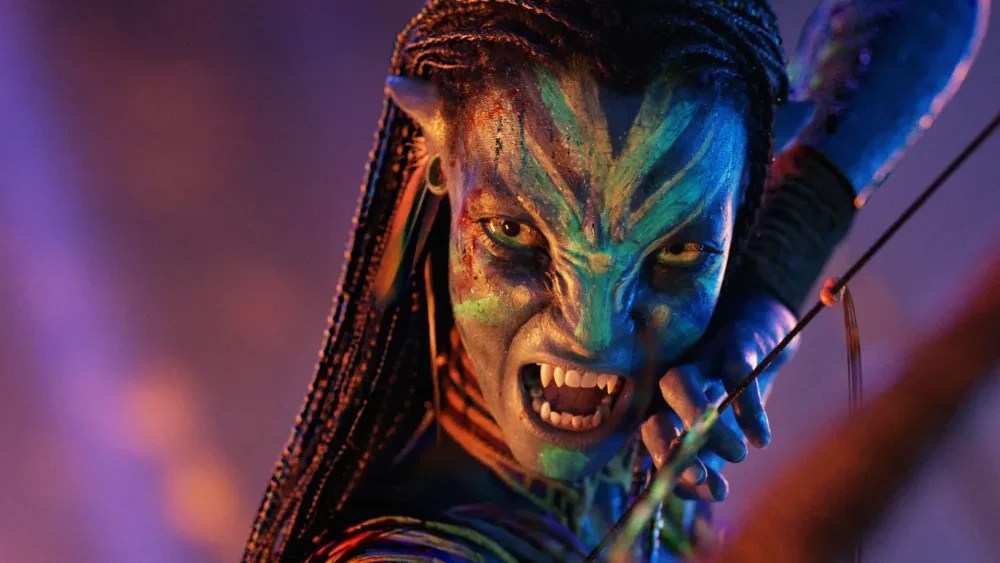
Avatar: Fire and Ash (2025) is directed by James Cameron, who also wrote the film alongside Rick Jaffa, Amanda Silver, Josh Friedman, and Shane Salerno. It stars Sam Worthington, Zoe Saldana, Jack Champion, Stephen Lang, Sigourney Weaver, Britain Dalton, Oona Chaplin, Edie Falco, Kate Winslet, Cliff Curtis, Trinity Jo-Li Bliss, Jamie Flatters, Jemaine Clement, Giovanni Ribisi, David Thewlis, Joel David Moore, CCH Pounder, Brendan Cowell, Bailey Bass, Filip Geljo, Duane Evans Jr., Matt Gerald, Dileep Rao, and Wes Studi. The film picks up shortly after the events of Avatar: Way of Water (2022), as Jake (Worthington) and Neytiri (Saldana) try to pick up the pieces after the death of their eldest son, Neteyam. As Pandora’s war against human colonization rages on, Quaritch (Lang) allies with a tribe of bloodthirsty Na’vi known as the Ash People, significantly tipping the scales in Earth’s favor. Although they’re more protective than ever before, Jake and Neytiri are forced to trust their surviving kin, despite all being younger than the son they lost, as they set out on various quests to aid the impending battle against humankind.
The majority of the returning cast give performances consistent with the previous films, especially Worthington and Saldana—perfectly serviceable, but secondary to top-notch visual effects. Unfortunately, this consistency in quality also means some of the last film’s weaker performances haven’t improved one bit. This mainly applies to the younger cast, but it’s hard to blame them when they’re given such inauthentic dialogue. Cameron and his writing team attempt to emulate modern teen dialects, but it’s often so heavy-handed and awkwardly placed that it’s clear their lines were written by older people who don’t fully understand how to use the slang in a way that feels natural. Not to mention, why even make the creative choice to have them, for some reason, use the same slang as Earth children? Even if you want to argue that their previously human father could’ve influenced them, Jake comes from a generation that never spoke that way, so it still doesn’t track. It’s not logical, nor does it achieve its goal of building a deeper connection with younger audiences. This mainly effects the character Spider (Champion), who receives a large bulk of the focus this time around. He’s often immature, silly, bone-headed, and generally forgettable. A lot of his humorous moments fail to land, and because there’s nothing unique about his personality, morals, or motivations, it’s tough to honestly care about where he’ll end up. Not to mention, he’s also the perfect example of arguably the film’s biggest flaw; It fails to provide its characters with arcs that develop them in meaningful ways.
Other than Netyiri becoming a bit more bloodthirsty due to her son’s death (a shift that never actually goes anywhere), nearly every character ends this film as the same person they were at the end of the previous installment. This is even more egregious when considering the film’s massive length and scale; You’d think there’d be time to give these characters arcs that are, at the very least, mediocre. Even some predictable character development would be better than none at all. The only character/performance that feels like a true highlight here is Stephen Lang’s third turn as the franchise’s big bad, Miles Quaritch. This installment easily solidifies him as the franchise’s most complex and interesting character. The script provides him with some of his best lines of dialogue, a handful being so irresistible that it’s tough not to start rooting for him despite his villainous behavior. Unfortunately, although the character does have an arc, it’s the same one as in the previous film, but worse. Despite coming to the exact same redemptive realizations for the second climax in a row, he doesn’t change. Teasing the audience with his eventual redemption can only work for one film. As soon as it happens twice, and there’s still no payoff, it just starts to feel like the director is either intentionally trolling the viewer or is just utterly devoid of new ideas.
Other than the large-scale, beautifully conceived action sequences, the film spends much of its runtime expanding on previously introduced ideas related to its world-building. The problem is that a majority of the ideas added or expanded upon are too vague or simple to be truly compelling. Nearly every reality-shaking change to the world/reality of Pandora is due to some vague ethereal force that can seemingly, at any moment, change or control whatever it wants. It’s just a lazy, surface-level device that creates plot holes as problematic as the “why didn’t they just ride the eagles to Mt. Doom?” question in The Lord of the Rings trilogy. The inconsistent and illogical rules of this world remain somewhat palatable because of the tangible visual effects. Unfortunately, the reality of the world never matches the authenticity of the visuals. This hurts its ability to immerse the viewer in its world, making this the franchise’s most generic installment.
On top of all the film’s script blunders, it also adds fuel to some of the franchise’s most common criticisms. Instead of taking these criticisms seriously, it often feels as if Cameron is outright telling the audience, “Don’t like it? Well, here’s twice as much. Shut up and praise what I give you. I’m a genius, and you’re just a hair-brained idiot who likes explosions.” For example, the film has the most extended runtime in the franchise, yet requires it the least. As one of the few people who believe the first two films actually earn their length, even I found myself checking my watch/phone. Everything achieved story-wise could’ve been done in two hours or less, proving that Cameron doesn’t have a single person to tell him when enough is enough.
Overall, this is easily the weakest of the three Avatar films. It continues the franchise’s tradition of top-tier visual effects and creatively conceived large-scale battle sequences. Unfortunately, it forgets that compelling storytelling starts, first and foremost, with original characters the audience can connect with and thus care about. It’s also painfully long and fails to advance the story in an exciting and/or meaningful way. At least Stephen Lang is in top form; he’s irresistible here. Other than that, this is essentially generic blockbuster crap with a glossy coat of paint. If it weren’t for the visuals, I’d consider the movie to be as forgettable as they come. C+

 The Movie Matt