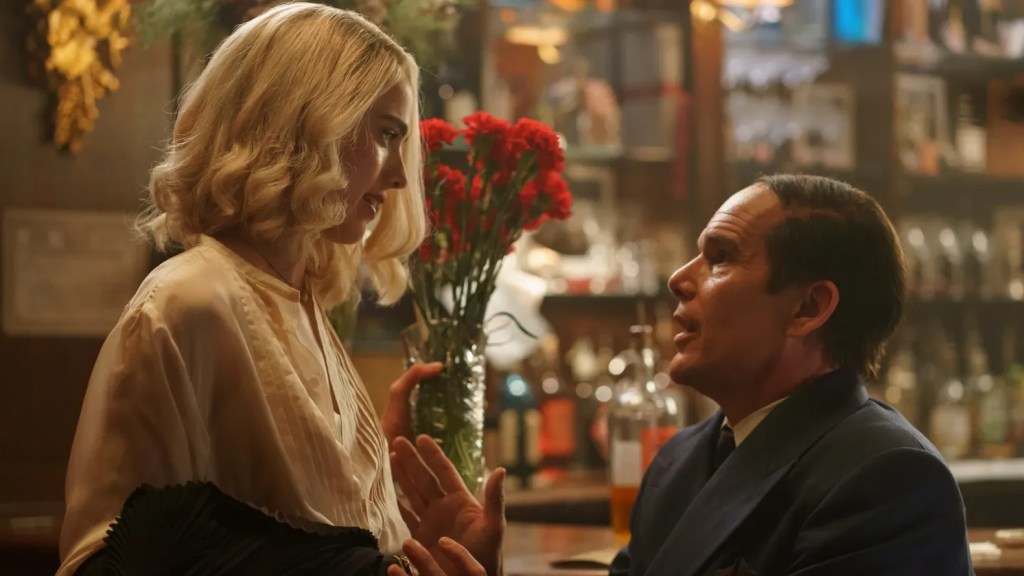
Blue Moon (2025) is directed by Richard Linklater and written by Robert Kaplow. It stars Ethan Hawke, Bobby Cannavale, Margaret Qualley, Andrew Scott, Patrick Kennedy, Jonah Lees, Simon Delaney, Giles Surridge, Cillian Sullivan, Michael James Ford, David Rawle, and Elaine O’Dwyer. The film, set on the opening night of Oklahoma!, is based on real letters exchanged between composer Lorenz Hart and his muse, college student Elizabeth Weiland. It follows the eccentric Hart (Hawke) as he sits in the theater’s bar, conversing with various patrons, slowly coming to terms with the stratospheric success of his former writing partner, Richard Rodgers (Scott). Through his Forest Gump-like interactions with various Broadway, Hollywood, and literary legends, we’re given an intimate look into one of music’s most talented but troubled legends.
As the forgotten half of the musical duo that preceded the legendary Rodgers & Hammerstein, Ethan Hawke gives a committed performance that nails nearly all of the man’s joyful theatrics without forgetting that they’re only a tool to shroud his deep-seated pain. Whether the character is complimenting someone or insulting them, Hawke successfully conveys a kind of depression that feels fitting for a man who struggles to connect with those around him. He also toes the line well between emotional drunk and troubled artist. It never feels like his issues are due solely to either booze or life experiences, but a combination of the two. He’s a man who seems to feel things on a deeper level than most human beings, and alcohol only amplifies those feelings.
The character’s emotionally complex, wordy rants are simultaneously compelling and annoying. This is occasionally a problem during the first half because, despite it being clear to the viewer, no other character really acknowledges the relentless, often annoying nature of his personality. He claims to have countless close friends, adoring fans, and a beautiful college student as his muse. However, as the film transitions to its second half, we begin to realize this is nothing more than a facade. As his sobriety begins to fade, so does the fantasy that he’s thriving both personally and professionally.
His professional relationship with Richard Rodgers is surprisingly effective in its subtle tragedy. It presents a team of writers who use their differences and disagreements to challenge each other in ways that lead to truly great art. However, these differences also cause them to resent one another, hinting that their breakup was always inevitable. The reason they succeed together is the same reason they can no longer work together. However, the most tragic element comes from the fact that although Hart claims their break-up is due to irreconcilable differences, it’s clear it has more to do with his alcoholism than anything else.
Overall, this is another tightly contained, dialogue-heavy Richard Linklater-directed character study in the vein of his previous efforts, Before Sunrise (1995) & Tape (2001). General audiences are sure to be bored to death by the eccentric, melodramatic conversations and references to classic Broadway. I didn’t know much about the subject going in, but I ultimately found myself interested in the character and Ethan Hawke’s performance. The film often references Casablanca (1942), and rightfully so. The ultimate enjoyment of the experience lies in its general feeling of old Hollywood, when people in showbiz actually believed in the unexplainably levitating, almost supernatural power of great art. It’s a niche, subtle experience aimed at artists and musical theatre nuts, but it achieves nearly everything it sets out to. B

 The Movie Matt