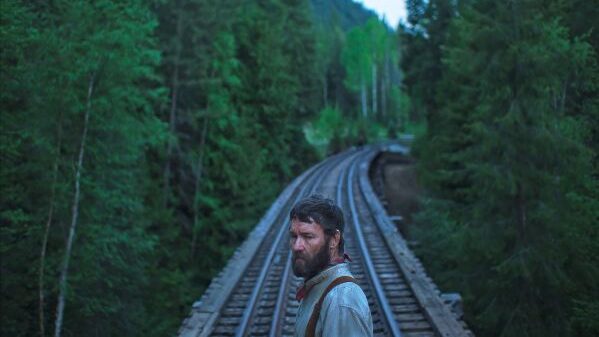
Based on the novella by Denis Johnson, Train Dreams (2025) stars Joel Edgerton, Will Patton, Felicity Jones, William H. Macy, Kerry Condon, Nathaniel Arcand, Alfred Hsing, John Patrick Lowrie, Paul Schneider, John Diehl, David Paul Olsen, Brandon Lindsay, and Clifton Collins Jr. The film follows the life of Pacific-Northwest logger and railroad worker Robert Grainier (Edgerton) as he tries to make sense of a world that contains both awe-inspiring beauty and cruel, impartial tragedy. Along the way, he finds love, purpose, and perspective, but most importantly, comes to terms with the fact that nothing can or will last forever.
As the quiet and contemplative Robert Grainier, Edgerton is perfectly cast. His expressive, pained eyes are intimidating in their silence but also feel neutral and non-judgmental. He’s a character who listens, watches, and takes everything in—the good and the bad. The character often leaves the viewer to form their own opinions about what they see and how they feel about it, which constantly forces them to ruminate on these otherwise mundane events in ways most of us never would. The script also does a great job of giving this character traits that are praised in the modern day, but set during a time when these particular morals were not as common. For example, Robert is traumatized by the experience of watching his white co-workers kill a Chinese employee in cold blood for simply no good reason. This clearly bothers Robert, but he just lets it go and tries to accept it because that’s what society urges him to do—his heart and his head tell him two different things. It’s not as cathartic as seeing him fight back against this injustice, but it’s infinitely more realistic for the era. He’s an average white dude, and most average white dudes during this era aren’t going to stand up to racism, possibly risking both thier job and even their life, whether they want to or not. Also, it generally just fits his quiet personality. He’s a forward thinker, but also a realist. His world has rules, and just because he wishes to change something doesn’t mean he can.
The film’s narration by Will Patton works surprisingly well despite being a storytelling device I often find lazy or, at best, a little cheesy. However, the simplicity of the narration mirrors Grainer’s simple way of life and provides small details we’d otherwise never get from such a silent protagonist. It’s a rare case where this works to support the overall tone rather than simply serving as a lazy exposition delivery mechanism.
The film touches on a handful of different ideas about the general nature of life and purpose, and although it never commits to one, the choice feels appropriate. Robert just wants to connect with the world in a meaningful way, but can only do so once he takes a holistic view of his life experiences. Individual events either bring him happiness or pain, but together they paint a picture of someone who changed, loved, and persevered, eventually becoming a better man. No single experience or lesson leads him to this, and that’s the entire point.
Some viewers may find the film slow and lacking in plot, but I think they’d be overlooking the power of its jaw-dropping visuals and Terrence Malick-like soul. In fact, I believe this is actually more accessible than any of Malick’s films in the sense that it avoids becoming too abstract in its storytelling. We see the world through the protagonist’s eyes, and Grainier often struggles to make sense of what he sees. He can’t quite understand the world, but as viewers, we’re not asked to understand it for him. The fact is, Grainer feels things, which is precisely what translates. We try to understand the world, but there’s no guarantee we will. The only certainty in life is that you’ll feel something. Ultimately, this finds truth in a world that often lacks such an idea.
Overall, this is a visually stunning film featuring a strong emotional core, likable characters, and compelling themes. For a movie that takes place over such a long period of time, it’s also impeccably edited and rarely drags. The end comes about a little too abruptly, but I suppose that’s the nature of a film that is simultaneously about everything and nothing. It’s a film that relies almost entirely on its ability to make an emotional connection with the viewer, and when it does, it flies. If it somehow doesn’t connect with you, you might want a doctor to take a look at that stone heart of yours. B+

 The Movie Matt