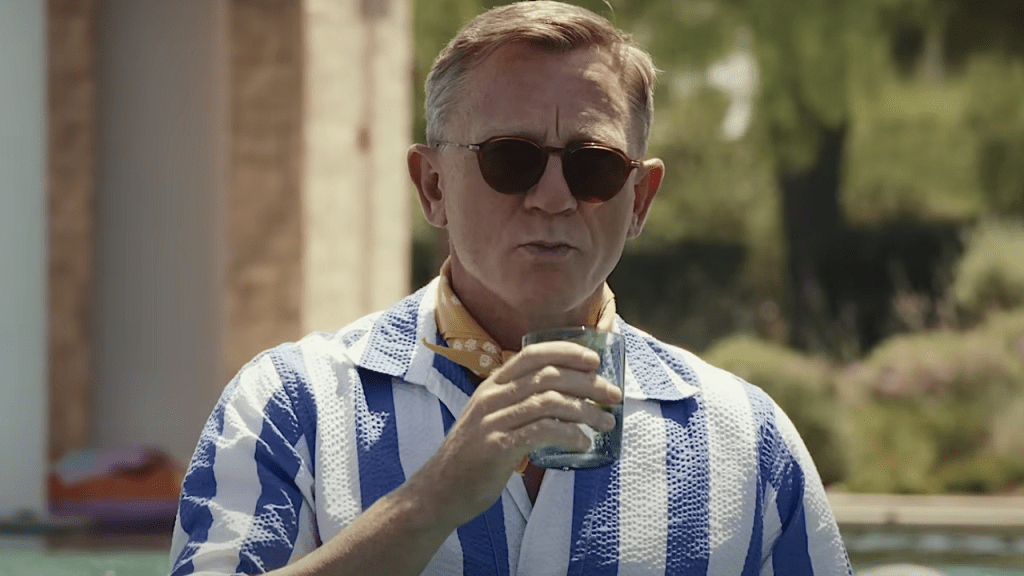
Glass Onion (2022) is written & directed by Rian Johnson. It stars Daniel Craig, Edward Norton, Janelle Monae, Kate Hudson, Kathryn Hahn, Leslie Odom Jr., Dave Bautista, Madelyn Cline, Jessica Henwick, and Noah Segan. This sequel to Knives Out (2019) follows eccentric detective Benoit Blanc after he’s invited to attend a murder-mystery party hosted on the private island of tech billionaire Miles Bron (Norton). After he discovers that his invitation is a fake, Blanc begins to suspect that one or more of the guests may harbor sinister intentions. Is this all just the product of a billionaire’s elaborate performative gag, or is something truly sinister afoot?
As Benoit Blanc, Daniel Craig once again gives a memorable, lively performance. His portrayal is notably goofier this time around, but it fits the film’s slightly more comedic approach. A majority of Knives Out (2019) was presented from the perspective of Ana De Armas’ character, so making Blanc the clear protagonist this time around allows the viewer to understand the more human, intentionally flawed aspects of the character. Even though he is the world’s finest detective, he’s not nearly as infallible. This makes sense, considering the first film’s perspective; the way others perceive him is a far cry from who he actually is. This sequel finds the character in a situation where even if he unmasks the culprit, there’s not much he can do to bring them to justice. He’s not some kind of physical beast who can take someone down once their crimes have been revealed, a reality the film leans into. This not only makes him a unique protagonist to follow, but it also gives the supporting characters agency in moments when Blanc’s skills don’t apply. The first film intrigued us with the character, but this sequel fleshes him out in ways that make him easier to connect with and ultimately enjoy. It’s the rare case of a character actually being more likable due to his overly-caring, almost ‘soft’ disposition.
Like Knives Out, the film also features a dynamite ensemble of suspects played by an A-list cast that consists of some of Hollywood’s best performers. Against all odds, I actually think this cast of suspects is superior to the first film’s, which I still consider one of the better ensembles of the last decade. There isn’t a single weak link, but my personal favorites are easily Edward Norton and Kate Hudson. Norton seems to understand precisely the kind of movie he’s in, delivering a near–perfect balance of quirky and slimy. He’s precisely the type of rich guy you want in a film where everyone has a reason to commit the crime. Does getting this rich require a certain level of shadiness, or does it speak to weak morals, and thus a propensity to commit murder?
As for Hudson, she’s an absolute scene-stealer as a famous, but astoundingly dim-witted actress who speaks as if she’s always on a potent cocktail of various painkillers. She’s a caricature of the typical LA wannabe actor archetype, something the actress seems to understand deeply. Early on, she’s presented as someone whose success has made her see even her so-called friends as lesser than. However, it quickly becomes clear that she’s just an idiot – her attitude of superiority stemming simply from the fact that she’s an oblivious pill-popper. This is confirmed by a hilarious scene in which she admits that she invested in a business that uses sweatshops because she thought “sweatshops are where they make sweatpants.”
The lush Greek island setting simultaneously creates a visual identity distinct from the first film while still feeling like a traditional/recognizable setting within the genre. Although this was most likely chosen to avoid COVID-19 protocols, it fits this story and the series as a whole perfectly. It’s not only beautiful to look at, but it’s also a functional setting in the sense that it provides a believable reason for the authorities not to be involved once the body turns up. Speaking of the body, Johnson does a fantastic job of manipulating the one expectation he knows each member of the audience will surely have: there’s going to be a murder. Instead of kicking off with the murder, the film opens with Blanc being invited to a murder-mystery party. Instead of simply asking “whodunnit?” throughout the first half, we’re instead forced to ask a handful of equally compelling questions that work to amplify the setup’s intrigue. Why has Blanc been invited? Who invited him? Why do all of the guests, the host’s so-called best friends, seem so uncomfortable? Yes, the ‘whodunnit’ question eventually takes center stage, but not before raising smaller questions that further complicate the mystery in compelling ways. Johnson understands that answering the ‘whodunnit’ question isn’t nearly enough. There have to be convincing and original answers to HOW and WHY they did it, as well as answers to more minor details, like WHEN they did it and WHAT they did it with.
Murder mysteries can quickly become boring if the only element of intrigue relates to the killer’s identity. In other words, the motivations/reasons should always be far more critical than the face behind the mask. Johnson understands this well, which justifies his choice to reveal the murder’s clear #1 suspect as the ultimate big bad. The character’s guilt isn’t surprising, but his motivations are, and that’s what’s of utmost importance. No single reveal or twist is particularly mind-blowing, besides maybe one halfway through involving identical twins (a genre trope that’s used masterfully here). Still, they all work in tandem to give the story an overarching feeling of intrigue. In other words, these small questions build on one another, either contradicting our current theories, confirming them, or jumping back and forth between the two. Whenever we feel certain, we’re given a strong reason not to be, and vice versa.
The humor can sometimes take a step too far into the absurd. Whether these moments work for you will simply be a matter of taste. Other than that, a majority of the humor is sharp, original, and delivered with peak comedic timing. Whenever the mystery stumbles (which isn’t often), the humor easily picks up the slack. At the same time, the humor never feels like it handcuffs the story’s macabre, more serious elements. Some people may feel a tad cheated by the eventual reveal that the killer is just kind of an idiot, but it actually works as a compelling explanation of why Blanc struggles to solve the case. Everything about the murder seems complex and meticulously planned, which makes Blanc overestimate the killer. As it turns out, the killer is just absurdly wealthy, which allows them to carry out even the dumbest plans with impunity. Blanc mistakes wealth and spectacle for skill and success, something we often do in real life. Sure, those are good indicators of talent and success, but that’s about it. This initially seems like a funny choice, but it’s actually a key moment in solidifying the themes.
Overall, this is a worthy sequel to Knives Out and, in many ways, even an improvement. Each character receives the proper amount of focus, and the performances are arguably better than those of the previous installment. The humorous tone can often become a bit too quirky, but it’s a choice that isn’t objectively flawed. If it’s on your wavelength, it’ll hit. However, I think more jokes land than don’t, even if they aren’t your style; it’s just that well-written. These aren’t easy films to write, but Johnson solidifies/proves himself as a rare master of the genre. Each time I watch it, I like it a little more. If that’s not the sign of a great movie, let alone a sequel, I don’t know what is. B+

 The Movie Matt