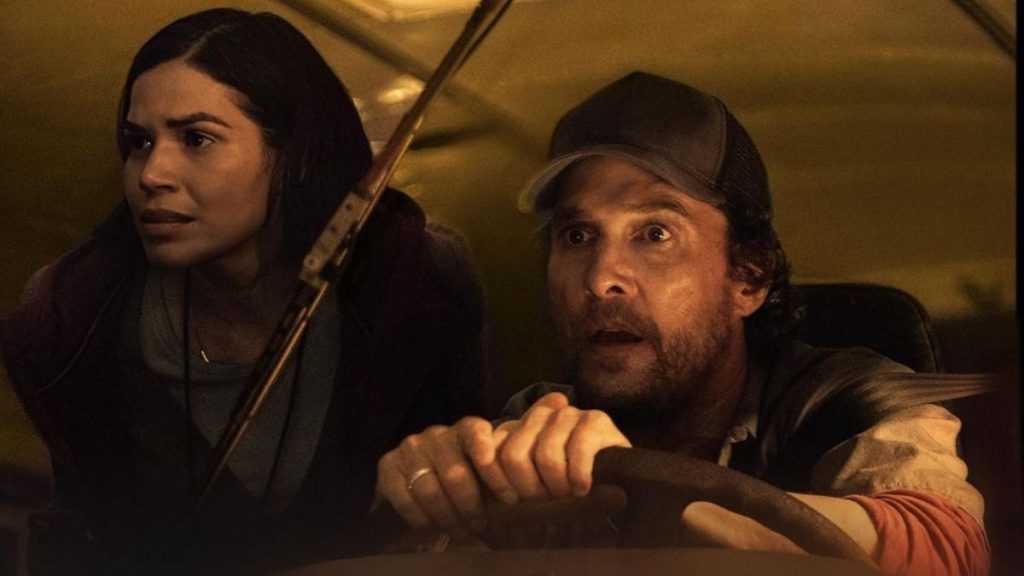
The Lost Bus (2025) is directed by Paul Greengrass, who also wrote the screenplay alongside Brad Ingelsby. It stars Matthew McConaughey, America Ferrera, Yul Yazquez, Ashlie Atkinson, Kimberli Flores, Levi McConaughey, Kay McConaughey, John Messina, Kate Wharton, Danny McCarthy, Spencer Watson, Beth Bowersox, Nathan Gariety, and Olivia Darling Busby. Based on the novel “Paradise: One Town’s Struggle to Survive an American Wildfire” by Lizzie Johnson, the film follows down-on-his-luck bus driver Kevin McKay (McConaughey) after he discovers he’s the only one capable of reaching a class of 22 children stranded in the midst of a deadly forest fire. With the help of their teacher, Mary Ludwig (Ferrera), Kevin attempts to traverse the dangerous terrain, but the situation quickly goes from bad to worse. Surrounded by deadly infernos with no clear escape route, the adults are forced to rise to the occasion so they can keep the children safe, even if that means laying down their own lives in the process.
McConaughey fits this sort of hard-luck character, and he unsurprisingly nails his more soulful, emotional moments. Even when the script fails to provide him with believable flaws, his performance successfully conveys all of the human anger, fear, and frustration the character requires. It’s an expected effort from the actor, but also a strong one. On the other hand, America Ferrera is also well-cast, delivering an equally impressive performance as Mary, an out-of-her-depth but fully committed elementary school teacher. I love the way in which the script immediately builds tension between her and Kevin. When Kevin arrives to pick them up, he’s dumbfounded by Mary’s slow, calm demeanor. The fire is swiftly approaching, but she still takes the time to ensure her students line up from shortest to tallest. He’s annoyed by her lack of urgency, but any teacher will confirm the importance of routine when it comes to keeping their students calm. The quicker that routine is broken, the faster fear takes over. In a situation like this, keeping everyone calm is arguably one of the most important things to do.
The film, for the most part, focuses on the story of the bus, but does a great job of occasionally zooming out to provide context for the disaster on a larger scale. The fire department’s response to the situation adds an extra layer of urgency, constantly reminding us that there’s much more at stake than just the 24 people on the bus. We’re also given a subtle yet clear arc of the events that led to these fires, resulting in an obvious yet mostly effective criticism of California’s response to these disasters, which seem to occur more frequently every year.
The story features a lot of variation; it’s not just 2 hours of kids screaming as Matt drives like a maniac through what’s basically Hell on Earth. Granted, there’s still a lot of that, but it never feels overdone. Greengrass’s trademark gritty, grounded visual style feels perfect for this kind of story. It works to heighten the intense confusion of being trapped in this type of wasteland, and keeps things feeling authentic when certain liberties are taken with the realism.
The two aspects of the film that really hold it back are its cliche emotional dialogue and the fact that it’s one of the most predictable stories you’re likely to see all year. Even someone like me, who never tries to actively outguess a film, knew precisely what was going to happen. Thankfully, I’d consider this a case of delivering something you recognize, but in a way that’s far more impressive than you’re used to. Unfortunately, there isn’t this kind of upside for the emotional dialogue. It’s often so unoriginal and cliché that I couldn’t help but laugh. For example, after establishing that Kevin’s having a rough time at home and work, we get a moment where he sits down and says, “I just can’t seem to catch a break.” Yeah, I think everyone watching the film noticed. I could go on referencing all of the stupid lines here, but the review would then be about 10,000 words (hyperbole, calm down. I’m making a point).
Overall, this is an exciting, well-acted film that’s also a perfect marriage between story and storyteller. I think Greengrass’s style is ideal for these kinds of true story films. It works to elevate the material to its full potential, allowing me to have a lot of excitement throughout a movie that’s as predictable as they typically get. I dislike this genre quite a bit, but I like this movie. I have a feeling most casual audiences will too. It’s nothing mind-blowing, and the dialogue is wildly inconsistent, but it’s otherwise an undeniably well-made film. B

 The Movie Matt