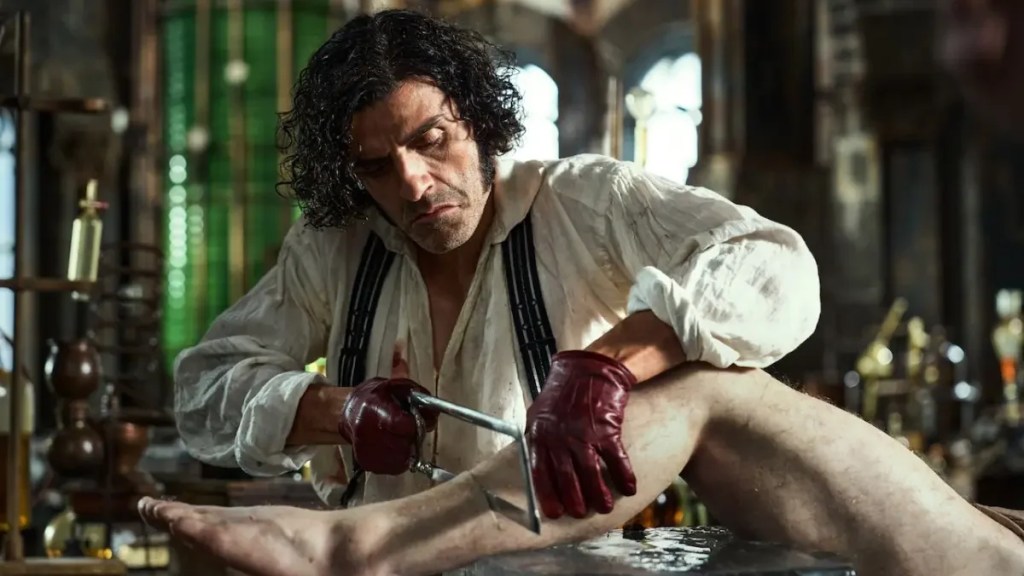
Based on Mary Shelly’s classic novel, Frankenstein (2025) is written & directed by Guillermo del Toro. It stars Oscar Isaac, Jacob Elordi, Mia Goth, Christoph Waltz, Felix Kammerer, Lars Mikkelsen, Charles Dance, David Bradley, Christian Convery, Sofia Galasso, Joachim Fjelstrup, Ralph Ineson, Peter Millard, Peter MacNeill, and Burn Gorman. The film follows Dr. Victor Frankenstein (Isaac) as he attempts to convince his peers that he has found the key to resurrecting the dead. Although most ignore his controversial ideas, he eventually secures funding from his new father-in-law, the like-minded Baron Harlander (Waltz). This provides him with the resources to birth a monstrous, human-like being (Elordi). Quickly regretting his creation, Victor attempts to destroy all traces of his work. Unfortunately for him, his creation survives, venturing out into a cruel, mysterious world. After the monster discovers the cold nature of mankind, he vows to take revenge on his creator for cursing him with such an inhumane existence.
As Dr. Frankenstein, Isaac gives one of his strongest performances in years. It’s a role designed to engage/compel the viewer while never being outright likable, a balance that Isaac nails. We’re consistently able to sympathize with Victor’s motivations while never entirely buying into them. This is aided by the script’s tendency always to show the regret he feels for his decisions. This often makes him more of a tragically misguided character as opposed to one who’s outright evil. He’s frequently immoral, but he’s never actually trying to be.
Even when Victor’s actions reach the peak of their depravity, the script intelligently shifts its perspective to that of the creature. It’s a welcome shift that, about halfway through, gives the story the propulsion it requires. Elordi absolutely disappears into the role of the monster, providing the precise doses of physical intimidation and tragic soulfulness the character requires. This could’ve easily felt like a jarring shift, but Elordi holds his own.
I appreciate the structure in which Guillermo chooses to tell this story. He shifts perspectives and jumps back and forth in time, but none of it feels convoluted. It all serves to enhance the effect of certain story revelations, as well as the characters’ emotional climaxes. It also allows del Toro to jump to more exciting portions of the story during the extended, exposition-heavy first act.
Most of del Toro’s trademark fantastical flourishes work well here, but a handful feel far too silly for this otherwise macabre tale. The monster’s supernatural ability to heal is never satisfyingly explained. The nature of this is all very abstract, and to me, it feels more lazy than thematically resonant. Thankfully, this is just one small aspect of the experience.
The film ultimately culminates in a way that many will consider to be overly optimistic about the future. Normally, I’d agree, but del Toro’s script ultimately earns this resolution. This is partly because it’s not a very “clean” ending for the characters despite its optimism. In other words, things don’t turn out great for everyone even though they find common ground. Some key consequences prevent things from becoming overly sentimental.
Aside from a handful of particularly gruesome surgery sequences, the film is never exactly frightening. Fortunately, del Toro’s expertise in the more romanticized aspects of gothic storytelling more than makes up for the lack of scares. The film often emulates the feeling of watching a classic monster film – it’s not scary, but it’s filled with the sort of dark vibes we’ve come to adore about the genre (castles, stormy nights, graveyards, etc.). It’s like a classic horror novel–something that I’d hoped it would be.
My biggest gripes with the film would have to be Mia Goth’s performance as Elizabeth, as well as the character herself. She falls in love with the creature purely out of sympathy after what feels like 30 seconds. Not to mention, the script asks us to see her as the moral compass here, yet spends most of the film seeing her choose to get romantically involved with seemingly every male character. Played by a cold and overly theatrical Mia Goth, she just feels annoying and sloppily written.
Overall, it’s not perfect, but it’s a highly entertaining modern adaptation of the classic tale. Other than Mia Goth, the performances here totally hit the mark. Even Christoph Waltz delivers one of his more compelling characters. Del Toro’s visuals are epic in scale and stunningly gothic in design, but he also proves to be an impressive storyteller. He structures the story in a way that maximizes its pace, resulting in one of the most purely entertaining Frankenstein films ever made. Compared to something like last year’s Nosferatu, its technical elements leave a bit to be desired. However, Frankenstein is also a much more rewatchable and accessible experience. Honestly, I think the two films would make a fantastic juxtaposing double feature. B

 The Movie Matt