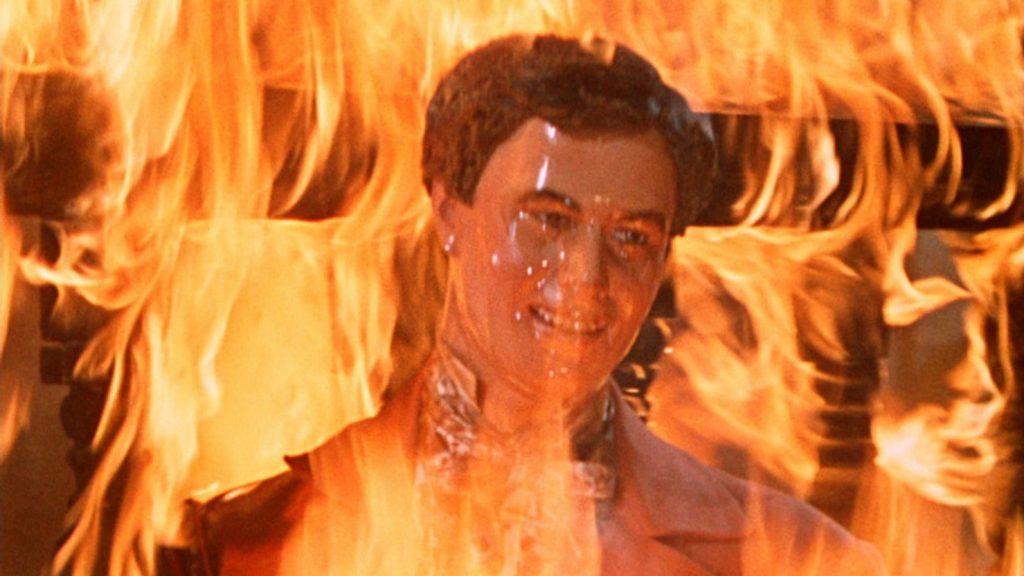
House of Wax (1953) is directed by Andre De Toth, featuring a script by Crane Wilbur and Charles Belden. It stars Vincent Price, Phyllis Kirk, Paul Picerni, Carolyn Jones, Roy Roberts, Frank Lovejoy, Paul Cavanagh, Charles Bronson, Angela Clarke, and Dabbs Greer. The film follows gifted wax sculptor Professor Henry Jarrod (Price) as his beloved museum is burned to the ground by a jaded investor (Roberts). Years later, a now paraplegic Jarrod returns after being presumed dead, determined to reopen his museum with a new macabre twist. Meanwhile, a mysterious, facially deformed assailant begins terrorizing the local population, committing murders and stealing the bodies. When Jarrod hires a new assistant (Picerni), he becomes infatuated with the man’s beautiful significant other, Sue Allen (Kirk), seeing her as the perfect model for his magnum opus sculpture. However, it soon becomes clear that Jarrod and the town’s mysterious killer may be more connected than anyone thought. With danger following close behind, Sue attempts to solve the mystery before it’s too late.
Other than an early supporting turn from future action star Charles Bronson, the only truly memorable performance is, unsurprisingly, provided by legendary horror maestro Vincent Price. Although not his first foray into the genre, this is the film/performance that established him as a master of the macabre. Not having much experience with Price’s work, I expected the film to have a certain dark side (which it does), but, by today’s standards, it primarily works as an exhibition of lush set design and simple yet effective audience manipulation.
Obviously, the film’s long, more theatrical stretches of dialogue can feel a tad slow by today’s standards, but it holds one’s attention much better than most films from its era. The plot has enough twists, turns, and subversions of expectation to fill most modern horror-thrillers, let alone one from 1954. Obviously, it’s not as unpredictable as something released last week, but I was genuinely surprised by its ultimate twist. It’s one of those fantastic moments that certain great, slow-burning horror films spend most of their runtime building toward, and it’s worth it. For example, it gave me a moment of shock similar to the killer reveal(s) in Scream (1996), one that is entirely unexpected despite how obvious it seems in hindsight. We’re provided with plenty of red herrings that feel far more likely for the era due to their simplicity, so watching this during an age that thrives on complexity and originality often works in the film’s favor.
The concept of a killer who encases his victims in hot wax and then displays them in his museum for the unwitting public is timelessly chilling. It finds the simple horror in the still, empty stares of the lifeless wax statues. It chills us with the idea that maybe the victim’s soul could be trapped inside, or perhaps they’re still alive, their skin melted and just waiting on the most demented form of starvation. It’s just a fun example of classic horror, and I genuinely think most people who like this era of film will enjoy it.
Other than its more dated aspects, which would be silly to criticize by modern standards, House of Wax works as a timeless display of spooky, ‘perfect for Halloween season’ vibes. It kinda feels like a more accessible version of Phantom of the Opera (1925). Some people might find some aspects a little too similar to that film and its many remakes, but it’s an undeniable upgrade in terms of pure watchability. Some may disagree, but I find this to be one of the more memorable ‘perfect for Halloween’ classics. Not to mention, the majority of the practical effects earn a chef’s kiss. I think it might just have to enter my yearly October film rotation. B+

 The Movie Matt