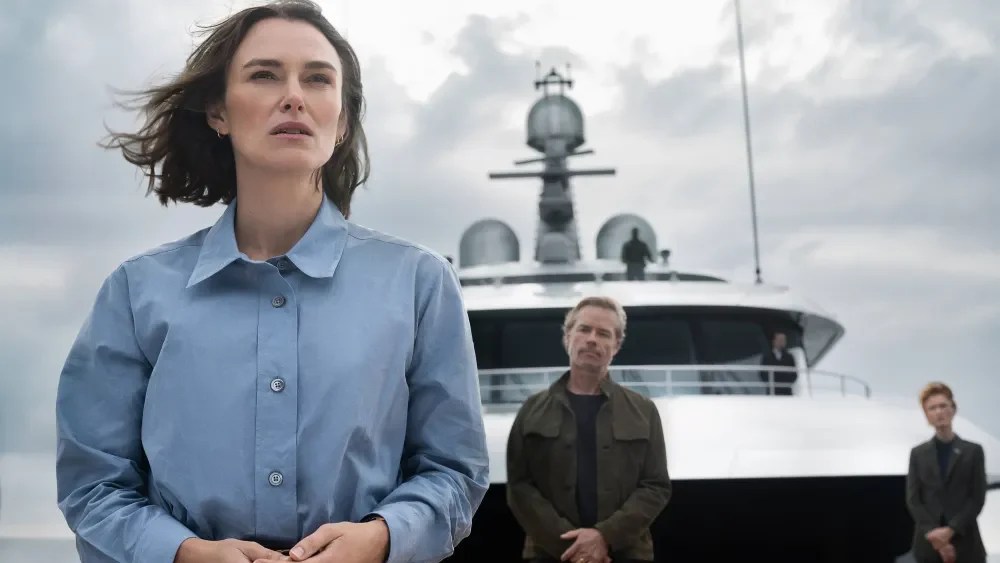
Based on the novel by Ruth Ware, The Woman in Cabin 10 (2025) is directed by Simon Stone, who also wrote the screenplay alongside Joe Shrapnel and Anna Waterhouse. It stars Keira Knightley, Guy Pearce, David Ajala, Gitte Witt, Art Malik, Gugu Mbatha-Raw, Hannah Waddingham, Kaya Scodelario, David Morrissey, Daniel Ings, Christopher Rygh, Pippa Bennett-Warner, John Macmillan, Paul Kaye, Amanda Collin, and Lisa Loven Kongsli. The film follows Laura Blacklock (Knightley), a journalist who witnesses a murder while traveling aboard a luxury cruise yacht. Despite her pleas, no one believes Laura’s story. This urges her to take matters into her own hands, soon uncovering a murderous plot involving the yacht’s billionaire owner, Richard Bullmer (Pearce), and his terminally ill wife. Unfortunately for Laura, it quickly becomes clear that someone doesn’t intend to let her make it to shore alive.
Despite the film’s many missteps, its large cast of veteran English actors often helps sell the crappy, plot-hole-ridden script. This is especially true for Knightley, who feels right at home in this kind of role. The only downside is that Lauren is often relegated to breathlessly asking, “Why don’t you believe me?” This is a necessary beat for this kind of thriller, but it’s not something that should be sustained for ⅔ of the film. This results in us often asking, “Why don’t you just try something different?” She’s a character who never seems to learn, frequently coming across as dimwitted, as opposed to clever and capable.
There’s also a lot of inconsistent logic in relation to how every single person on the boat immediately treats Laura as if she’s just some kind of emotionally unhinged dumpster fire. This would’ve made sense if everyone were an accomplice in the conspiracy at hand, but that’s not how things play out. In hindsight, this gaslighting only makes sense for the handful of people who genuinely know what’s going on. For everyone who’s revealed not to be involved (which is the majority), this attitude feels unrealistically dismissive. If someone reports that they witnessed a murder, wouldn’t it make sense to at least, for maybe five minutes, pretend to take that person seriously? These supposedly smart people even go as far as justifying their skepticism by condescendingly asking Laura, “Do you REALLLLY think someone could’ve been in the room if it wasn’t reserved?” as if it’s some kind of trump card. Is it really that hard to believe that someone could’ve entered a room they didn’t book? Answer: It’s not. This script just thinks we’re completely brain-dead.
These leaps in logic could’ve been forgiven if the film’s mystery/thriller elements were more exciting. Unfortunately, the first two-thirds stumble through just about every genre cliche you can imagine. If that weren’t bad enough, it also randomly becomes a by-the-numbers action film in its final moments. It seemingly has no concern with maintaining tonal consistency, almost as if AI wrote the third act. At the very least, the film flies by at a swift 92 minutes. Unfortunately, I also think this short runtime is one of the reasons its mystery falls so flat. Because everything is so condensed/rushed, the film’s mystery fails to hold the viewer’s attention. There’s almost no time for us to form predictions about what’s going on or who’s behind it all. We’re given little time to think, let alone engage with the mystery’s many complex details. Maybe it’s for the best; The more you actively think about what’s going on, the less sense it all makes.
Overall, the film is just a forgettable murder-mystery thriller that features far too many annoying plot holes and frustrating characters. It does contain some strong performances and sharp cinematography, but that’s about it. Like its muted color palate, the film is a dull, cold, and emotionless experience. It exemplifies the kind of movie that studio’s cynically ‘dump’ onto a streaming services, never to be talked about again. I feel mostly bad for fans of the novel, but at least it’s over quick. C

 The Movie Matt