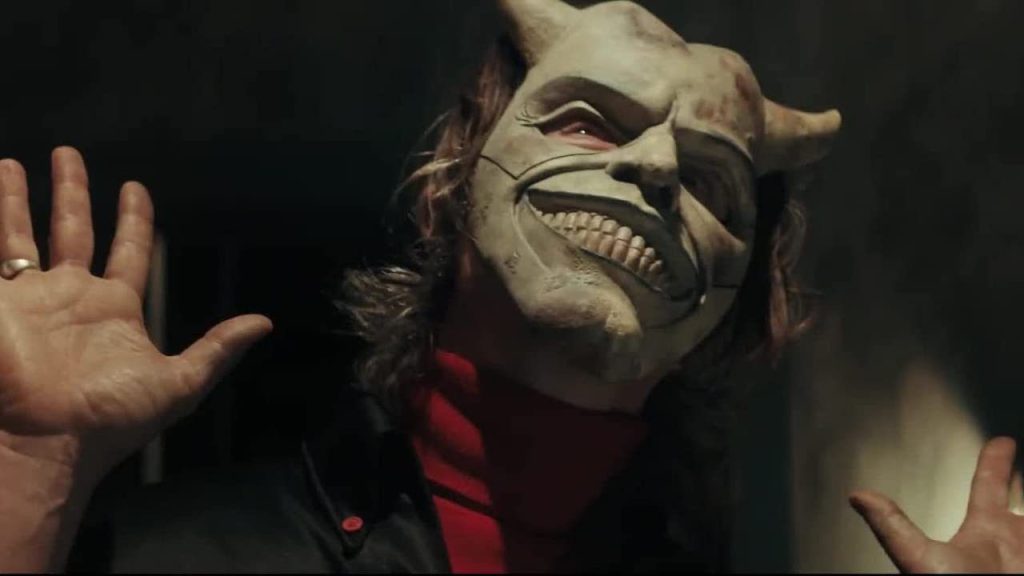
Based on the short story by Joe Hill, The Black Phone (2021) is directed by Scott Derrickson, who also wrote the screenplay alongside C. Robert Cargill. It stars Mason Thames, Ethan Hawke, Madeleine McGraw, Jeremy Davies, James Ransone, E. Roger Mitchell, Troy Rudeseal, Miguel Mora, and Tristan Pravong. The film is set in North Denver, 1978, and follows 13-year-old boy, Finny Blake (Thames). Bullied at school, he struggles to stand up for himself, an issue quickly forgotten when a child killer known as The Grabber (Hawke) begins terrorizing the area. After unknowingly killing one of Finny’s friends, The Grabber chooses Finny himself as his next target. Now trapped in The Grabber’s dingy basement prison, Finny is forced to buy enough time for his precognitient little sister, Gwen (McGraw), to find his whereabouts and send the police. With little means of defense, Finny must rely on advice from The Grabber’s past victims, who contact him through the room’s broken black phone.
As Finny, young Mason Thames successfully leads the majority of the film. His character isn’t a flashy one, but he never has to be. Nearly every supporting turn, no matter how small, is nuanced and memorable. More than anyone else, this is especially true for Ethan Hawke as The Grabber. Hawke may not be my favorite actor, but performances like this make it clear that he has a strong understanding of film theory and film history. No matter if he’s working as a dark horror villain or a soft-spoken romantic lead, he seems to have a deep knowledge of what the audience wants to see. This results in a villain who respects the iconic slasher characters who paved his way, yet is unique enough to never feel like a retread. Other than his look, there isn’t enough here to place the character alongside greats like Michael Myers, Freddy Krueger, or Jason Voorhees. That being said, he does have the potential. With a few solid sequels, he might reach that level quicker than most.
Although Gwen could’ve easily been written as the boring ‘concerned sibling’ archetype, she’s instead treated as a fully-formed, important character who’s likable and original. She’s whip smart, brave, and swears like a sailor. It’s sometimes tough to believe that someone so young could have a sharper wit than most insult comics, but it’s the kind of logical stretch I’m happy to accept if it leads to something enjoyable.
I’m typically a bit tired of the abusive alcoholic father character in horror movies, so I was happy to find that Jeremy Davies’ take on the trope is more nuanced than most. We’re not asked to forgive his behavior, but that doesn’t stop the script from letting us know that he still loves his kids more than anything. He’s a deeply flawed person hiding an immense amount of pain. He’s not a great guy by any means, but he does feel real.
The film does a great job of prioritizing visual storytelling over spoken exposition. This makes the dialogue engaging because it implies that when characters do choose to talk, their words are most likely crucial. The grounded setup helps to immerse the viewer before unveiling the story’s more supernatural elements. A lesser script would’ve allowed this kind of supernatural shift to shatter its realism completely, but Hill and Cargill always maintain a sense of overarching mystery. In other words, they never entirely discredit the idea that these elements could all be something the characters are imagining while in a state of shock (or psychosis, in The Grabber’s case).
Despite its contained, minimalistic setting and lack of a real body count, the film remains engaging and tension-fueled from start to finish. The tight script subtly sets up Finny’s hero turn in the third act, with nearly every movement working as a callback to how he was bullied at the beginning of the film. The only difference is that, this time, he’s not the victim. Seeing someone turn the tables on a villain has never been this satisfying.
Overall, this is a well-paced cat-and-mouse serial killer story elevated by its intelligently contained supernatural elements, as well as its uncommonly memorable lead performances. It’s a simple story, but one that does nearly everything right. It doesn’t force anything and is therefore an effortlessly compelling watch. I can’t wait to see where the franchise goes next. B+

 The Movie Matt