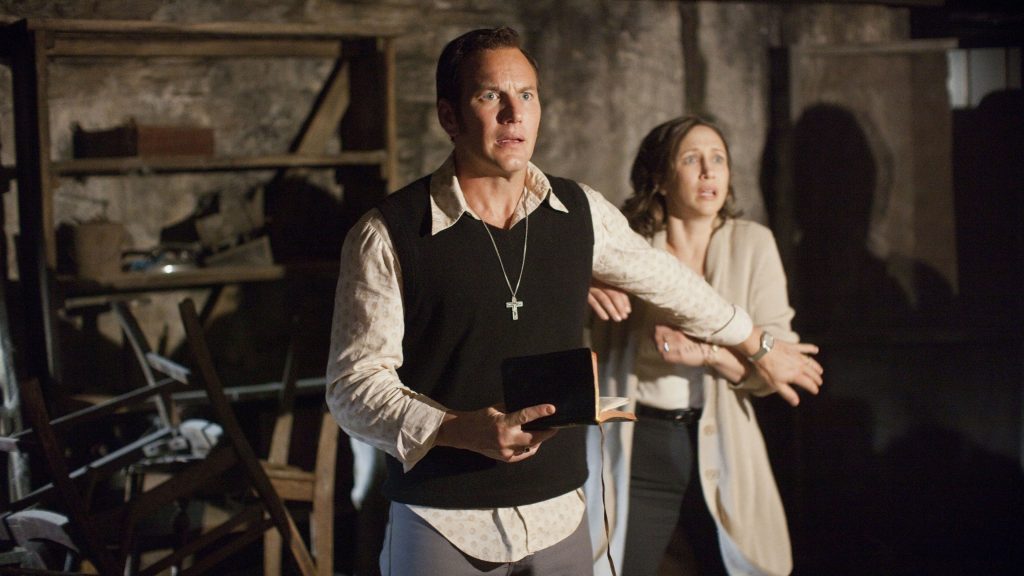
The Conjuring (2013) is directed by James Wan, featuring a script by Chad Hayes and Carey W. Hayes. It stars Patrick Wilson, Vera Farmiga, Lili Taylor, Ron Livingston, Shanley Caswell, Hayley McFarland, Joey King, Mackenzie Foy, Kyla Deaver, Shannon Kook, John Brotherton, and Sterling Jerins. Loosely based on the real-life cases of paranormal investigators Ed (Wilson) & Lorraine Warren (Farmiga), the film follows the couple as they attempt to help a family of 7 rid a vengeful demon from their secluded, newly purchased home.
As Ed & Lorraine Warren, Wilson and Farmiga present a likable, grounded version of a couple whose real-life legacy is shrouded in controversy. In the context of reality, it’s clear these two were, at best, nothing more than gullible spiritualists, or, at worst, shameless grifters looking to take advantage of people’s worst fears. This would’ve been an interesting fact to explore, but this isn’t the kind of film that’s particularly unsure about whether ghosts actually exist. The film assumes that the Warrens were honest about their experiences, which eliminates any reason the audience may have had to distrust their otherwise wacky claims. The two aren’t particularly original or complex characters, but Farmiga and Wilson’s strong performances end up saving the day. The two exhibit a lot of authentic romantic chemistry, remaining relatable and grounded despite their unconventional careers. This is in part because the script chooses to make it clear that the things truly important to them have nothing to do with the supernatural. They’re great at what they do, but that’s not what drives or defines them. Instead, they display more or less universal values that people can sympathize with, or at least empathize with. Being a ghost hunter is cool and all, but not if it comes at the expense of one’s core needs, such as family, acceptance, and love.
All of the characters here are likable and feel authentic, especially Ron Livingston’s kind-hearted father character. Unfortunately, every single character, except Ed & Lorraine, is written to be nothing more than a bland, surface-level cliché. The film occasionally hints at certain subplots related to these minor characters, but never fully develops any of them. This ultimately hurts the third act because we don’t have a meaningful understanding of who these people are, so there’s little reason to care whether they live or die.
The film’s well-paced rollout of its many thrills and chills seems a bit tame over a decade later, but it remains impressive in the sense that each scare goes at least half a step further than the one preceding it. Often credited alongside Wan’s earlier effort, Insidious (2010), as the film that popularized the modern-day horror genre’s egregious use of jump scares, The Conjuring works as an excellent example of how to manipulate the viewer’s focus for the sole purpose of maximizing scares.
The combination of the terrifying score and off-kilter camerawork results in a permeating sense of unease. This mostly makes up for the fact that the film often lacks a chilling visual element, but it’s undeniable that this kind of atmosphere-forward, ‘things that go bump in the night” approach is painfully stale when viewed through a modern lens. A significant portion of the film is devoted to various family members strolling through their home in the middle of the night, breathing heavily as the viewer waits in boredom for the next inevitable jump scare. These stretches would be easier to accept if they worked to achieve something beyond their ultimately meaningless “Boo!” moments, but all they do is pad out the runtime.
Overall, The Conjuring (2013) remains one of the best modern examples of the haunted house subgenre, despite not holding up as well as I hoped it would after 12 years. It’s not award-worthy, but it’s the kind of horror film that works wonders if viewed alone during the middle of the night, cuddled tightly in your favorite blanket. Above all, it features two great protagonists brought to life through Wilson and Farmiga’s warm, relatable portrayals. They’re the main reason this franchise continues to this day, and rightfully so. B-

 The Movie Matt