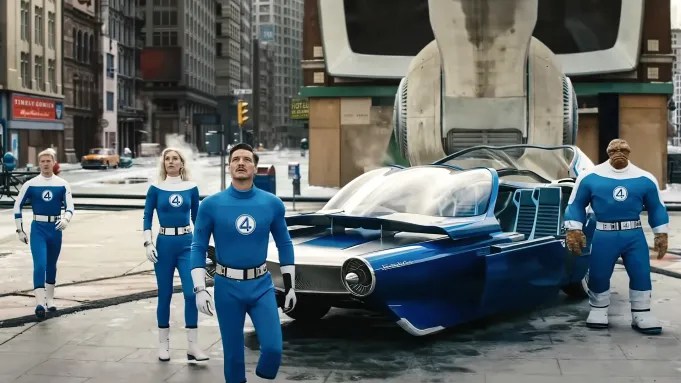
The Fantastic Four: First Steps (2025) is directed by Matt Shakman, and features a script by a committee of 5 writers. It stars Vanessa Kirby, Pedro Pascal, Ebon Moss-Bachrach, Joseph Quinn, Julia Garner, Ralph Ineson, Paul Walter Hauser, Natasha Lyonne, Sarah Niles, Mark Gatiss, Ada Scott, and Matthew Wood. Set in an alternate, Jetsons-style MCU timeline, the film follows Earth’s sole protectors, a team of genetically mutated astronauts known as The Fantastic Four. After Sue Storm, aka The Invisible Woman (Kirby) and Reed Richards, aka Mr. Fantastic (Pascal), welcome their first child, Franklin (Scott), a mysterious silver alien (Garner) arrives to announce the impending arrival of Galactus (Ineson), an intergalactic God who devours entire planets to quell his insatiable hunger. After an attempt to reason with this infinitely powerful being, he offers the team a choice: Give him Franklin or watch their planet die. When they refuse, the citizens of Earth quickly turn against them. With seemingly little hope, the team is forced to rely on one another in a last-ditch, desperate attempt to not only save Franklin but reclaim their status as Earth’s most trusted protectors.
The four members of the titular team are well-cast, with each performance resulting in the best versions of these characters to date. Although canonically one of the most intelligent heroes in the entire MCU, Pascal’s performance intelligently focuses on the downsides of being more intelligent than everyone else. He’s brilliant, but also a chronic over-thinker whose analytical thought process often hinders his ability to communicate on an emotional level. Like Tony Stark, it’s not his super-powered abilities that make him compelling; It’s actually the ways he remains distinctly human despite them.
Vanessa Kirby as Sue Storm is easily the beating heart of the film, providing the experience with a certain feminine, motherly sense of care that glues everything and everyone together. There’s a clear sense that, without her presence on the team, the three boys would bicker and goof around to the extent that they’d forget their responsibilities as Earth’s protectors. Her role as Franklin’s mother also provides some necessary complexity to the team’s impossible decision. This could’ve resulted in her being a frustrating character who’s willing to kill everyone to selfishly save her son, but it’s clear she never sees it as a binary choice. She refuses to give up her son, not because she’s willing to sacrifice everyone else, but because she’s not willing to sacrifice anyone.
Joseph Quinn as Sue’s hotshot brother, Johnny Storm, aka The Human Torch, plays a version of the character who’s still notably charismatic, but far less of a playboy than previous iterations. It’s made clear that he’s still a flirtatious bachelor of sorts, but he’s nowhere near the playboy that Tony Stark was. In fact, his flirtations with Julia Garner’s Silver Surfer hint at the possibility of a romance that’s more meaningful and lasting than you’d initially expect the character to be involved in. Instead of focusing on how his sometimes erratic behavior hurts the team, the script instead shows how this is often a necessary piece of their chemistry. This results in a character we recognize, but can take far more seriously than ever before.
I was initially hesitant about Ebon Moss-Bachrach’s casting as Reed’s best friend and colleague, Ben Grimm, aka The Thing. However, it quickly became clear that the strong, but emotionally vulnerable presence he perfected in The Bear is perfect for such a tragic character. His deep, rough Bostonian accent nicely parallels his body’s rough edges, while also making him approachable as a sort of average Joe. The ‘it’s what’s on the inside that matters’ message the character provides isn’t new, but it’s timeless and heartwarming.
As for the film’s antagonists, I was pleased to discover that Julia Garner’s portrayal of the female Silver Surfer does nothing to compromise the integral aspects of the character. In fact, this actually serves to make the character more complex, leading to unexpected character dynamics, such as her relationship with Johnny. It also helps that the film provides the most explicit portrayal of her powers, such as her visually stunning ability to literally surf through intergalactic wormholes. The film’s main villain, on the other hand, is portrayed with chilling gravitas by the wonderful Ralph Ineson. Because Galactus is a mostly CGI character, all he really requires is the right voice to bring him to life, and boy, what a voice Ineson has. It’s so deep and powerful that it does, in fact, feel alien. He’s also an interesting Marvel antagonist in the sense that he’s less of a proactive villain and more of a natural, emotionless, eternal force whose arrival is inevitable. He doesn’t even want to eat planets, but he’s cursed to do so. This makes him sympathetic in a way, but also infinitely more terrifying in the sense that he can’t really be reasoned with on an emotional level. No matter what you say or do, his motivations can’t be changed.
The alternate, Jetsons-inspired world in which the film takes place gives it a wonderful visual identity that sets it apart from the rest of the MCU. It presents a rose-tinted view of a technologically enhanced, white-picket-fence future. This helps the viewer align with the team’s mission, as their world actually feels worth saving.
With this being the 3rd attempt to bring these characters to the big screen, the film smartly trusts the audience to understand who they are at a basic level, thus avoiding long stretches where we’re pointlessly refed their well-known origin stories. This allows the film to naturally develop them throughout the course of the story, as opposed to telling us everything about them in the first 20 minutes.
Whether it’s the back-and-forths between the team or their interactions with Paul Walter Hauser’s hilarious Mole Man character, the film features some surprisingly strong humor. For example, I appreciated the fact that The Thing’s iconic catchphrase, “It’s clobbering time!” is just something he says in an in-universe cartoon version of himself, so he’s constantly annoyed that people want him to say it. It’s nothing particularly hilarious, but just clever enough to place a goofy grin across your face.
My only real issue with the movie is that it often feels like the filmmakers are trying to show off the team’s powers as sparingly as possible. Until the third act, we rarely get to see anyone power up in a satisfying way. In fact, there were multiple instances in which I wondered why Mr. Fantastic doesn’t stretch more. For Pete’s sake, he doesn’t even use his powers to help grab items around the room. It’s almost as if he resents them. Even the bad Fantastic Four movies had fun with these powers. Here, it just feels like a missed opportunity. On top of this, the film is ultimately predictable in the sense that we know these heroes will eventually find a way to save the world with little consequence. I expect this kind of formula going in, but that doesn’t change the fact that it’s boring and has been for a long time.
Overall, this marks the second Marvel film in a row that feels as if it captures the magic of the MCU’s golden age. It’s a fun, standalone superhero story featuring eye-catching visuals, likable characters, and compelling, tense action sequences. It unsurprisingly still suffers from a handful of the MCU’s most glaring, inherent issues, but it’s primarily a fun, refreshing superhero experience that finally nails the IP’s “first family.” Also featuring the franchise’s strongest post-credits scene since The Marvels (2023), this is one installment fans shouldn’t miss. I wasn’t excited for Avengers: Doomsday before seeing this, but now I am. B

 The Movie Matt