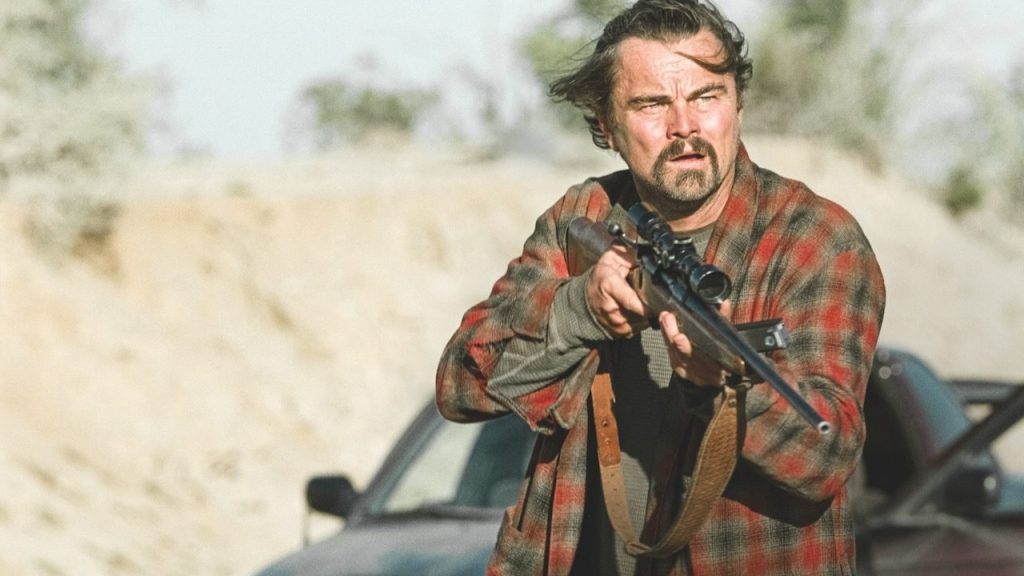
Inspired by Thomas Pynchon’s novel, “Vineland,” One Battle After Another (2025) is written and directed by Paul Thomas Anderson. It stars Leonardo DiCaprio, Sean Penn, Chase Infiniti, Benicio Del Toro, Regina Hall, Teyana Taylor, John Hoogenakker, Tony Goldwyn, Kevin Tighe, Alana Haim, Wood Harris, Shayna McHayle, Scarletta DuPois, Eric Schweig, James Downey, and D.W. Moffett. The film follows Bob (DiCaprio), a revolutionary/terrorist who parts ways with his wife (Taylor) after the birth of their daughter, leaving the extremist life behind to raise their child in peace. Sixteen years later, Bob is forced to reenter the fight when his now-teenage daughter, Willa (Infiniti), is kidnapped by his former adversary, the perverted and mentally unhinged Colonel Steven J. Lockjaw (Penn). With the help of his martial arts sensei and fellow former revolutionary, Sergio St. Carlos (Del Toro), Bob attempts to shed his newfound skin as a middle-aged, Lebowski-esque stoner and find the bravery to save his daughter before it’s too late.
As Bob, DiCaprio delivers one of the most unique and memorable performances of his already storied career. In the simplest terms, he’s essentially a more hard-edged version of The Dude. This kind of complex character allows him to explore a vast range of emotions, all of which he unsurprisingly nails. This results in Bob feeling like a fully formed character, one that feels real despite his many goofy eccentricities. He’s a deeply flawed, sometimes frustratingly incompetent human being, but is always likable because, despite his many missteps, his number one priority remains protecting his family.
In her first major role, Chase Infiniti delivers a subtle yet powerful emotional performance. It might just be Anderson’s masterful filmmaking, but she seemingly displays the kind of rare ability to say a thousand words with a simple flick of her eyes. Whereas Bob’s journey throughout the film provides a majority of the humor, Willa’s is nearly the opposite. She’s consistently placed in peril, forced into situations traumatic for anyone, let alone a 16-year-old girl. The life-or-death nature of Willa’s arc allows us to root for Bob despite the goofball nature of his comparatively zany journey. He’s woefully unequipped to handle the problem, but if he doesn’t at least try, who else will? Willa is the character we genuinely want to see survive, which is precisely what Bob wants. Thus, we accept Bob as dramatically relevant despite his goofball nature because we genuinely feel his goal is an important one.
It’s also easy to root for a character like Bob when he’s pitted against someone as cartoonishly despicable as Sean Penn’s Col. Lockjaw. His performance matches Leo’s in terms of being gleefully unhinged, but he goes even further. For example, his wild sexual kinks and unapologetic racism clash, painting a portrait of a man who’s almost being crushed under the weight of his own hypocrisy. This even translates physically in Penn’s posture and movements, as he uncomfortably trots along like he has an anchor chained to his ankle. He’s extremely over-the-top, but if you’re to believe anyone would take a grudge this far, it makes sense it would be someone as unhinged as Lockjaw.
One Battle After Another explores similar timely themes to Ari Aster’s Eddington (2025), but does so in a more accessible, humorous, and crowd-pleasing way. These themes are also much less specific than the ones featured in that film, which sounds like it would make them less compelling, but actually achieves the opposite effect. This gives them a much broader, subjectively meaningful appeal, providing that ‘it can mean different things to different people’ quality that all great movies have.
The film above all else works as an easily accessible story of the recurring ups and downs that define this specific father-daughter relationship. If you wish to dig deeper, the nature of their dynamic also parallels the film’s belief that life is, or at least often feels like, one battle after another—physical or otherwise. It’s easy for people to lose their humanity and become jaded due to the relentless nature of life’s challenges. However, the film makes it clear that these battles become worthwhile when they’re waged in the name of something worth fighting for, which is often our loved ones. Once one’s battles become more important than their reason for fighting them, it is a clear sign of extremism. Like any great anti-war/battle movie, the film understands that once bullets start flying, a soldier’s only goal quickly becomes making it back home to their family and friends in one piece. These themes of endless struggle are hammered home visually with the film’s climactic car chase, in which multiple vehicles pursue each other along an endlessly hilly road.
Overall, the film’s balance of dark drama, outlandish humor, and absurdist satire is seamlessly balanced, resulting in one of the more tonally unique theater experiences in recent years. This keeps the viewer consistently guessing which direction it will take next, helping the nearly 3-hour runtime to fly by. Not all of Anderson’s otherwise commendably brave creative flourishes work for me as well as they seem to for a majority of critics. Still, I recognize it as a wholly original, frighteningly relevant, and uncommonly entertaining experience. Anderson’s filmmaking isn’t everyone’s cup of tea, but everything he produces is undoubtedly well-conceived, original, and generally features something meaningful to say about the nature of the human condition. It won’t be my favorite of the year, but it’ll comfortably make my top 15. That said, I have a sneaking suspicion this might be a film that only gets better on a second viewing. It’s a great film, albeit one that isn’t quite 100% on my personal wavelength. B

 The Movie Matt