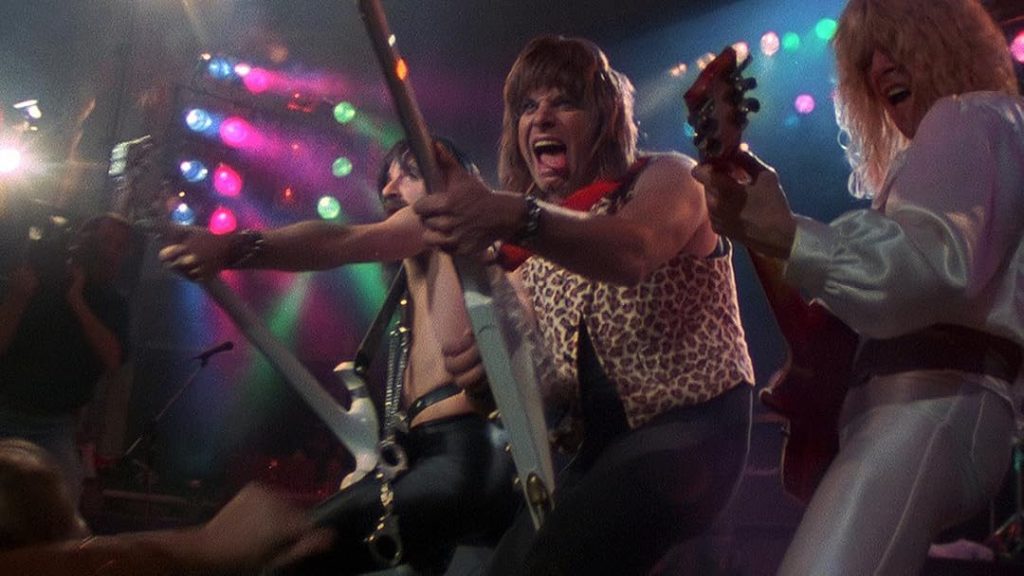
This Is Spinal Tap (1984) is directed by Rob Reiner, who also wrote the film alongside Christopher Guest, Michael McKean, and Harry Shearer. It stars Michael McKean, Christopher Guest, Rob Reiner, Harry Shearer, Tony Hendra, Fran Drescher, June Chadwick, Bruno Kirby, Ed Begley Jr., Danny Kortchmar, Patrick Macnee, R.J. Parnell, David Kaff, Sandy Helberg, Howard Hesseman, Dana Carvey, and Billy Crystal. Set in 1984, the movie follows filmmaker Marty DeBergi (Reiner) as he attempts to document the long-awaited US tour of the controversial metal band, Spinal Tap. As the tour progresses, the band notices its audience slowly dwindling. This results in tension between the bands’ two original members, the snobby David St. Hubbins (McKean) and the dimwitted Nigel Tufnel (Guest). As the last leg of the tour approaches, the band can’t help but act as their own worst enemy, which often fosters hilarious results. Can they clean up their act in time to cement their status as one of the greatest, loudest metal bands of all time, or will their petty grievances lead to their slow demise?
The three members of Spinal Tap are all extremely likable despite being some of the dumbest characters ever put to screen. Similar to a film like Dumb & Dumber (1994), we’re able to follow these idiots not because they’re easy to laugh at, but because, despite their lack of intelligence, they’re ultimately kind-hearted people. A majority of the film’s most iconic moments are improvised, an approach that can often lead to awkward, hit-or-miss comedy. Thankfully, this kind of random, sometimes nonsensical ab-libbing fits the characters perfectly, feeling more real than improvised. Even when they’re not laugh-out-loud funny, the performances are so wonderfully silly that it’s tough not to have a consistent, goofy grin across one’s face. This makes it all the more impressive that the few flashes of deep emotion between David and Nigel are so effective. No matter how goofy things get, there’s always this tragic undertone of a broken friendship that both parties want to fix, but struggle to do so because of their painful history.
Despite being a full-blown comedy from beginning to end, Reiner’s approach naturally presents a range of complex and interesting ideas about the nature of art. There’s always a juxtaposition between the mental simplicity of the band and the complexity of the art they create. As they say in the film, “there’s a fine line between stupid and clever,” and nothing displays that idea better than 80s hair metal. A majority of the era’s popular music features innuendo-heavy lyrics that rarely hold meaning beyond glamorizing sex, drugs, and partying. This begs the question: Is Spinal Tap’s willingness to outright say the dirty things other artists only hint at a stupid miscalculation, or is it actually an intelligent way to set their music apart? Are they foolish, clever, or just honest? I’m still not sure, and don’t want to be.
The real-life longevity of ’80s rock bands has actually made the film’s satire of fading musicians even more relevant than it was upon release. Just like what would happen in 2025, the band is criticized for their music’s misogynistic overtones, leading to hilariously oblivious reactions. For example, the band is incapable of understanding why their album cover, which features a woman who’s on all fours and wearing a dog collar with a black glove shoved forcefully in her face, is somehow misogynistic. As the world becomes more sensitive in its treatment of women, this scene only grows funnier. This moment continues to work because it’s made clear that the last thing the band wants to do is demean women; they just don’t seem to understand what “demeaning” even means.
Overall, this remains the most masterfully crafted example of the “mockumentary” subgenre and has only become more relevant since its initial release. It’s filled with characters that are not only funny, but disarmingly easy to care about. The balance of satire, pathos, realism, and idiotic humor results in one of the most unique films ever made. Even if you don’t laugh, you’re sure to be quoting it for the rest of your life. Hell, I even catch people who haven’t seen the film regularly quoting the “turn it up to 11” bit. It may not be on everyone’s wavelength, but at a tight 82 minutes, there’s only bad reasons to avoid giving it a shot. A-

 The Movie Matt