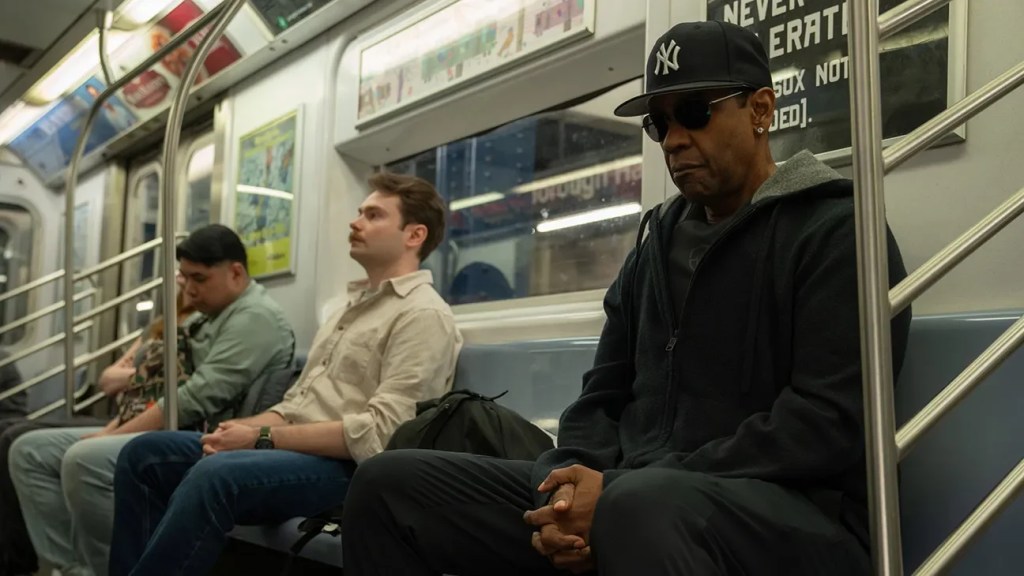
Highest 2 Lowest (2025) is directed by Spike Lee and features a screenplay from Alan Fox. It stars Denzel Washington, Jeffrey Wright, A$AP Rocky, Ilfenesh Hadera, Aubrey Joseph, Elijah Wright, Michael Potts, Allison Worrell, Dean Winters, LaChanze, John Douglas Thompson, Wendell Pierce, Eoin O’Shea, Gregory Dann, Andy McQueen, Sunni Valentine, and Frederick Weller. Although based on Ed McBain’s (aka Evan Hunter) 1959 novel, “King’s Ransom,” Highest 2 Lowest is more specifically based on Akira Kurosawa’s 1963 adaptation of said novel, High and Low (1963). The film follows David King (Washington), a renowned music producer struggling to keep his label afloat amid an emerging culture that prioritizes profit over artistry. With his finances at an all-time low, David finds his situation infinitely more complicated when his clean-cut athlete son, Trey (Joseph), is kidnapped and held for ransom at 17.5 million dollars. Unfortunately, a case of mistaken identity involves Kyle (E. Wright), Trey’s best friend and the beloved son of David’s loyal driver, Paul Chistoper (Wright). This forces David to choose between the survival of his business and protecting the people he considers family.
Nearly every performance is spot-on here, but Denzel Washington unsurprisingly carries the majority of the film’s dramatic weight. The overly charismatic, “I’m the greatest and the best,” schtick he injects into a majority of his recent characters is present, but it fits a film like this much better than one like Gladiator 2 (2024). There’s no denying he provides a certain screen presence that keeps David compelling, but I wish he were a more interesting character on paper. He’s often meant to represent the kind of person who has the tools to handle the pitfalls of fame. He’s a go-getter who, when push comes to shove, is capable of taking matters into his own hands no matter what the situation may entail. This makes the character a certifiable badass, but also someone who’s tough to connect with. His only true struggle is deciding whether he’s going to let his best friend’s son be murdered in cold blood or save his already failing record label. He’s neither flawed enough nor likable enough to root for, so it’s a significant relief that actors such as Jeffrey Wright provide some heart.
As Paul Christopher, Wright works as a necessary foil to Denzel’s David King character. Whereas David stays calm when he believes his son has been kidnapped, Paul explodes with recognizable human emotions, making it clear that David is missing something. This forces David to realize that, although he’s had success, he couldn’t have achieved it alone. He forgets about love and compassion, but Paul is there to remind him. None of the success matters if it comes at the expense of those you love. Choosing people over money is almost always the right choice. That being said, the film also isn’t shy about showing how prioritizing people can sometimes come back to bite you. You can’t ever build something if you’re constantly giving everything away.
The film is well-directed by Lee, but although none of his creative choices are objectively flawed, there are at least two that don’t exactly work for me. The first is Lee’s use of an overly sentimental, almost dated score that consistently broke my immersion. It makes otherwise well-written character beats feel desperate and flowery, which quite frankly doesn’t fit the subject matter whatsoever.
Other than a few silly plot conveniences that are mostly easy to ignore, the only other misstep from Lee is his heavy focus on New York City. This isn’t surprising for a well-known New Yorker like himself, but it doesn’t align with the story he’s trying to tell. NYC is meaningless in terms of how it influences this tale, so why feature so many scenes that essentially boil down to “New York City is the best! Isn’t it the best? Look! It’s the best!”? I suppose if you love the city, you’ll love these moments, but most people haven’t lived in NYC. Even if they have, I can’t imagine it’s a place everyone automatically adores. It’s not a bad choice, it just has a very niche appeal.
What made this film ultimately work for me is the eventual clash between David and Yung Felon (the kidnapper), played by A$AP Rocky. This is because the script intelligently keeps Yung Felon’s motivations a secret throughout most of its runtime. The answers we get aren’t particularly mind-blowing, but they are thematically resonant. They highlight the importance of doing things the “right” way, a theme that not only relates to achieving success, but also to how we prioritize the art business over the art itself. If the art doesn’t come first, the business suffers. Great art is the most lucrative kind. Therefore, it makes little sense to prioritize monetary gain over the art itself. Great art IS what leads to financial success (especially in the long term).
Overall, this is a perfectly serviceable retelling of High and Low, but unsurprisingly never reaches the masterful heights of such a film. Lee puts his unique stamp on the material, for better or worse. Your enjoyment of the film will mostly depend on your feelings toward Lee as a director, but even then, it’s tough to deny the power of such energetic filmmaking. It’s nothing that feels particularly new, but it’s definitely worth a watch for committed Denzel (or Lee) fans. Honestly, I’m very curious to discuss it with other film fans, whether that conversation is positive or not. That being said, I’m not clamoring for a second watch. B-

 The Movie Matt