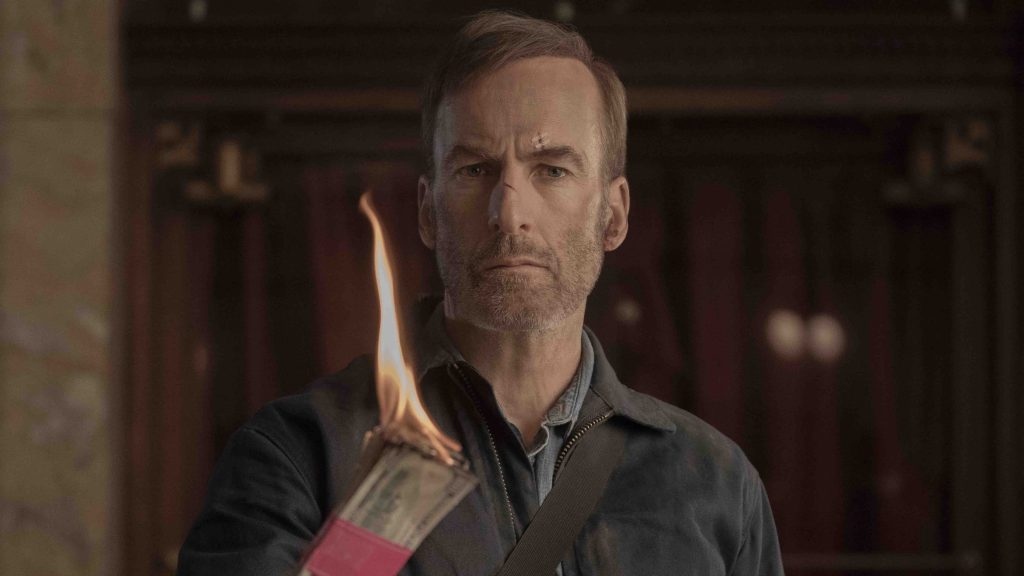
Nobody (2021) is directed by Ilya Naishuller and written by Derek Kolstad. It stars Bob Odenkirk, Aleksey Serebryakov, Connie Nielsen, Christopher Lloyd, Michael Ironside, Colin Salmon, RZA, Billy MacLellan, Araya Mengesha, Gage Munroe, Paisley Cadorath, and Aleksandr Pal. The film follows Hutch Mansell (Odenkirk), a seemingly ordinary family man whose violent past begins to resurface after he fails to intervene when two robbers break into his home. To prove to himself that he’s capable of protecting the people he loves, Hutch picks a fight with a group of local thugs, but is unaware that one of them is the son of Yulian Kuznetsov, an influential and often psychotic crime lord (Serebryakov). With his entire family now targeted, Hutch fully embraces his mysterious past as a CIA “auditor.” As the bodies pile up, Yulian and his crew realize that Hutch, despite being one man, is not to be underestimated.
As Hutch, Odenkirk gives a performance that proves once again why he’s one of Hollywood’s more skilled dramatic actors. He has proven himself to be a comedic force throughout most of his career, but since Better Call Saul (2015-2022), he has transitioned masterfully into playing more dramatic roles. Hutch isn’t nearly as complex a character as Saul Goodman, but he’s uncharted territory for Odenkirk. Hutch is a serious, badass physical action hero, but he’s also past his prime, which naturally adds an element of humor. Thankfully, Odenkirk allows this to all play as situational humor, which helps him to keep the character consistent even when we’re supposed to laugh. In other words, the situations are sometimes funny, but Hutch never is, which allows us to take him seriously throughout the film. Odenkirk, despite his age, also nails the character’s fight sequences. Instead of ignoring his age, the choreography plays into it, resulting in a character who’s sure to win the fight, but not without a few injuries of his own. Similar to John McClane in Die Hard (1988), this helps to highlight the character’s desperate desire to survive, forcing us to feel every shot he takes, which makes his eventual triumph all the more cathartic.
The supporting cast members, for the most part, bring their A game, especially Christopher Lloyd as Hutch’s elderly father, David. The film’s humor is usually quite dark, but when delivered by a seemingly helpless nursing home patient, it elicits a lot of laughs. I don’t necessarily agree with his thirst for violence, but it plays like a grandparent who has simply stopped caring about what other people think.
Connie Nielsen is well-cast as Hutch’s estranged wife, Becca, but the character doesn’t get much to do outside of typical movie mom duties. This leaves RZA as the only other notable addition to the cast. His inclusion is fun but a tad gimmicky. He’s Hutch’s brother (for unexplained reasons), but does nothing to distinguish the character from his actual self. He basically only shows up to be a badass, say some one-liners, and then dip. Look, RZA playing himself is better than no RZA at all, but I have to admit that his inclusion here feels forced.
Released in the wake of the John Wick craze, Nobody features a similar premise, but with a few key differences that set it apart. In fact, the film often uses its similarities to John Wick to set up our expectations in a certain way, which it then subverts. For example, the script teases us with the idea that Hutch’s motivation to commit violence is born from his desire to find his daughter’s stolen kitty cat bracelet, but that’s never actually the case. The film never takes any shocking turns, but it rarely goes in the direction you initially expect. This causes the otherwise predictable plotline to work because we’re simply focused on something else.
The script also holds a lot more thematic weight than a film like John Wick, focusing on the fickle relationship between being capable of violence and knowing when to use it. The film takes its time getting to the action, which is ultimately a positive thing. It highlights Hutch’s hesitancy to adopt his old ways, which in turn establishes the idea that although heavy violence happens throughout at least two-thirds of the film, it should never be taken lightly. Sure, the film has a lot of fun with this violence, but it’s dark situational humor that fits naturally and doesn’t sacrifice stakes.
Along with some slick, energetic editing during the action sequences, the film also features a fun soundtrack, with each song integrated in a way that supports/fits the visuals. On top of this, I also appreciated that the otherwise generic, climactic siege action sequence adds a violent Home Alone (1990) element. These creatively deadly traps add some giddy fun to the proceedings (despite them sacrificing a bit of realism).
The only element that doesn’t work is the idea that Hutch’s family would resent him for not taking violent action against the people who break into his home. This would make sense if something bad happened as a result, but Hutch solves the situation non-violently. Most people would agree that achieving the same result without a couple of dead bodies is something to respect. Why does his family crave needless violence? Either they’re a bunch of psychos or the writers dropped the ball, but it’s most likely the former.
Overall, this is a fun, fast-paced John Wick-inspired romp that succeeds in establishing a unique identity. The plot isn’t very original or surprising, but it subverts enough expectations to work as an engaging (yet simple) story. The performances are strong, especially Odenkirk’s, and the action is consistently kinetic and creative. If you’re not into action films in general, there’s nothing for you here. If you’re anyone else, this should work as a nice way to kill 90 minutes. B

 The Movie Matt