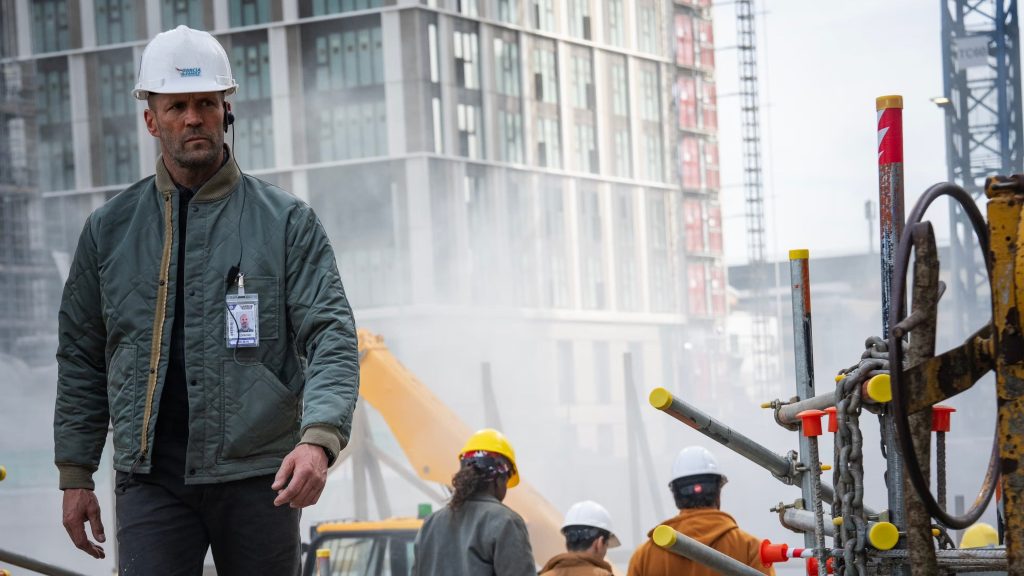
Based on the book ‘Levon’s Trade’ by Chuck Dixon, A Working Man (2025) is directed by David Ayer, who wrote the script alongside Sylvester Stallone. It stars Jason Statham, Maximilian Osinski, Jason Flemyng, Arianna Rivas, David Harbour, Isla Gie, Michael Pena, Cokey Falkow, Merab Ninidze, Emmett J Scanlan, Eve Mauro, Chidi Ajufo, Ricky Champ, Kenneth Collard, and Muki Zubis. The film follows Levon Cade (Statham), a former Green Beret who trades a rifle for a hard hat after his wife passes away. After years on construction sites, Levon has built a healthy life alongside his young daughter (Gie), but everything goes south when human traffickers kidnap his boss’s (Pena) teenage daughter (Rivas). Initially hesitant to readopt his old ways, Levon agrees to help after realizing that even the police can’t be trusted. Now on a violent one-man crusade, Levon teaches the city’s criminal scum that when a working man is asked to do a job, he won’t quit until it’s done.
The ensemble cast gives it their all, but a majority of the characters they’re asked to play are painfully generic. Jason Statham is his typical self, which doesn’t exactly scream blue-collar Chicago construction worker, but it’s a special kind of fun to see him kick ass (for the first half of the film, at least) with the most innocuous of tools. He’s surrounded by easily weaponized equipment such as hammers and shovels, but chooses instead to beat people to death with his hard hat. Suppose you’ve ever worked construction or are close with someone who does. In that case, there’s an almost hilariously cathartic pleasure to seeing a commonly underappreciated member of the workforce transforming into a kind of vigilante superhero.
This kind of self-aware silliness is the film’s biggest strength, so it’s a shame that Ayer doesn’t lean into it. His previous collaboration with Statham, The Beekeeper (2024), embraced the cliché nature of its otherwise stock script, cranking the things we like about the genre up to eleven and lacing the things we don’t with a comically self-aware edge. This is precisely why that film works so well, but Ayer didn’t seem to get the message.
The movie is clearly inspired by other successful action films such as The Equalizer (2014) & Taken (2008), but desperately struggles to establish a unique identity. It plays every cliche story beat with deadpan commitment, which only further highlights its lack of originality. This includes its cast of villains, which is far too large, with each character being indistinguishable from the others in terms of personality.
The action throughout is capably executed, and it’s no surprise that Statham looks like a natural. Unfortunately, all the action is meaningless because Levon is a character who never feels like he’s actually in any danger. He’s basically the blue-collar Terminator, and that’s not much of an exaggeration. Even a character like John Wick never feels this invincible, and that’s not a good thing.
Overall, this is a generic, low-intelligence action-thriller that’s saved by some capable technical filmmaking and an occasional “so bad, it’s good” quality. Some of the dialogue is so crappy, I’m not sure if it’s self-aware or just careless. For example, when Levon is talking with a blind fellow veteran, he ends the conversation with the line, “I couldn’t save your eyes. I’m sorry.” Statham adds so much gravitas that you can’t help but die of laughter. What was he supposed to do, give the guy goggles? There’s also the somewhat lazy subtext, intended or not, of a white foreman saving the lives of his Hispanic coworkers. People say the white savior trope is starting to die, but this film makes me think it’s just becoming harder to detect. Also, it always leaves a bad taste in your mouth when a movie like this shamelessly tries to set up a sequel in its final moments. It’s just arrogant studio greed, through and through. Either way, it’s an ok experience if you like the genre, just don’t expect anything new. C

 The Movie Matt