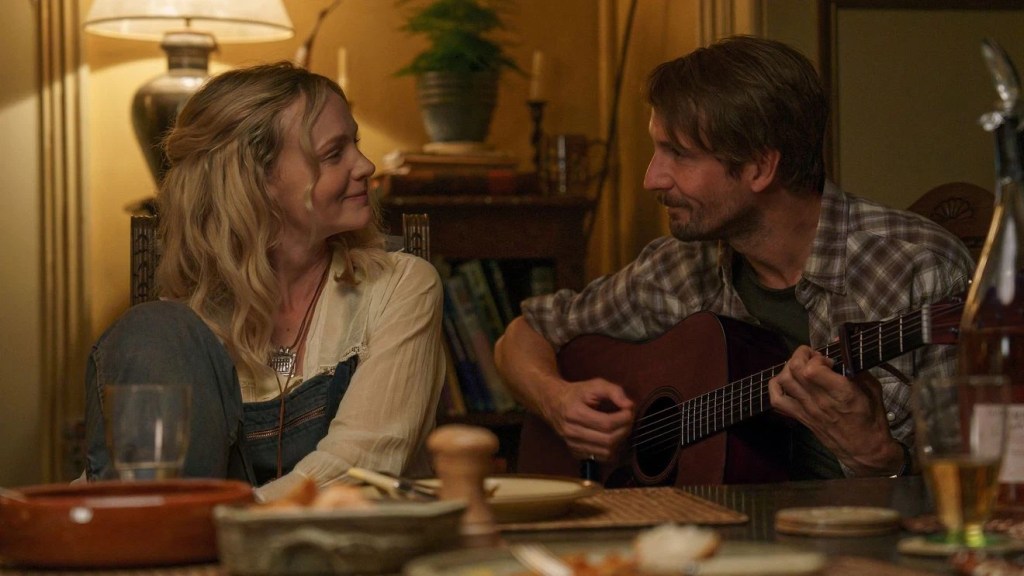
The Ballad of Wallis Island (2025) is directed by James Griffith, featuring a screenplay by Tom Basden and Tim Key. It stars Tom Basden, Tim Key, Carey Mulligan, Sian Clifford, Akemnji Ndifornyen, Steve Marsh, Luka Downie, and Kerrie Thomason. The film follows Herb McGwyer (Basden), a musician best known for the folk duo McGwyer Mortimer, after he’s hired to play a private show at a wealthy superfan’s island estate. Initially creeped out by his new employer, widowed lottery winner Charles Heath (Key), Herb tries desperately to cancel the gig. However, his attitude changes when he learn that Charles also hired his ex-partner/lover, Nell Mortimer (Mulligan). Although her presence quickly improves Herb’s music, he’s also forced to accept the fact that Nell has moved on with her life. As the day of the show approaches, details of Charles’s tragic past are revealed, forcing Herb to realize that moving on can sometimes be the deepest act of love.
Carey Mulligan is excellent in her role, as expected. She’s played this kind of character before, but it’s not much of a negative considering that she isn’t asked to carry the story. She’s a strong addition, but the true stars here are Tim Key and Tom Basden, who also wrote the film.
Basden plays the lovesick, faded musician archetype with ease, but is never so depressed that his presence becomes unpleasant. He nails the character’s emotional beats, as well as the handful of original songs he’s asked to sing. Herb isn’t a groundbreaking character by any means, but he works as an excellent foil to Charles, who’s the more purely entertaining of the two.
Tim Key brings an almost Paddington-like sweetness to Charles, allowing us to forgive his goofy, sometimes even creepy, quirks. No matter how strange his behavior may seem, it’s always made clear that his intentions are pure. He consistently delivers doses of effective, low-key British humor, but the character also works as a subversion of the typical “obsessed fan” archetype. It’s no surprise that artists have historically portrayed their fans as unstable, broken individuals who obsess over them because they have nothing else in their lives. In reality, most ‘superfans’ aren’t necessarily creepy or troubled; they just simply enjoy the art. In this film, Tim’s fandom is endearing, ultimately working as a comment on how artists often treat their fans with disdain despite those same fans being the reason they have any success in the first place. He also serves as an example of how fans can inspire artists in the same way artists inspire them. Whether we admit it or not, praise and love are often the best kinds of artistic fuel.
The performances and general commitment to realism easily carry the viewer through the 100-minute runtime, but it’s not a particularly complex or original film. These kinds of small, human stories pop up a couple of times a year, but I had more fun with this one than I do with most. It’s just a warm, uplifting film, even when it doesn’t land on the happiest of outcomes.
Overall, this is a light, sweet, and wonderfully British film that features some compelling human stories, as well as a couple of nice songs. If this is your kind of thing, you won’t be disappointed, but I’ll urge anyone to check this out simply for the Charles Heath character played by Tim Key. Even though he wins the lottery twice, he is such a good guy that I wouldn’t mind seeing it happen to him a third time. B

 The Movie Matt