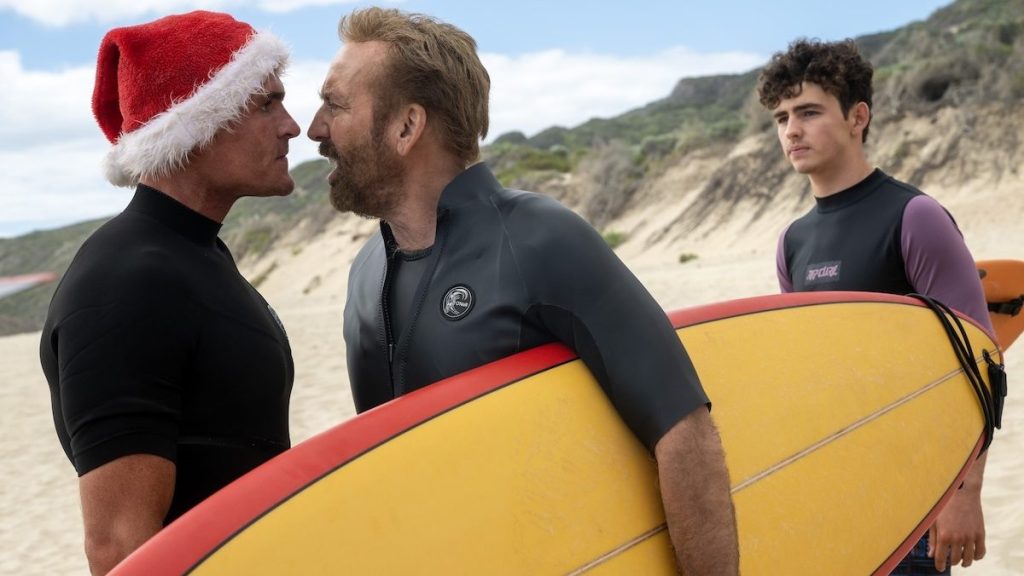
The Surfer (2025) is directed by Lorcan Finnegan and written by Thomas Martin. It stars Nicolas Cage, Julian McMahon, Nicholas Cassim, Finn Little, Justin Rosniak, Miranda Tapsell, Alexander Bertrand, Rahel Romahn, Michael Abercromby, and Rory O’Keeffe. The film follows a middle-aged divorcee (Cage) living in Australia and on the verge of purchasing his beachside childhood home. Finally feeling like he has his life in order, the man takes his teenage son (Little) to surf at a nearby beach. Much to their dismay, a group of local surfers threatens them to stay away. Determined to surf on the same beach he did as a child, the man develops an unhealthy obsession, which only causes the locals to react with mounting hostility. As their rivalry comes to a head, the man is forced to come to terms with the fact that his quest for revenge may signal a need for something far more profound and human: acceptance.
If you haven’t yet been convinced of Cage’s abilities as a dramatic actor, his performance here won’t be enough to change your opinion. That being said, if you consider yourself a fan of Nic “The Cage” Cage in any way, the film is a satisfying vehicle for his unique personality. However, it’s not quite the zany, ‘go further than anyone else ever would’ performance that the marketing promised. Don’t get me wrong, he still gets a handful of opportunities to act like a wild man, but the script forces him to pull back before things go too far. Sure, this deprives the film of any truly memorable “Cage-isms,” but results in a better overall experience.
I’m glad that Cage’s character doesn’t just completely descend into madness by the end—I’ve seen that kind of film before. Still, I do think it spends a little too much time showing him going partially insane, which is honestly a little frustrating. The cause/nature of his descent isn’t satisfyingly explained or even partially alluded to. Once a particular event/reveal occurs to kick off the third act, his madness is whisked away for entirely abstract reasons. Once this happens, it shifts to being a more traditional, grounded film that delivers a more universally satisfying end. This is a slightly jarring tonal shift, but ultimately works to recontextualize the themes of male acceptance.
The overly contemplative tone mixed with the whimsical, chime-based score is goofy at times, but it’s often balanced by the film’s ability to build some decent tension. There’s something compelling about watching Cage’s frustration slowly begin to develop, continuously forced to ask yourself when he might explode. There’s also a decent “nightmare comedy” element throughout the second act. Everything that can go wrong for the character does, his bad luck eventually building to the point where it’s so over-the-top unlucky that you can’t help but laugh.
Overall, this is often a strange fever dream of a film that, fortunately (or maybe unfortunately, depending on your taste), pulls back before things get too wild. Cage is the star of the show, and although it’s far from his most memorable performance, it allows him to show off his wide range of skills. It’s not going to have broad appeal, but I ended up enjoying it. It’s just one of those experiences where you have to ride the wave and see where it takes you. I actually have a feeling this will become a future under-the-radar Cage classic. It’s weird, but it’s unique. B–

 The Movie Matt