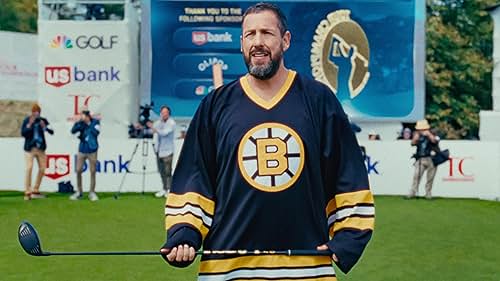
Happy Gilmore 2 (2025) is directed by Kyle Newacheck and features a screenplay from Tim Herlihy & Adam Sandler. It stars Adam Sandler, Christopher McDonald, Benny Safdie, Bad Bunny, Ben Stiller, John Daly, Haley Joel Osment, Lavell Crawford, Julie Bowen, Jackie Sandler, Sadie Sandler, Sunny Sandler, Maxwell Fiedman, Steve Buscemi, Kevin Nealon, Eric Andre, Martin Herlihy, Margaret Qualley, Verne Lundquist, Eminem, Travis Kelce, Robert Smigel, and Jon Lovitz. The film picks up with Happy Gilmore (Sandler), who, years ago, abandoned golf after a devastating tragedy. Now a washed-up alcoholic and father of 6, he’s forced to attempt an improbable comeback when he learns that one of his daughters wishes to attend a prestigious ballet school. He soon discovers that the Tour Championship is being threatened by a new, more extreme version of the sport called Maxi Golf. To earn the money he needs and save the sport he once loved, Happy teams up with new friends (and even a few old enemies) in an attempt to prove that “newer” isn’t always “better.”
Like the majority of Happy Madison comedies, the expectation is that the acting will be passable at best, and that’s no different here. Sandler goes through the motions, treating this film as nothing more than an easy paycheck. It’s clear that he’s saving his talent for his prestige projects, but why? He doesn’t need to give lazy performances just because this is a ‘stupid’ comedy. Even if he was, for some reason, forced to make the film, why not give it his best effort to avoid tarnishing the original’s legacy? He just seems tired, which isn’t ideal for his joke delivery.
Christopher McDonald’s return as Happy’s former rival, Shooter McGavin, is a welcome one. There’s a sense that in the three decades since the first film, McDonald has only fallen deeper in love with the character, seeing it as one of his more iconic roles (which it undoubtedly is). This palpable new affection for the character makes up for any energy lost due to his older age, allowing him to often match and occasionally even exceed his original performance. The problem is that the script doesn’t know what to do with the character during the second half, often relegating him to just another spectator cheering for Happy. This is not only odd when considering how much focus the character receives during the first half, but he’s also a far cry from the Shooter we previously knew. The decision to make him Happy’s ally isn’t an inherently bad one, and his desire to save the traditional version of golf tracks. The issue is, his hero turn happens almost instantaneously. There’s no transition, so although his motivation makes sense, it still feels extremely forced. This would make more sense if the character were to revert to his old ways later on, but that just never happens. One of the funniest aspects of the character was that he often resembled a mustache-twirling, cartoon villain, something that’s all but abandoned this time around.
The return of Ben Stiller’s ‘evil nursing home manager turned evil AA counselor’ character is initially fun, but like Shooter, it quickly becomes clear that the script treats his inclusion more like an obligation than something that naturally fits the story. At the very least, this could’ve worked to explain the character’s behavior in the original, but unfortunately, he’s still the same piece of dirt without being inebriated. Honestly, this is the character who should’ve been a good guy this time around, not Shooter.
The only disappointment from the returning cast, other than Sandler, is easily Julie Bowen as Happy’s wife, Virginia Venit. There’s nothing wrong with her performance, but the choice is made to kill her off less than 5 minutes into the film. This is highly disappointing in its own right, but it’s made even worse considering that she was plastered all over the film’s marketing as Sandler’s main costar. On the surface, this may seem like a fun misdirect by the marketing team, but when considering how beloved the character is for many fans, it mostly just feels like a slap in the face. It also doesn’t help that her death is played off as a cheap rehash of the way Happy’s dad died during the opening of the original film. The difference is, one is a character we have no attachment to, and the other is one we’ve been waiting to return for nearly three decades.
Standouts from the supporting cast are John Daly as a slightly more animated version of himself and Bad Bunny as a clueless Spanish waiter whom Happy recruits to be his caddy. Other than those two, no one stands out, despite the film featuring a multitude of cameos from big-name stars. The actors are mostly able to sell their moments, but a majority of these cameos are from people who don’t and/or can’t act. Sandler seems determined to include every pro golfer, all his favorite musicians, and even his entire family. Very few of these inclusions are funny; they only distract from the legacy characters, who are far more interesting.
Like its predecessor, the humor can often be described as low-hanging fruit, which provides a few cheap belly laughs but ultimately just feels lazy. It retains all of the juvenile silliness that defined early Sandler comedies, but completely loses its X-factor. This is because, even more so than most sequels, it features a gratuitous number of references/callbacks to the first film. There’s nothing original about even one second of the movie, which strips it of any heart it would’ve otherwise had. As if copying the original wasn’t bad enough, it also recycles the same jokes multiple times throughout the film. For example, there’s only so many times the film can ask a person to laugh at raging alcoholism before they just want to check out. Sure, the absurdity is amped up quite a bit here, but not for the better—it’s just silly.
Overall, this is a mostly disappointing sequel to Happy Gilmore (1996), but I think it was always destined to be. Refusing to reference the first film would have been disappointing, but doing so keeps the movie from establishing its own identity. It’s honestly just a hodgepodge of lazy references, crappy acting, and childish toilet humor. That being said, it’s not a particularly awful experience, especially if you adore the original. It’s not quite an insult, but I don’t see myself revisiting it for a future Happy Gilmore double feature. C-

 The Movie Matt