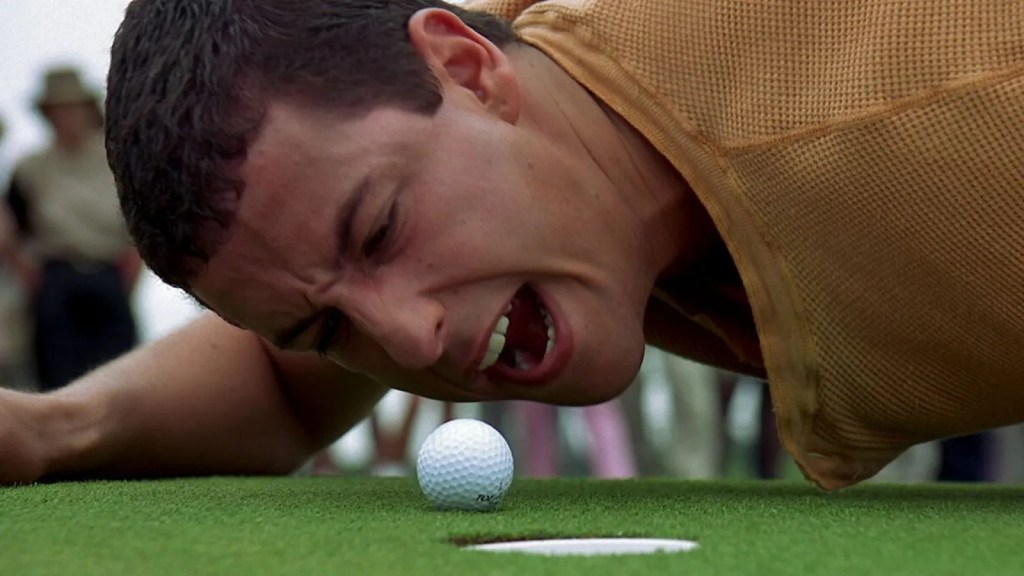
Happy Gilmore (1996) is directed by Dennis Dugan and written by Tim Herlihy & Adam Sandler. It stars Adam Sandler, Julie Bowen, Christopher McDonald, Frances Bay, Carl Weathers, Allen Covert, Bob Barker, Richard Kiel, Joe Flaherty, Ben Stiller, Kevin Nealon, Robert Smigel, Dennis Dugan, Lee Trevino, Verne Lundquist, and Will Sasso. The film follows wannabe hockey player Happy Gilmore (Sandler), who, after finding out his grandmother’s house is being repossessed, sets out to make some quick cash. Happy soon realizes that his powerful slap shot translates perfectly to driving a golf ball, which gets him noticed by former pro golfer, Chubbs Peterson (Weathers), who decides to take him under his wing. After finding quick success despite constant fits of unchecked rage, Happy soon finds himself targeted by golf’s current golden boy, Scooter McGavin (McDonald), who sees him as a disgrace to the game. After Happy sparks a romance with the tour’s heartthrob publicist, Virginia Venit (Bowen), a jealous Shooter challenges Happy to a winner-takes-all round of golf. If Shooter wins, Happy retires; If Happy wins, Shooter pays off the house.
Although the film represents a period in Sandler’s career when his skills as an actor were undeniably weak, it’s also a prime example of when his films were at their funniest. Sandler’s performance rarely feels real and constantly reminds us that Happy is, in fact, not a real person. That being said, pure comedies of this kind don’t rely as heavily on their performances. As long as the jokes land, that’s all that matters. Even when Sandler’s delivery feels awkward, he still displays perfect comedic timing. In certain moments, his unnatural delivery works in favor of the comedy, giving it a zany “wtf” factor that causes you to laugh even harder. It doesn’t make sense, but that’s kind of the beauty of Adam Sandler comedies; the laughs are often caused by such over-the-top scenarios that expecting any sort of logic just feels like an unfair way to approach the material.
Despite Happy being a character who’s in desperate need of anger management, he is balanced by the fact that when he’s not angry, he’s equally gentle and sympathetic. The people he rages at also feel like they mostly deserve Happy’s outbursts. Yeah, He’s cartoonishly angry, but the people around him are cartoonishly mean. Happy is also a pure underdog, which likewise supports his likability. It’s nothing complex or new, but it is tried and true. There’s no quicker shortcut to get the audience to root for a main character than by painting them as an underdog.
Although Sandler’s acting is often weak, I surprisingly found myself bought into his romance with Julie Bowen. At this age, he exudes a certain magnetic, fun-loving boyish charm that, in comparison to characters like Christopher McDonald’s Shooter McGavin, feels like the kind of guy all girls deserve, but never actually pursue. His gentle, almost childlike delivery in these more serious scenes works virtually as well as his delivery in the many comedic ones. That being said, the dialogue during these serious moments still stinks despite Sandler’s strong delivery, so it’s good that they’re few and far between. Unlike most modern “comedies,” Happy Gilmore intelligently prioritizes jokes above all else. This shouldn’t be a rare feat (and didn’t used to be), but unfortunately, it is. You know the state of modern comedies is bleak when a film like this is an all-time masterpiece by comparison.
The supporting cast of characters has become somewhat iconic over the years, the standouts being Richard Kiel (best known for playing Jaws in the 007 franchise) as a monstrously large spectator, Christopher McDonald as the hilariously maniacal Shooter McGavin, and especially the late Bob Barker as a version of himself who isn’t afraid challenge Happy, a man half his age, to a fistfight (which he wins effortlessly). Two days before writing this review, a benefit I attended raffled off a still from the movie framed alongside a signed check from Barker himself. Boy, oh boy, did I desperately want to win it, but higher powers weren’t looking down on me fondly, I suppose. These characters undoubtedly earn their iconic status, and that’s even if I exclude the “You suck, JACKASS!” guy played by Joe Flaherty. His performance is a prime example of unique, committed delivery, elevating what would otherwise be a painfully basic line of dialogue.
The cast is a lot of fun, but there are still a few of these “iconic” characters who don’t work as well as diehard fans of the film will lead you to believe. For example, Chubbs is a character who is a lot of fun when the film focuses on his feud with the one-eyed alligator that bit off his hand decades prior. Unfortunately, this subplot culminates in a bit that sees Happy gift Chubb the gator’s severed head, which causes him so much shock that he falls out a window and dies. The moment simply isn’t funny enough to justify eliminating such a likable character, so everything about it ultimately just feels like a big waste.
This is similar to Ben Stiller’s character, the evil nursing home manager. On one hand, Stiller’s zany turn is as hilarious as expected, but on the other hand, I don’t generally find the idea of nursing home elder abuse to be particularly funny. More specifically, I don’t feel that the joke works on a level beyond “Happy is oblivious. Isn’t that funny?” I’m not saying there isn’t an effective comedic angle in which to approach the subject, but this just isn’t it. Anyone who’s had loved ones in a nursing home knows the unwavering anxiety that comes from constantly worrying about whether they’re happy, comfortable, or (in the absolute worst case scenario) safe. I won’t go as far as saying the writers had mean intentions behind this gag, but there’s no doubt that it doesn’t exactly land as well as the others.
His acting isn’t great, but Sandler effectively utilizes his unique comedic schtick, complete with silly voices. Nearly 30 years after its initial release, it’s starting to become clear just how much Sandler’s early films have influenced the genre. For example, his trademark use of angry outbursts for the sake of comedy is on full display in this film, a style that, to this day, comedians such as Tim Robinson continue to implement and even build upon. This causes the punchlines to have, for me, a nearly 90% success rate. Personal taste will have a lot to do with how an individual feels, but that’s been the nature of comedy from its inception. The only issue I encountered was that Happy’s outbursts happen so often that they eventually become annoying. There are only so many times the same joke can be told before you begin to react with indifference, and eventually, disdain.
Overall, Happy Gilmore earns its reputation as a comedy classic, albeit one that revels in bad taste. The story is as basic as they come, the acting is a mixed bag, and it isn’t even slightly concerned with being intelligent. Despite all this, the film isn’t just funny in a way that makes you grin; it’s often funny in that uncontrollable, instinctual way that’s so pure, it’s almost confusing. It’s an attack on the most crude, animalistic portions of the viewer’s brain, which many people consider low-hanging fruit. My response to that would be, “What’s low-hanging fruit about a film that features more uncontrollable laughter than a majority of comedies released over the last decade and a half?” Sometimes being dumb is the smartest thing a film can do. It’s like dumb humans—some are annoying and some are hilarious. This and movies such as Dumb & Dumber (1994) fall into the hilarious category. It doesn’t all work, but it’s charmingly silly in a way that’s seemingly tough to replicate, and even tougher to explain. B

 The Movie Matt