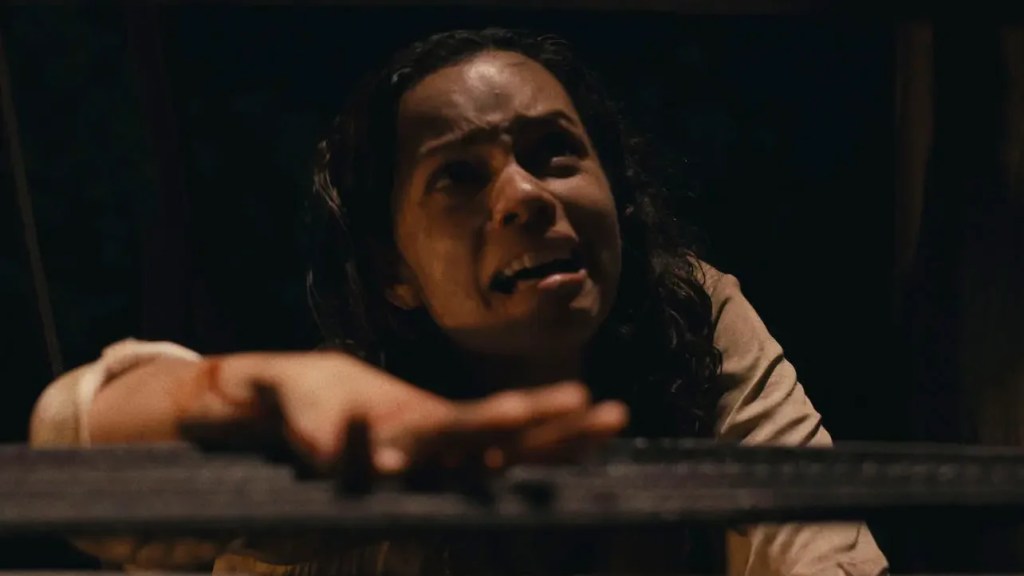
Barbarian (2022) is written & directed by Zach Cregger. It stars Georgina Campbell, Bill Skarsgard, Justin Long, Matthew Patrick Davis, and Richard Brake. The film follows Tess (Campbell), a woman who arrives at her Airbnb during an intense storm, only to find it already occupied by Keith (Skarsgard), a seemingly friendly man who booked the house through a different service. Initially wary of one another, the two eventually hit it off, and everything goes well until they discover a secret basement door leading to a series of mysterious underground tunnels. Exploring the tunnels, they soon realize that they may not be alone.
Meanwhile, the homeowner, a successful actor named AJ (Long), finds his career in a tailspin after a costar accuses him of sexual misconduct. Forced to liquidate his Airbnbs to gather some quick cash, AJ arrives at the house and finds Tess and Keith’s belongings, but not Tess and Keith. Upon discovering the same secret door, AJ initially sees it as an opportunity to add value to the property, but quickly discovers the same dark secrets as Tess and Keith, forcing him into a desperate battle for survival.
The film features a fantastic first screenplay from The Whitest Kids U’Know’s Zach Cregger, but none of it would work if not for the three capable performances from the central cast. Played by Georgina Campbell, Tess is a character who exudes the common hesitations women face when encountering male strangers. Many lesser films would have written this character in a way that would imply she has an overarching distrust of all men. Instead, this script intelligently derives her distrust from the scenario itself, rather than the fact that a male stranger is involved. Being forced to bunk with a stranger would be unsettling for both parties, regardless of the other person’s sex. I understand why a woman would feel most threatened by this particular scenario, but by not fully attaching the premise to gender, it allows for a more universal experience. That being said, the theme of women being forced to distrust men remains prevalent; the script just doesn’t rely on it as a crutch. Tess being female definitely adds to the tension, but it’s not the core element that makes it tense. This allows what would otherwise feel like a stale theme to work in a way that naturally provides an interesting angle on the topic.
The casting of Bill Skarsgard as Keith is genius in the sense that the first half of the script hinges on the audience distrusting him. Although Keith doesn’t do anything particularly creepy, we immediately see him as a threat because his only iconic role up to this point was Pennywise the Clown from the It films. When his motivations (or lack thereof) are confirmed, it is surprising, even though the script doesn’t give us any reason to think he’s anything other than a great guy. We just assume he’s not because our subconscious relates him to evil characters. This won’t work as well for people unfamiliar with the It films, but it still works nonetheless. He’s just a neutral character in that scenario, which still maintains the mystery of his motivations/intentions (or lack thereof).
Although he doesn’t show up until about halfway through, Justin Long easily steals the show as AJ. The character’s friendly, well-kempt demeanor clashes with the fact that he’s most likely a sexual predator. This highlights the theme of evil often being random and undetectable because AJ is a somewhat famous actor. We frequently feel like we know celebrities, but in reality, we only know their carefully curated image. This forces the viewer to consider the idea that, in terms of people we know and people we don’t, the biggest threat is the people we THINK we know. The film forces us to follow this scummy character for a considerable amount of time, but it works for a couple of reasons. First off, although the character is an ass, he’s also consistently funny, but never in a way that asks us to laugh with him, only at him. This allows the jokes to land without endearing us to him. If we liked everything about the guy besides his gross crime, his presence would have felt like the epitome of “a mixed message.” In other words, he’s fun but not very likable. Secondly, the character is often accompanied by Tess, whose intelligence, strong morals, and general likability work to balance AJ’s self-serving attitude. As soon as it’s confirmed that he’s not the story’s ultimate hero, he’s a lot more palatable because it’s clear we’re not supposed to like him. To round things out, the script provides a certain catharsis for the audience by eventually giving the character his comeuppance. Retroactively, it becomes clear that all our negative feelings about the character were manipulated to bolster the effect of his downfall.
The movie’s juicy and original Airbnb premise feels relevant to the current social zeitgeist. Most films with such an intriguing setup often struggle with taking their story in directions that match the strength of their premise, but Barbarian is the rare exception. Cregger dishes out satisfying surprises at a consistent pace, and although they may be too wild for certain audiences, they’re also undeniably original in a way that spiritually excites a movie buff like myself.
In terms of pacing, the movie is near perfect. However, this isn’t just in terms of “what happens,” it’s also well-paced visually. Although primarily set in a dark network of underground tunnels, the script finds innovative ways to relocate its characters, keeping things visually fresh. Like our brains, our eyes require variety to be stimulated.
Unfortunately, horror films face a unique challenge in that fear is often deeply associated with darkness/the unknown. This is because darkness is essentially the lack of stimulating imagery. The fear created through darkness is a form of mental stimulation. The lack of an image only gives the viewer the option to THINK about what could be hiding. Don’t get me wrong, darkness is often a key element in creating fear, but it comes with a price. Too much darkness without reprieve eventually just becomes so dull that the resulting creepy tone doesn’t feel worth it. Barbarian avoids this compromise by not only finding innovative ways and reasons for the characters to leave specific locations, but also by devising equally intelligent reasons for them to return. This allows the film to naturally transition between night & day, inside & outside, and so on.
Additionally, these locations are more specific than usual, which makes them far more memorable. For example, they’re not in any old house; they’re in an Airbnb. They’re not being chased through an abandoned neighborhood; they’re being chased up an abandoned water tower in said neighborhood. They’re not in a basement; they’re in a secret, complex, underground tunnel system.
The script consistently impresses in its avoidance of many of the common “what an idiot” moments that horror fans often experience. The characters are usually complex and even unlikable, but they’re never cartoonishly idiotic. For example, AJ is vain and selfish, but never stupid. Even when he does mess up, it’s easy to understand the reasons why. Even the few times those reasons are unclear, they’re easy to forgive because, in real life, everyone occasionally makes stupid mistakes they can’t quite rationalize. In other words, these characters feel real. If they made all the right choices, that would be as dumb as them making all the wrong ones.
The only issues I have are minor, but they signal to the audience that Cregger is a writer/director with room for improvement. For example, there’s one particular moment in the film’s climax when a character falls off a water tower, which is almost comical due to its use of slow motion. This makes the entire sequence awkwardly stylized in a way that confuses the viewer, leaving an unflattering impression just as the film is about to wrap up. It’s not enough to ruin the film or even the climax exclusively, but it is hard to ignore. The only other moment that stood out as problematic is its painful execution of the horror genre’s “oblivious cops” trope. They tell Tess to leave them alone because they’re sure she’s a junkie due to her dirty clothes, which is honestly absurd. So you’re telling me that these cops are observant enough to see her dirty clothes but not observant enough to realize she’s well-spoken, clearly sober, and in honest emotional distress? I guess I understand them thinking she’s a junkie, I suppose, but it doesn’t make a lick of sense that they wouldn’t at least do a surface-level follow-up to confirm their theory. I mean, shit, they don’t even get out of their car.
Overall, this is an entertaining, original, and timely addition to the horror canon from writer-director Zach Cregger, which is all the more impressive considering it is his first feature-length directorial effort. He still occasionally shows signs of a rookie artist experimenting with what works and what doesn’t, which leads to one or two awkwardly executed moments. Still, he mostly proves himself to be not just one of the more exciting filmmakers in horror, but one of the more exciting filmmakers in any genre. It’s a wild experience from beginning to end, dishing out surprises left and right, and not letting up until the credits roll. Getting into too much detail will only ruin the experience, so I’ll simply say that if you like the genre, you should give this movie at least a chance. I have a feeling you’ll have a crazy, grand ole time. Boy, am I hyped up for Weapons (2025). B+

 The Movie Matt