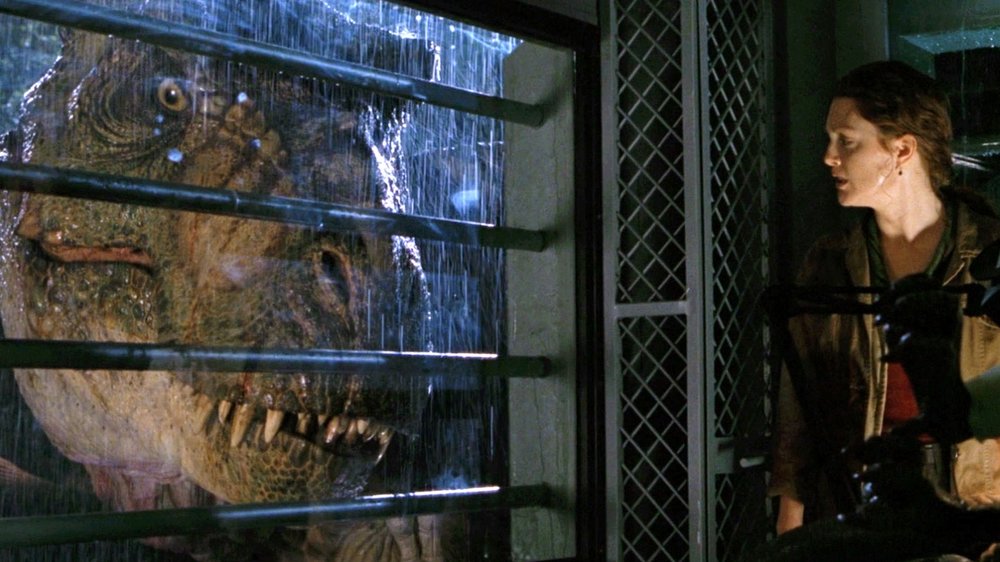
The Lost World: Jurassic Park (1997) is directed by Steven Spielberg and written by David Koepp. It stars Jeff Goldblum, Julianne Moore, Vanessa Chester, Pete Postlethwaite, Vince Vaughn, Arliss Howard, Peter Stormare, Richard Schiff, Harvey Jason, Thomas F. Duffy, and Richard Attenborough. Based on the novel by Michael Crichton, the story follows a more experienced and mature Dr. Ian Malcom (Goldblum) after John Hammond (Attenborough) approaches with an offer to lead a small team on a mission to research wild dinosaurs on Isla Sonar, Jurassic Park’s original breeding site. Furious that John kept the site a secret, Malcolm reluctantly accepts the mission when he learns that his estranged girlfriend, Sarah (Moore), is already on the island. Upon arriving, Ian and his small group of allies are forced to contend with the bioengineering company InGen, and its enigmatic leader, Peter Ludlow (Howard). With the help of a large militia led by an ex-big game hunter (Poslethwaite), Ludlow attempts to capture the dinosaurs for use in his new San Diego-based theme park/zoo. This unsurprisingly angers the native predators, proving they may have bitten off a lot more than they could chew. In a desperate fight for survival, the survivors desperately search for a way to escape the island before they all become “lizard lunch.”
The decision to bring back Jeff Goldblum as the lead this time around always confused me when I was growing up. The Alan Grant character would have been able to serve the same purpose as well as maintain a certain continuity in terms of whose story this franchise is trying to tell (other than the dinosaurs’). That being said, I’ve come to realize over the years that Jeff Goldblum’s portrayal of Malcolm is easily the most inspired performance in the original film. He’s easily the most unique and entertaining character, and although we care more about Grant due to his given focus, Malcolm is far more interesting. Don’t get me wrong, I adore Alan Grant, but his characterization isn’t particularly new. The Lost World’s story wisely decides not to rehash or abandon but rather challenge the reckless, playboy-esque behavior that makes his first appearance so much fun. The events that took place at Jurassic Park seem to have fundamentally changed how he views the world, resulting in a comparatively mature character who is much more suitable as a lead. He’s a changed man forced to confront his past mistakes, including his strained relationship with his daughter, Kelly (Chester). It’s slightly disappointing that the character isn’t as fun as he was in the first movie, but the script provides a level of depth that allows him to transcend his origins as comedic relief. Besides, Goldblum’s trademark quirks and ticks provide enough silliness on their own. Not to mention, the film is also generally much campier than its predecessor, so I have a feeling the original, goofier version of Malcolm would have felt overwhelming in this context.
The supporting characters, although flawed in various ways, are ultimately a lot of fun. Actors such as Peter Stormare, Richard Schiff, and Vince Vaughn succeed in providing their surface-level characters with the necessary personality, keeping them from feeling truly forgettable. Julianne Moore is a strong, fitting addition to the franchise, but her character unfortunately feels like a shameless clone of Ellie Sattler, as played by Laura Dern. This decision to occasionally emulate characters from the original film is slightly confusing, but it does work well with Roland Tembo, played by Pete Postlethwaite. The character bears a striking resemblance to the game warden from the first film, Muldoon, played by Bob Peck. This works because the script frames Roland as a foil for Muldoon rather than a carbon copy. Muldoon, although convinced that the dinosaurs should never have been brought back, fails to make Hammond see the error of his ways (it’s unclear if he even tries). This made Muldoon unquestionably complicit in the eventual tragedy, which leads to/explains/justifies his death. Muldoon had a lot of potential as an avenue to explore some more profound questions related to the morals surrounding human technology and its relationship with nature. At the same time, the character is forced to contend with the idea that his pursuit of dangerous thrills isn’t worth the lives it ultimately costs — a clear parallel to John Hammond’s arc, but from a more human, and thus relatable, “cog in the machine” perspective.
For the most part, the film’s tone is consistent with that of its predecessor. This is primarily due to Spielberg’s capably shot visuals and John Williams’ inventive spin on the franchise’s iconic score, but it also maintains the familial themes of its predecessor. In addition to fresh themes such as environmental conservation, the script implements almost everything that worked about the previous installment, for better or worse. Other than its clear inspiration from iconic movie monsters such as Godzilla and King Kong, the film struggles to offer much beyond more dinosaur mayhem. That being said, the dinosaur mayhem is satisfying and intense but also accounts for a large portion of the runtime. It’s disappointing that Spielberg doesn’t use this sequel as an opportunity to introduce any new species of dinosaur; he just sticks to the T-Rex and Raptor combo. Granted, I don’t know if a good Jurassic Park film could exist without those two, but it’s not an excuse to highlight only two species in what’s supposed to be the quintessential dinosaur franchise.
Overall, this is a fun, capably directed monster movie that delivers on its promise of dino mayhem, but is hindered by a script that’s much more campy and on-the-nose than its predecessor. Characters constantly act in hilariously stupid ways that ultimately undermine the film’s much-needed horror elements. Whether it’s a wildlife expert who’s so scared of snakes that he’d rather be eaten alive by a T-Rex or a 90 pound pre-teen using her gymnastics skills to kick a full grown raptor out a window, the film is larger than life in ways that are guaranteed to frustrate a large portion of the audience. However, suppose you’re like me and don’t worry much about rock-solid logic when it relates to genetically engineered dinosaur films. In that case, I have no doubt that suspending your disbelief should be an easy task. Unfortunately, the film’s biggest issue is that even its best moments seem to have been pulled out of a recycling bin. In conjunction with the script’s ham-fisted themes of environmentalism, this results in a sequel that’s predictably lesser than the original in nearly every way. That being said, being coined a step down from a masterpiece isn’t the insult that it initially seems. It’s not fresh, and it’s not particularly smart, but it’s undeniably fun if you’re into this kind of big-budget blockbuster junk food. B-

 The Movie Matt