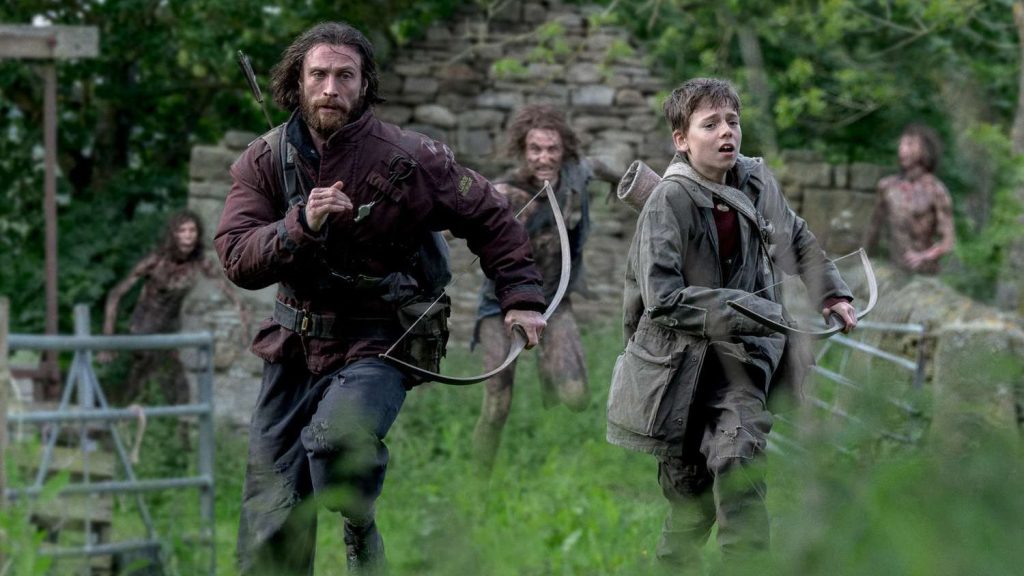
28 Years Later (2025) is directed by Danny Boyle and written by Alex Garland. It stars Alfie Williams, Aaron Taylor-Johnson, Jodie Comer, Ralph Fiennes, Edvin Ryding, Christopher Fulford, Amy Cameron, Stella Gonet, Geoffrey Austin Newland, Chi Lewis-Parry, Joe Blakemore, and Jack O’Connell. 28 years after the RAGE virus decimated a majority of the UK, Jamie (Taylor-Johnson) decides its time for his twelve-year-old son, Spike (Williams), to leave their isolated island community and accompany him on a journey to the mainland in search of resources. After learning about a reclusive doctor (Fiennes) who lives there, Spike sees it as an opportunity to save his sick mother (Comer). Against his father’s wishes, Spike secretly takes his mother on a journey to find the doctor before it’s too late. Soon faced with the unimaginable dangers of the mainland, Spike is forced to use the survival skills taught to him by his father in order to reach their destination in one piece.
The cast here is unsurprisingly top notch, but the standouts are easily Alfie Williams and Ralph Fiennes. It’s rare to see an actor this young provide such a well-rounded performance, but it’s also equally rare to see a young character written this well. The unique context of his upbringing allows the script to avoid annoying teen tropes, because Spike isn’t a normal teen. Ralph Fiennes provides a uniquely compelling presence as the reclusive and odd Dr. Ian Kelson. For protection against the virus, he covers his body in iodine, which gives him an unsettling look. He immediately catches the viewers attention visually, but remains interesting due to his ruminations about the nature of death. It’s odd, because although his motivations and background are left extremely vague, he’s still a wholly satisfying character, and I think that’s due to the fact that what he does provide is integral to the film’s success. Besides one or two, a majority of the characters don’t receive full/finished arcs, but it’s easy to ignore considering that this was, from its inception, announced to be a trilogy. The script leaves a proper number of loose ends that can be explored in the sequel while still providing enough closure that the film remains satisfying as a standalone experience.
Like 28 Days Later, Boyle and Garland succeed in not only creating a film unique to the 28 Days franchise, but one that’s unique for the genre as a whole. Granted, the central plot of trekking across a dangerous area to find some kind of cure or solace is overplayed, but Boyle constantly takes it in unexpected directions. Some may be disappointed to find that the film often trades zombie action (especially in the third act) for slower, more methodical explorations of its various themes. That being said, it still has enough zombie-related sequences to satisfy most people. Whether it’s the zombies, the humans, or nature of its violence, Boyle, against all odds, consistently finds ways to top the intensity of previous entries. He seems keenly aware of what the audience is thinking, allowing him to control their expectations, which he then subverts. He proves that the intensity he brought to 28 Days Later (2002) wasn’t just a fluke; he actually has more to offer.
My only real issue with the film is that it ends in a place that sees the introduction of a new group of characters who feel tonally inappropriate for the franchise. Granted, this is something that could easily be explained in the sequel, but I struggle to understand why Boyle would leave us on such a jarring note. It’s disappointing that it doesn’t stick its landing, but it’s also something that’s easy to ignore or forgive.
Overall, this is not only a fantastic 28 Days sequel, but also one of the more original zombie films in recent years. It’s a strong starting point for this planned trilogy, and features ideas that are compelling despite the fact that its script only scratches the surface. I’m extremely excited to see how these themes/ideas develop in future installments. This is a movie that’s strange, occasionally abstract, but balanced in a way that creates satisfying cohesion. Besides one or two cliche elements related to the setup, the film works as a wholly original experience that completely justifies the franchise’s revitalization. If the sequels are as strong as this, we might be graced with the best horror trilogy of the modern era. B+

 The Movie Matt