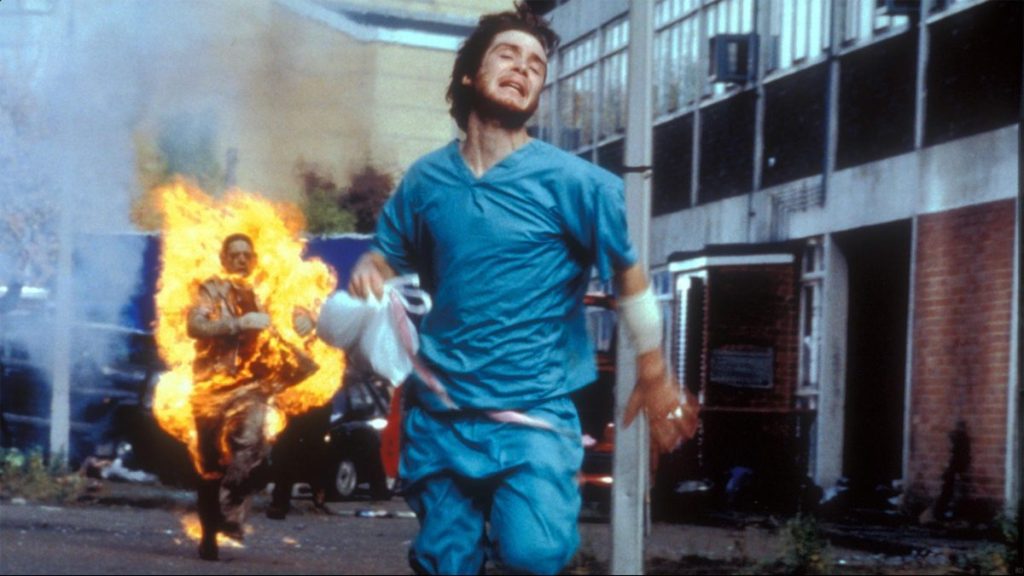
28 Days Later, directed by Danny Boyle, stars Cillian Murphy, Naomie Harris, Brendan Gleeson, Megan Burns, and Christopher Eccleston. With the announcement of the reteaming of director Danny Boyle and writer Alex Garland (Ex Machina, Annihilation, Men) for an eventual 28 Years Later, I felt it appropriate to revisit the original film. With the upcoming release of Alex Garland’s Civil War (2024) next month, that just gives me more of a reason. The film takes place four weeks after a devastating virus known as “RAGE” devastates London. Soon after, a man named Jim (Murphy) wakes up in a hospital with not a soul in sight. After exploring the abandoned city, he is soon attacked by groups of “zombies” (although not referred to as such) but is saved at the last minute by a survivor named Selena (Harris). Recognizing that two are better than one in terms of survival, they team up to find sanctuary. Eventually joined by Frank (Gleeson) and his daughter, Hannah (Burns), the group sets out to find a military compound that promises safety and shelter. Along the way, the group discovers that the infected may not be their only threat.
I’ve watched this film multiple times in my life and each time, I discover something new to appreciate. One of the things that stood out to me on this particular viewing were the fantastic lead performances. I honestly expected there to be a gap in quality between the performances early in Murphy’s career and his eventual Oscar-winning work in Oppenheimer (2023). What I realized is that Cillian Murphy has always been equally talented throughout his career. I don’t see any clear gap in the quality of this performance and the quality of his performance in Oppenheimer. Granted, they’re such different roles that they’re hard to compare, but what is clear is that Murphy’s impressive emotional range has existed from the very start. The character doesn’t receive almost any backstory, but that seems to be an intentional choice by director Danny Boyle (one of my personal favorites). The movie is focused on who these characters have become after the outbreak. Who they were before is treated as irrelevant.
Whenever I see Naomie Harris in this film, it reminds me how talented of an actress she truly is. There’s just a certain spunk and strength to her personality that keeps the character likable even when she would otherwise come across as cold. Likewise, she’s able to convey a certain level of subtle vulnerability that shines through even when the character is actively trying to hold back their emotions. This helps the eventual romance between the two leads feel earned. Trust is hard to come by in the real world, let alone a world ravaged by “zombies.”
The last performance I want to point out is Brendan Gleeson as Frank. I find myself loving Gleeson much more as an actor when he takes on characters that are likable and moral. He holds a certain teddy bear element that just makes a person want to smile. He keeps the mood light within the group, loves his daughter to the moon and back, and delivers some of the film’s best comedic relief. He’s just a character you desperately want to survive, even when he’s clearly shrouded in the spectre of death.
The film features a grainy, low-quality look that is initially jarring, but gives the film a documentary, almost PBS-style feeling. This, combined with the use of uncomfortably skewed camera angles puts the audience on the edge of their seats simply due to the its visual identity. To me, this still feels like the most realistic example of a “zombie” apocalypse film. For example, it begins with infected monkeys being released from a lab by animal activists. After the COVID-19 pandemic, this film almost comes off as prophetic. Also, this is the first “zombie” film to feature mostly sprinting zombies. Running zombies have existed in the past, but the majority of the pack walks slowly. To feature zombies that exclusively sprint only adds to the film’s tension/danger. It’s a simple creative choice that you would think the genre had implemented a long time ago. This is all supported by the film’s kinetic editing. I could see this giving certain audiences a headache, but for me, it was balanced enough to support the film’s tone instead of distracting from it.
This film truly is a groundbreaking and influential piece of the genre. Hearing the score reminded me how similar it is to the score from The Last of Us video game/HBO series. People adore that score, but it couldn’t be more clear where that influence originated. 28 Days Later also feels like it inspires The Last of Us in terms of its bleak tone and its exploration of what truly makes survival worth it. The idea of holding onto one’s humanity in the face of total devastation is a strong emotional core. Even the beginning with Jim waking up in the hospital is similar to the beginning of The Walking Dead (2010-2022). The comic book series that the show is based on was released in 2003, a year after the release of 28 Days Later. This film is the origin of countless zombie apocalypse tropes that were often featured throughout the 2000s. I could see someone watching this and feeling like it’s a bit derivative, but they probably don’t understand that this was the first to feature these tropes that they falsely recognize as unoriginal.
The film features a unique London setting and a lot of well-written post-apocalyptic dialogue that still holds up to this day. The main characters are likable across the board and the smaller characters are fleshed out efficiently in the second half. It works as a typical zombie movie experience but also on a scene-to-scene level. For example, even the scenes that don’t have anything to do with the group’s life-or-death situation have some kind of entertaining hook. The film is smart to occasionally focus on some of the slightly enjoyable aspects of being the few people in a large, abandoned city.
Overall, this film is a modern “zombie” classic that is both strikingly original and purely entertaining. The cast is great and the direction is strong. I don’t feel like a moment is wasted nor do I feel like any key moments are missing. The only slight criticism I have would be the film’s sometimes blurry look. Though, as mentioned before, it achieves more for the film than it takes away. If one desires an affective, original, and streamlined “zombie film,” you can’t do much better than 28 Days Later. A-

 The Movie Matt