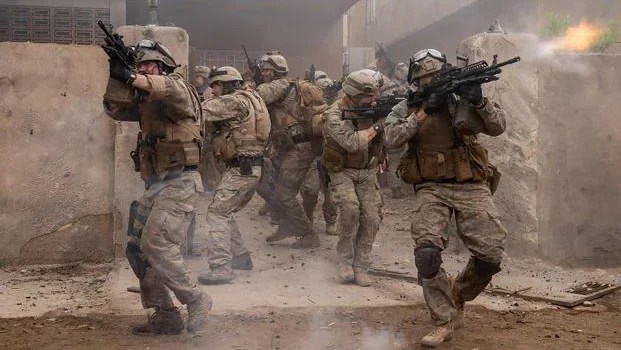
Warfare (2025) is written and directed by Ray Mendoza & Alex Garland. It stars D’Pharaoh Woon-A-Tai, Will Poulter, Cosmo Jarvis, Joseph Quinn, Michael Gandolfini, Henrique Zaga, Charles Melton, Noah Centineo, Aaron Mackenzie, Alex Brockdorff, Finn Bennett, Kit Connor, Evan Holtzman, Joe Macaulay, Laurie Duncan, Jake Lampert, Aaron Deakins, Taylor John Smith, Adain Bradley, and Tom Dunne. The film is a recollection of director and former Navy SEAL Ray Mendoza’s experiences during the war in Iraq. Specifically, it follows a young Ray (Woon-A-Tai) and the rest of his platoon as they are trapped in a small home after it is besieged by insurgent forces. As their situation devolves and many of the men see the true horrors of modern war for the first time, they soon realize that the only people they can rely on are each other.
The cast reportedly received extensive training from real Navy SEALs, and it mostly shows on screen. I have no real military experience, so there might be a few inaccuracies in their behaviors, but people like me won’t notice them. These characters aren’t particularly deep or memorable, but they’re well-acted and likable. This is also very clearly a film intended to portray this platoon as a cohesive unit rather than a team of warring personalities. Instead of explaining who these people are as individuals, the script spends its time establishing the intense, often unspoken bonds between them. Objectively, these characters are the film’s weakest element, but that doesn’t mean they don’t work. It’s a simple, specific story focusing on warfare, which suits such simple characters because it allows the audience to consider how these experiences generally affect all soldiers, rather than these soldiers specifically. Brotherhood isn’t a particularly new theme for war films, but Warfare explores it in a way that is realistic, subtle, and efficient.
This is the kind of meat-and-potatoes war movie we’ve seen countless times before, but crafted with an uncommon level of care. Pairing a genuine Navy Seal (Mendoza) with a respected, more artistically inclined director (Garland) proves to be an ingenious choice. Mendoza provides irresistible realism, while Garland brings the proper cinematic visual flair.
The film often shows instead of tells, which, in combination with the lack of score, allows the audience to revel in the tension of approaching combat.
The battle/war sequences are again nothing new, but feel consistently authentic. They don’t come close to achieving the intensity of a film like Black Hawk Down (2001), or even the pure entertainment factor of something like The Hurt Locker (2008), but they’re noticeably more immersive. Even the themes explored, one of which could’ve felt a tad dogmatic, are implemented naturally. For example, the climax uses its one-sided perspective to provide an ending that’s not necessarily surprising or new, but effectively reframes events without undermining them.
Overall, this is an impressively made yet slightly unoriginal war film that succeeds in being realistic without sacrificing its artistic edge. It’s a movie meant to immerse and thrill you, but it lacks any real surprises. Thankfully, it immerses the viewer so well that it’s easy to overlook the fact that it all feels a little familiar. This movie proves that genres based on real experiences, such as this one, should hire two directors – one who can provide the authentic experiences and one who can bring some artistic flair. B

 The Movie Matt