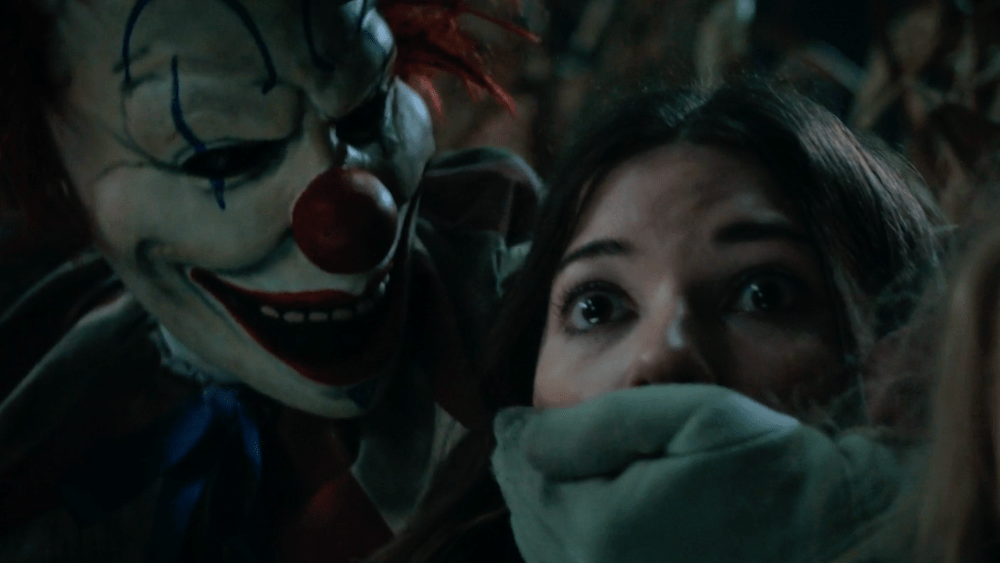
Based on the novel by Adam Cesare, Clown in a Cornfield (2025) is directed by Eli Craig, who penned the script alongside Carter Blanchard. It stars Katie Douglas, Aaron Abrams, Carson MacCormac, Vincent Muller, Will Sasso, Cassandra Potenza, Verity Marks, Kevin Durand, Ayo Solanke, Alexandre Martin Deakin, Catherine Wreford, Daina Leitold, Jean-Jacques Javier, and Bradley Sawatzky. The story follows Quinn (Douglas), a lonely teenager, and her dad, Glenn, after they move to the small midwestern town of Kettle Springs. Quinn soon befriends a local group of supposed troublemakers led by the mayor’s son, Cole (MacCormac). After filming a handful of horror short films revolving around Friendo the Clown, a local town mascot, Quinn and her newfound friends are soon pursued by someone who’s dressed as Friendo and intends to kill for real. Pursued through a remote cornfield, the group attempts not only to survive, but also to discover who’s behind such seemingly random bloodshed.
The acting here is nothing particularly special, but there isn’t a single bad performance. Everyone is pretty much just serviceable. The script, especially in the first half, incorporates numerous familiar teen and slasher movie tropes. This makes the first half incredibly dull, and although it uses this time to achieve some necessary characterization, it ultimately just feels like it’s going through the motions. Even Friendo is forgettable during the first half, feeling like the most generic version of an evil clown. Some may disagree, but I find killer clowns to be more overplayed than zombies currently.
Thankfully, the film utilizes its clichéd first half to set the audience up for the second half, which consistently subverts our previously established expectations. For example, there’s one particular reveal that’s admittedly simple, but surprisingly does a significant amount to give the story a unique flavor. It explores interesting themes related to the dangers of blind tradition and the timeless generational struggle between those who wish to maintain what they’ve built and those who want to change things in their image.
The second half also provides some of the more effective dark humor in recent memory. For example, there is one particular sequence that’s clearly inspired by one of the darkest comedic moments in Tropic Thunder (2008). I’m surprised that such a wildly silly scene works in a more grounded film such as this, which is partly due to the film’s strong comedic timing and willingness to push the boundaries in terms of just how dark the humor is willing to go. The jokes also do a great job of playing into the idea that these aren’t just teenagers, but specifically teenagers from the current era. For example, there’s a hilarious scene where the survivors are unable to call for help after discovering that the only accessible phone has a rotary dial. I imagine that current teenagers feel similarly about those as I do about fax machines: it probably wouldn’t be tough to learn, but there’s never been a reason to.
On the technical side, I was impressed with the lighting. The film utilizes numerous natural sources of light, which support visibility without making everything appear unrealistically bright. Darkness is usually an easy source of natural tension, but it’s also something that’s inherently in conflict with the idea that film is first and foremost a visual medium. That being said, losing sight is also a core, primal human fear, which makes it necessary in specific doses. Instead of using darkness to hinder our vision and create tension, the film cleverly utilizes its titular cornfield to achieve the same effect. It works so well that I’m honestly a little surprised it’s not a more common setting in horror movies. If I had to guess, this is most likely because it’s a setting that lacks variety, so it’s a pleasant surprise that the film doesn’t linger there for longer than necessary. Even when not in the cornfield, the characters stick closely to related settings, such as farmhouses, barns, and abandoned dirt roads. Even though they’re not in the cornfield, it feels close enough.
Overall, this is a pretty standard slasher movie elevated only by the script’s effective second-half subversions and surprises. The on-the-nose title perfectly represents what audiences should expect. It’s nothing more than a movie about a killer clown in a cornfield, but it completely works if that’s the only standard the viewer holds it to. If you expect something truly innovative or memorable, you’ll be fine skipping this one. If you’re a fan of the genre or clowns in general, it won’t blow your mind, but it has a lot more to appreciate than criticize. Knowing that this is only the first entry in a series, I’ll note that it does just enough to pique my interest in a sequel. B-

 The Movie Matt