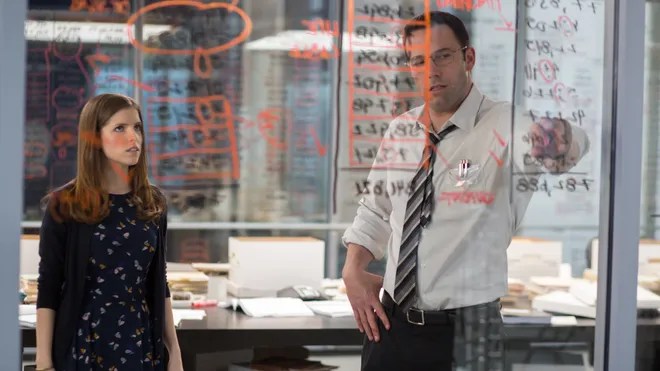
The Accountant (2016) is directed by Gavin O’Connor and written by Bill Dubuque. It stars Ben Affleck, Anna Kendrick, J.K. Simmons, John Lithgow, Cynthia Addai-Robinson, Jean Smart, Jeffrey Tambor, Andy Umberger, Alison Wright, and Robert C. Treveiler. The story follows Christian Wolff (Affleck), an accountant with high-functioning autism who assists his wealthy, high-profile clients in concealing their illicit financial activities. When he’s hired to audit a well-known robotics company, he develops a connection to Dana (Kendrick), a low-level accounting clerk who discovered millions in missing funds. Soon after, people close to the case begin to show up dead, which urges Christian to protect Dana by hunting down those responsible. Embarking on a violent crusade, he quickly becomes the target of not only countless violent thugs but also a veteran FBI agent (Simmons) and his newly recruited protégé (Addai-Robinson). To make matters worse, Christian continuously struggles with his traumatic past, one primed to return in unexpected ways.
The ensemble here is strong, with Affleck delivering a surprisingly skilled performance. Christian, who succeeds as a truly fresh action hero, is one of the film’s strongest aspects. The script appears to be very understanding and supportive of people with autism, but it also finds humor in the character’s awkward interactions and misunderstandings with the neurotypical majority. Kendrick’s character is fun and works as a strong foil to Christian. The problem is that, although the script effectively establishes the characters’ connection, I don’t feel that the two actors have any romantic chemistry.
Supporting characters with recognizable archetypes receive an unexpected level of depth, which is one reason audiences responded to the film so positively. These characters are easy to care about, which helps carry the viewer through some of the film’s more cliche, silly, almost comic-booky flourishes.
The film is well-paced, and I found myself genuinely enjoying its elements of crime-thriller intrigue. It also does a great job of balancing its goofy humor and unforgiving violence. It does this by avoiding entanglement with larger questions related to Christian’s morals. The more you think about the character, the more it becomes clear that he’s not the hero the film presents him as. I also found the choice to implement the classic “Solomon Grundy” nursery rhyme to be strange when considering its use in Batman lore, a superhero that Affleck was portraying at the time of this film’s release. It’s not an inherently bad choice, but it’s distracting for anyone familiar with the Batman character.
Overall, this is a mostly familiar but competently made crime thriller that distinguishes itself through its unique protagonist. The action is hard-hitting, and the humor mostly works. What doesn’t work, however, are the strange superhero-adjacent directions in which they take the characters and story. I understand the desire to portray the autistic community as capable of achieving anything a neurotypical person can, but it’s done in a way that undermines the film’s otherwise grounded, crime-thriller approach. Other than that, its theme of craving acceptance is basic, but effective. It doesn’t excite me as much as most people, but I definitely wouldn’t mind seeing a sequel. B

 The Movie Matt