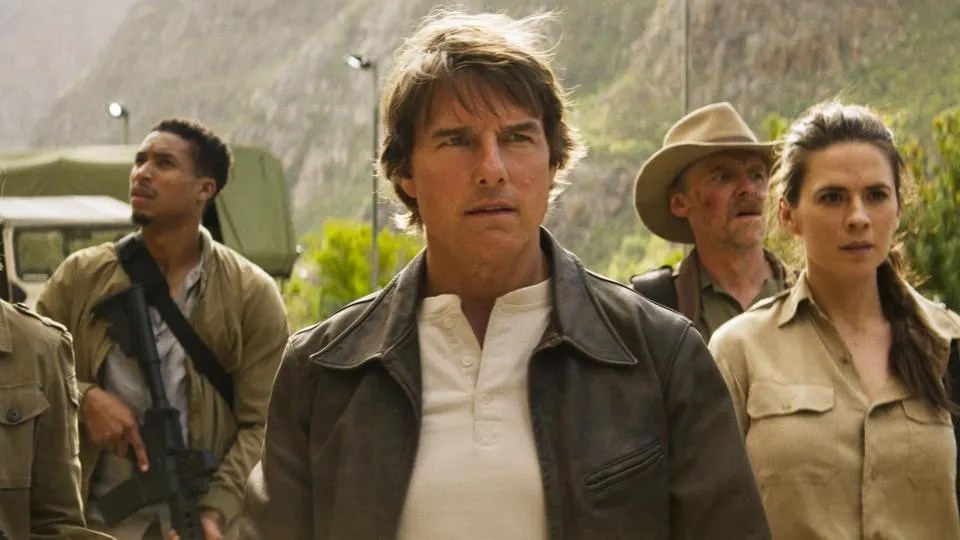
Mission: Impossible – The Final Reckoning (2025) is directed by Christopher McQuarrie, who wrote the script alongside Erik Jendersen. It stars Tom Cruise, Hayley Atwell, Ving Rhames, Simon Pegg, Esai Morales, Henry Czerny, Angela Bassett, Pom Klementieff, Shea Whigham, Greg Tarzan Davis, Janet McTeer, Nick Offerman, Katy O’Brian, Hannah Waddingham, Holt McCallany, Tramell Tillman, Charles Parnell, Mark Gatiss, and Rolf Saxon. The film takes place two months after the events of Mission: Impossible – Dead Reckoning (2023), following Ethan and his team as they continue to fight The Entity and its human pawn, Gabriel (Morales). On the verge of accessing The Entity’s mainframe, Ethan finds himself at the center of a cold war-like scenario involving various world governments that seek to control the AI’s immense power. This forces Ethan to go rogue one last time in an attempt to stop The Entity, destroy it, and save his friends in the process.
The performances from the returning cast members are consistent with what they brought to the previous film, which means there’s nothing to complain about. Last appearing in Mission: Impossible – Fallout (2018), Angela Bassett makes a welcome return as former CIA director, Erika Sloane, who’s a much more interesting character this time around. As the U.S. president, her “Big Boss” attitude is used in fun and exciting ways that work to breathe life into the otherwise lifeless exposition dumps. Unfortunately, many of the other characters featured are likable but severely underdeveloped.
Esai Morales’ Gabriel, who in Dead Reckoning worked as a chilling and worthy adversary, receives a confusing lack of screen time. This would be fine if the script took advantage of his few appearances, but instead, they only serve to undermine his villainous capabilities. Even the character’s eventual defeat is strangely treated as a comedic punchline. This would have worked if it had occurred earlier in the film, but instead, it bookends the climax. In a vacuum, I enjoy the moment. As a way to end one of the best action franchises of all time, it kind of feels like a middle finger.
The script makes the strange choice to not only introduce a handful of new characters but also provide them with a disproportional amount of focus. Nick Offerman, Katy O’Brain, Hannah Waddingham, Tramell Tillman, and Janet McTeer give strong performances, but in the context of what’s supposedly the franchise finale, their addition only serves to draw focus away from the infinitely more critical legacy characters. In addition to adding too many new characters, the film reintroduces an otherwise forgotten character from Mission: Impossible (1996) and assigns him an unexpectedly substantial role. The thing is, this character wasn’t someone the audience even slightly cares about. Once again, this just serves to strip focus away from the main characters. Even a film like Rogue Nation, which felt like an appropriate time to introduce new characters, didn’t overdo it. Unless the writers didn’t intend this to be the final film, I have no idea what they were thinking.
The script makes multiple attempts to connect its story to the original film, but they’re very hit-and-miss. For example, the previously mentioned return of a particular legacy character feels random, wasteful, and unnecessary. On the other hand, the script utilizes the events of the first movie to provide Shea Whigham’s character with a satisfying origin, which helps create the feeling that the story has come full circle. Most viewers born after 1980 probably won’t notice that the character also acts as an apology to fans of the original Mission: Impossible (1966-1973) television series, many of whom were furious that Brian De Palma rewrote the show’s protagonist to be the first movie’s villain.
Even though the film surpasses everything else in the franchise in terms of physical scale, the action set pieces feel familiar and generally struggle to raise the stakes. The underwater sequence is reminiscent of the one in Rogue Nation, and the aerial sequence feels similar to the climax of Fallout. That being said, they ultimately work because they’re taken at least two steps further than the sequences they’re riffing on. Let’s put it this way, I’d be happy to eat the same meal every night if it tasted better each time. The problem is that although these sequences are some of the most exciting this franchise has to offer, the stakes feel underwhelming, especially for what’s supposedly the finale. Dead Reckoning began to show signs of this struggle, but eventually utilized key character deaths to push the stakes further than ever before. Besides killing off more characters, which only maintains the stakes, events mostly feel like “business as usual,” as opposed to “the mission to end all missions.”
The film is also needlessly long. It’s as if the producers said, “It’s the final installment. It has to be the longest. A long film is an epic one; everyone knows that.” The script is very exposition-heavy, which is one of the reasons for the bloated runtime, but I always found these scenes of dialogue to be weighty and compelling. This hurts the overall pacing, but builds some of the series’ best tension in the lead-up to its action sequences.
Overall, The Final Reckoning is a perfectly serviceable Mission: Impossible film, but ultimately a slightly disappointing finale to a beloved franchise that has existed for almost three decades. I hate to say it, but Fallout would’ve been a much more satisfying conclusion. Even Dead Reckoning, which I think is a step down from Fallout, blows this finale away. The script isn’t even brave enough to give us a definitive conclusion to Ethan Hunt’s story, and instead provides an ending I’m relatively certain the series has used at least four times. It’s a shoddy production in many ways, but similar to most of these movies, it’s an undeniably impressive piece of large-scale, practical effects-driven action filmmaking. If you can detach yourself from the expectation that this will be the best or even one of the best entries, you’ll probably have a good time. In terms of baseball, this isn’t a strikeout or a home run; it’s more of a fielder’s choice that may or may not advance a runner. B-

 The Movie Matt