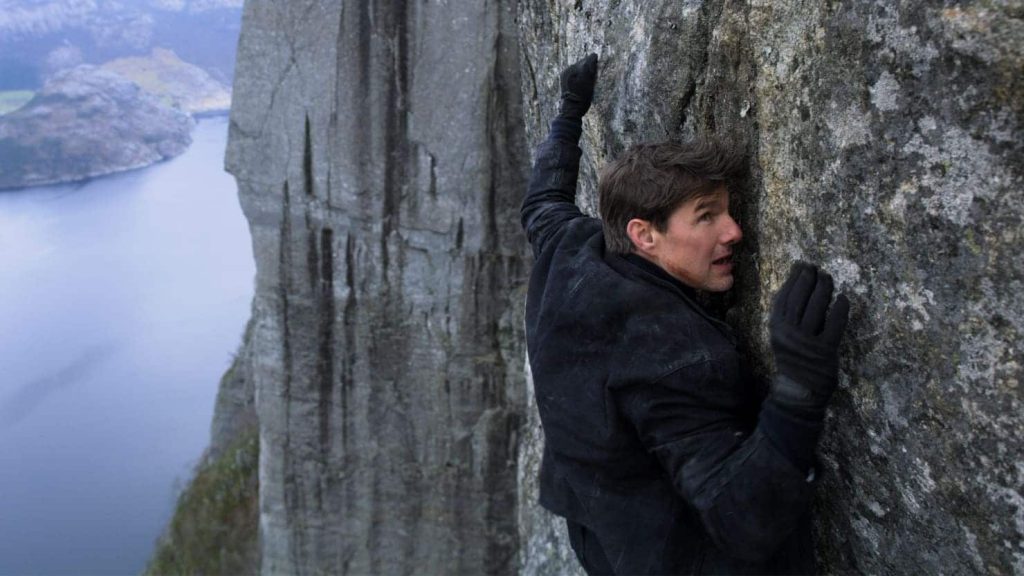
Mission: Impossible – Fallout (2018) is written & directed by Christopher McQuarrie. It stars Tom Cruise, Henry Cavill, Rebecca Ferguson, Ving Rhames, Simon Pegg, Sean Harris, Alec Baldwin, Angela Bassett, Vanessa Kirby, Michelle Monaghan, Frederick Schmidt, Wes Bentley, Liang Yang, and Kristoffer Joner. Two years after the capture of their leader, Solomon Lane (Harris), The Syndicate reforms into an even more radical organization called The Apostles. Now led by the mysterious anarchist, John Lark, they plan to build and detonate three nuclear bombs, killing ⅓ of the world’s population. To maximize their odds of success, the CIA assigns Ethan and his team to work alongside their #1 agent/brute, August Walker (Cavill). With paranoia at an all-time high, they face their most dangerous mission yet – one that forces them to accept the fact that, this time, they may not survive.
As Ethan Hunt, Cruise once again displays a rare kind of old-school movie star charisma. This deep into the franchise, there’s not much more to say about Ethan. Thankfully, Fallout continues the trend that originated in Rogue Nation (2015) and places Ethan in situations that challenge his well-established core beliefs. Six films in, the series somehow continues to raise the stakes. This is primarily a result of the mind-blowing action, but the script also does a great job of making things personal for Ethan. An unexpected number of his past choices and experiences come to a head, resulting in the first installment that doesn’t just pay homage to previous entries, but retroactively enhances them.
The addition of Henry Cavill as August Walker is a brilliant choice. Even when presented as an ally, Walker/Cavill’s bullish, golden boy attitude immediately establishes him as a series-best foil for Ethan Hunt. It’s also a relief that, unlike Jeremy Renner in the previous two installments, the filmmakers take advantage of Cavill’s natural abilities as an action star. I do feel as if his plain-Jane American accent is a tad exaggerated, but it mostly suits the character. The series has always been kind of hit-or-miss when it comes to villains, but Walker is easily one of its most unique, complex, and oddly chilling.
Angela Bassett as the director of the CIA is a small, fun addition to the franchise, but the film mostly avoids being bogged down by introducing too many new faces. The only exception is Vanessa Kirby as The White Widow, a crime lord with connections to Ethan’s past. Their flirtatious chemistry feels like a less-dynamic retread of the Ethan-Ilsa relationship, and her role in the plot, although meaningful, holds little entertainment value.
The story is like a breath of fresh air for the franchise, in that it finally commits to a certain amount of serialization. Surviving characters from previous entries, instead of being abandoned, are expanded upon in satisfying ways. Luther (Rhames) and Benji (Pegg) are still given annoyingly similar roles on Ethan’s team, but this time, the script does a great job of highlighting their subtle differences. Rhames/Luther, being the oldest and, as a result, weakest member of the team, regularly adopts a victim role. His continued peril helps highlight the fact that, with each new mission, death seems to creep a bit closer. At this point, it’s tough to believe anything could kill Ethan, so it works well to place that kind of vulnerability on the more naturally expendable supporting characters. Benji’s story of becoming a capable field agent received considerable attention in Rogue Nation, and although he’s comparatively sidelined this time around, it’s satisfying to see the fruits of that arc.
Ferguson’s return as Ilsa Faust is slightly less of a scene-stealer than the character’s first appearance, but still works to challenge the franchise’s otherwise black-and-white take on morality. She also adds a third party to the action sequences, which opens the door for countless new possibilities. The script also serves as a satisfying continuation of Ilsa’s connection to Solomon Lane, a character whom the script likewise improves upon. He’s not as memorable as Phillip Seymour Hoffman in Mission: Impossible III (2006), but there’s no doubt he’s the most ambitious and complex villain in the series so far. This is partly because he has twice as much screen time as every other villain, but his looks also subvert expectations. He’s short, mousy, and wears comically large glasses. Other than that, his actions and motivations come across as a tad generic. Luckily, he isn’t asked to carry the load villain-wise, which allows him to serve his purpose when it truly counts.
The film sometimes lacks creativity, as many of its action sequences are reminiscent of ones we’ve seen in the franchise previously. For example, the idea of yet another motorcycle chase doesn’t exactly fill me with excitement. Fortunately, the unoriginal concepts feel like an afterthought next to the quality of their execution. You’ve seen car chases, fist fights, and last-minute bomb diffusions before, but never in a package that displays such a masterful command of the filmmaking process. Like the previous entry but to a more impressive extent, the film takes the best elements of earlier installments and remixes them in exciting and subversive ways. The stakes are higher than ever, and more than any other entry, it feels like Ethan is up against impossible odds. This all culminates in one of the most exciting, large-scale displays of action ever put to screen. It’s layered in a way that’s as overwhelming as possible without becoming unpleasant. No matter how many times I see it, I find myself locked in and on the edge of my seat.
Overall, this is easily what I consider to be the best entry in the franchise. It tops everything that came before and feels like the film the series was always working toward. If the franchise ended here, I wouldn’t have complained. It’s not only a great Mission: Impossible movie, but in general, a great piece of action cinema that’s destined to be remembered and discussed for years to come. It’s hard to believe this is the fifth sequel to a film based on a 1960s television series. That’s not to say the previous films were anything other than good, Fallout is just a few steps ahead. A-

 The Movie Matt