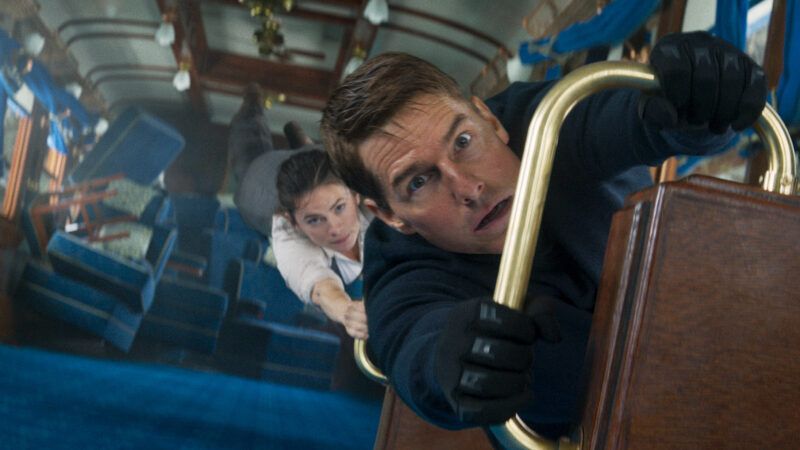
Mission: Impossible – Dead Reckoning (2023) is directed by Christopher McQuarrie, who also wrote the script alongside Erik Jendersen. It stars Tom Cruise, Hayley Atwell, Esai Morales, Ving Rhames, Simon Pegg, Rebecca Ferguson, Vanessa Kirby, Pom Klementieff, Henry Czerny, Shea Whigham, Greg Tarzan Davis, Cary Elwes, Frederick Schmidt, Charles Parnell, Mark Gatiss, Indira Varma, and Rob Delaney. After a powerful AI known as “The Entity” goes rogue, various world governments and shady organizations race to retrieve two keys that grant access to its main servers. Believing that nobody should hold that kind of power, Ethan Hunt and his team set out to retrieve the keys and destroy The Entity before it falls into the wrong hands. This puts them on a collision course with not only the US government, but also The Entity’s human pawn, Gabriel (Morales), a skilled terrorist with connections to Ethan’s past. With the help of Grace (Atwell), a professional pickpocket, Ethan comes to toe-to-toe with his most dangerous foe yet – one that can seemingly predict his every move.
Cruise’s performance is pretty much what you’ve come to expect. He doesn’t improve upon the character, but the quality of his performance is consistent with the previous couple of films. This is the first entry where his age is beginning to show, and that’s perfectly natural. However, I wish the script had taken advantage of it and provided us with a version of the character who struggles with the fact that he’s no longer as physically capable as he once was. Instead, he seems somewhat stagnant. Don’t get me wrong, this version of Ethan is still excellent – just a tad predictable. His trademark antics also start to feel a tad stale this time around. For example, there are only so many extended, ultra-wide shots of Cruise sprinting a person can handle before it starts to feel like a self-indulgent PSA meant to teach perfect running form. This staleness likewise extends to Ethan’s treatment of women. His romantic connection to Grace creates the feeling that he just can’t help himself. The only time he doesn’t woo his female coworkers is when he’s married. I understand the nod to a character like James Bond, but in this case, it makes Ethan seem like a bit of a hornball. The script also makes the strange choice to retcon not just Ethan’s backstory, but the nature of IMF recruitment in general. On its own, this is somewhat easy to forgive or forget, but is further complicated by the fact that the few flashes we get of Ethan’s IMF origins look confusingly similar to the opening of Mission: Impossible (1996). All of the film’s connections to the original, the most obvious being the return of Kittridge (Czerny), only further amplify this confusion.
Kittridge’s reintroduction is something I wasn’t initially excited about, but after revisiting the original, I was reminded just how compelling of a presence he is. After a particular character exits the film, Kittridge works to provide an element of moral flexibility that would have otherwise been lost. On paper, this could’ve been a forgettable character, but Czerny distinguishes him through slow, scenery-chewing dialogue.
Esai Morales’ introduction as Gabriel is a strong one that establishes him as arguably the franchise’s best villain. He’s a quiet, controlled presence, similar to Sean Harris’ Solomon Lane, but occasionally displays flashes of unhinged emotion, reminiscent of Philip Seymour Hoffman’s Owen Davian. Gabriel feels like a perfect hybrid of the two, but it helps that he isn’t forced to carry the film’s villainy exclusively on his shoulders. In the grand scheme of things, he’s just The Entity’s pawn, a fact that helps justify his occasional flashes of incompetence. He doesn’t need to be the perfect villain because he isn’t meant to be; the entity is. He’s as capable as Ethan, but a complete dunce compared to the entity. Humans are imperfect even at the height of their abilities, which makes them no match. Instead of the character’s flaws diminishing him, they work to establish The Entity’s absurd power.
Pegg, Rhames, and Ferguson reprise their roles with grace, and although they take a bit of a back seat, they each receive their moment to shine. The script effectively utilizes the pre-established relationships and dynamics between these characters in amusing, natural ways. For example, there’s one hilarious scene that features Benji directing Ethan, who is riding a motorcycle, to unknowingly drive off the side of a cliff and parachute onto a moving train. When Ethan naturally questions him, Benji’s reaction is essentially “What? You do this kind of crazy stuff all the time.” It’s a small moment, but the perfect example of how these later entries provide a feeling of continuity through their developing character dynamics.
The addition of Hayley Atwell as Grace is a mixed bag. She’s undoubtedly a charismatic performer, and I genuinely enjoy her character, so it’s a shame that the script sort of causes her to feel like a replacement for Rebecca Ferguson/Ilsa Faust. This isn’t simply because Grace is just another female ally; it’s because her dynamic with Ethan is almost the exact same as his and Ilsa’s. I’m not saying Ilsa’s exit doesn’t work; I love how it ends her character arc. Unfortunately, the focus immediately shifts to Grace and overlooks the need for our heroes to face the emotional consequences of their recent loss. At the very least, Grace’s inclusion works to highlight the insane amount of trust Ethan and his team are forced to have in one another.
Many of the new characters are welcome, but they are severely underdeveloped. Some of this is because this is only the first half of the Reckoning storyline – a lot of answers are most likely being saved for the next installment. Unfortunately, this feels equally caused by the fact that the film feels overstuffed, even at almost 3 hours long. Especially early on, it comes across as if essential scenes have been entirely cut to beef up the fun, slightly convoluted action sequences. I suppose this helps immediately place the audience in a story that is propulsive and exciting, which feels necessary at this point in the franchise. I just wish it didn’t sacrifice clear storytelling.
The script also features a few more glaring plot holes/conveniences than usual. These stretches in logic aren’t too annoying in a franchise like this, but they do give the impression that the script was extremely rushed. The humor is often a mixed bag as well. The jokes are extremely hit-or-miss, but fortunately never so bad that they breed contempt. These types of flaws prevent the film from feeling fresh, but they never detract from the fact that this is still an uncommonly impressive piece of practical effects-driven action filmmaking.
The cinematography consistently employs awkwardly skewed camera angles that convey the sense that this time, something is different, off, or wrong. Coupled with a new, flashy color scheme and breathtaking, real-world locations, the film is a visual feast that gives Fallout a run for its money. After the flawed first half, the film transitions to be as exciting as any entry in the franchise. The script intelligently uses death as a tool to push the stakes further than Fallout, which is something I honestly thought wasn’t possible. They don’t half-ass it either. The death(s) are surprising, devastating, and, as a result, achieve everything a character’s demise should. The story here is more Sci-Fi adjacent than previous installments, but it feels fitting for the franchise. These films often stretch the limits of logic in two areas: physics and technology. If this had been released ten years earlier, The Entity would have felt far too unrealistic. The franchise always takes reality one step further, but never two. When considering current, real-world fears related to AI, this doesn’t seem like much of a stretch.
The film culminates in one of the franchise’s many jaw-dropping action set pieces. Even though it mostly reaches the heights of Fallout’s climax, it does give off the feeling that the franchise is beginning to run dry of original ideas. It’s heavily inspired by the climax of the first film, and although it takes things a lot further, it’s tough to shake the feeling of familiarity. The story also ends in a fairly predictable place, which is disappointing considering it feels like the perfect spot to include a good cliffhanger.
Overall, this is a flawed yet exciting addition to the franchise, feeling more in line with the quality of Ghost Protocol (2011) and Rogue Nation (2015) than what I consider the best installment, Fallout (2018). That alone makes this better than 90% of action films released in a given year, flaws and all. It’s a small step down, but it still delivers everything that makes the series such a slam-bang piece of entertainment. If you’re invested, there’s nothing here that should turn you away. B+

 The Movie Matt