Mission: Impossible – Ghost Protocol (2011) is directed by Brad Bird and features a script from Josh Appelbaum and Andre Nemec. It stars Tom Cruise, Jeremy Renner, Simon Pegg, Paula Patton, Michael Nyqvist, Vladimir Mashkov, Samuli Edelman, Ivan Shvedoff, and Anil Kapoor. After the IMF is framed for a devastating terrorist attack on Russian soil, a now disavowed Ethan Hunt (Cruise) is forced to form a new team in order to help him clear the organization’s name.
After three films as Ethan Hunt, it finally feels as if Cruise fully understands what makes the character so irresistible. At this point in the franchise, the character doesn’t necessarily require much added depth. This leaves room for the script to feature a more complex story and effectively establish new characters. Renner is a brilliant addition as William Brandt, an IMF analyst with connections to Ethan’s past. There’s something surprisingly fresh about adding another capable action star to the franchise. The problem is that he’s severely underutilized in the action sequences. He’s mostly just a red herring character used to add a level of much-needed intrigue/mystery to the admittedly basic story. It works, but ultimately isn’t very consequential. I still like the character, but would like him a lot more if he kicked a little more ass.
Benji gets a much larger role this time around, and Pegg makes the most of the opportunity. He essentially just fills the hole left by Ving Rhames’ Luther Strickell, but adds a much stronger element of comedic relief. In future installments, Benji shifts to being a voice for the audience. Since Brandt works as that voice this time around, it allows Pegg to crank Benji’s fun meter all the way to eleven.
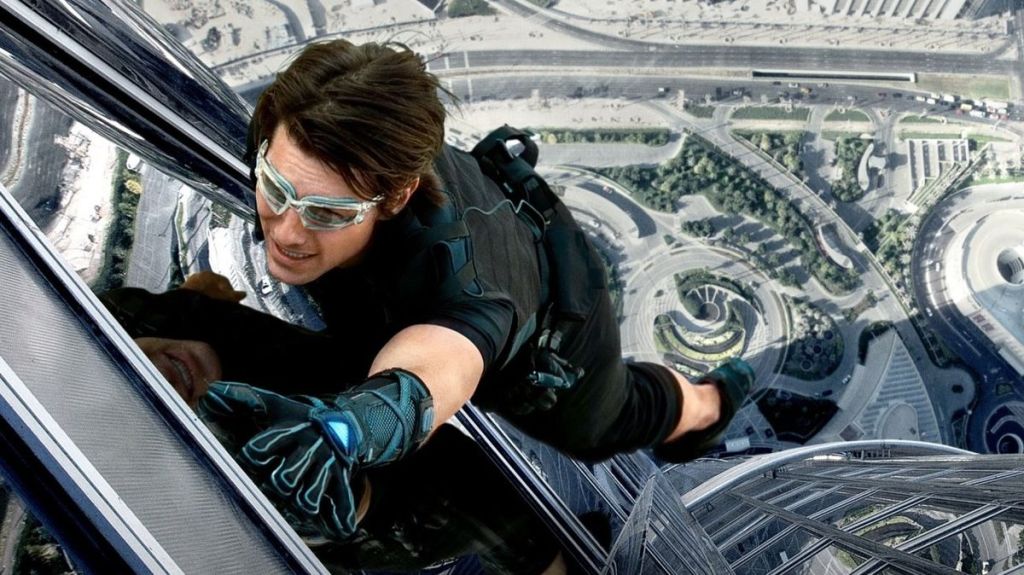
Even though the typical “someone’s trying to destroy the world and we have to save it” plot feels stale, the film pretty much perfects the franchise’s approach to action. The stakes are less personal than those in Mission: Impossible III (2006), which, in turn, makes them less effective. Thankfully, the inventive, large-scale action sequences consistently top anything featured in previous installments. For example, the now-iconic Burj Khalifa skyscraper sequence is a fantastic example of what can be achieved when there is a strong commitment to practical effects. Brad Bird’s more sci-fi-inspired, colorful approach to visuals is a tad too stylized for my taste, but it holds up a lot better than what J.J. Abrams brought to the previous film. This isn’t a movie that will impress you with its story or plot, but its near-perfect balance of action and fun makes it irresistible as surface-level entertainment.
What impressed me the most about the script is its ability to include multiple cheesy lines of dialogue that ultimately land because the characters are self-aware. For example, Ethan yells “Mission Accomplished!” as he presses a button to defuse a bomb. It initially feels goofy and out of place, but is quickly justified with a scene where Luther asks, “There’s no way you really said that?!” As long as a film is aware of its silly choices and logical inconsistencies, they’re a lot easier to either accept or ignore.
Overall, this is one of the best third sequels I’ve seen, and it succeeds at breathing new life into a franchise that desperately needed a clear direction for the future. The story and characters are slightly disappointing compared to the previous installment, but this is somewhat overshadowed by the impressive, newly improved approach to action. Sacrificing substance for spectacle is a risky direction to take, but Mission: Impossible – Ghost Protocol easily justifies the decision; The action is truly that effective. If you hate action, there isn’t enough depth to hold your attention. If you do (even slightly), this is a must-see. Surprisingly, it also works as a decent entry point for new fans. For picky viewers, it might actually be the best place to start. B+

 The Movie Matt