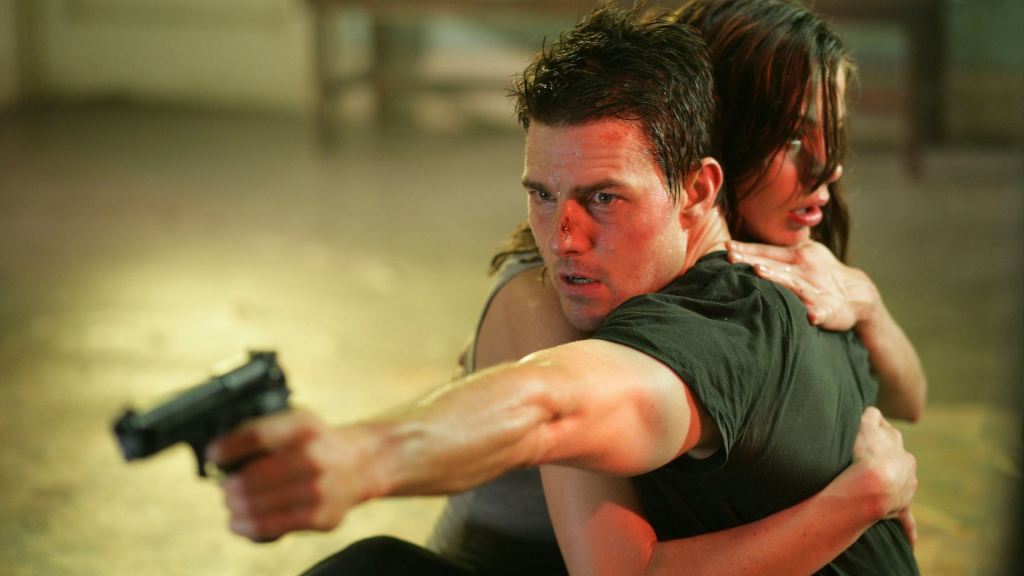
Mission: Impossible III (2006) is directed by J.J. Abrams, who also wrote the script alongside Alex Kurtzman and Roberto Orci. It stars Tom Cruise, Michelle Monaghan, Ving Rhames, Philip Seymour Hoffman, Billy Crudup, Maggie Q, Jonathan Rhys Meyers, Laurence Fishburne, Keri Russell, Eddie Marsan, and Simon Pegg. The film follows a now semi-retired Ethan Hunt (Cruise) on the verge of marrying his beloved fiancée, Julia (Monaghan). When he’s offered a mission to rescue one of his former protégés, Ethan reluctantly decides to return to the world of espionage one last time. This mission unwittingly puts Ethan in the crosshairs of Owen Davian (Hoffman), a brutal arms dealer in search of “The Rabbit’s Foot,” a powerful bioweapon capable of wiping out entire nations in the blink of an eye. When things become more personal than he ever could’ve imagined, Ethan desperately attempts to stop Davian before it’s too late.
Cruise once again nails the role of Ethan Hunt, partly due to a script that’s finally willing to explore a more human side of the character. The stakes are far more personal than in the first two films, allowing Cruise to deliver a more emotionally charged performance. This feels like a smart way to amplify stakes without having to create endless “impossible” scenarios that are forced to top the previous ones. The script also provides Ethan with a clear motivation that drives him throughout the franchise’s future: Protecting the ones he loves at all costs. Instead of being the hotshot agent who makes all the right moves, Ethan is finally written to be a character who makes mistakes. Fortunately, this never makes him seem incapable or stupid, only human. He still undertakes a seemingly impossible mission and ultimately succeeds; the only difference this time around is that he puts himself in that position. Every misstep he takes is because of love – something that’s easy to understand, and therefore easy to forgive. My only real issue with the script’s handling of Ethan is that I never fully believe the character as someone willing to pursue a typical, domestic family life. I think this has more to do with Cruise himself than the actual writing. I mean, just think about it. When was the last time you’ve seen him play a grounded, everyman type of character? I can’t think of one example (especially within the last 30 years), but I think there’s a good reason for it.
Ving Rhames is once again an irresistible supporting presence as Luther Strickell. Out of the three films up to this point, he’s given the most to do here. Unlike before, he never disappears for long stretches of the film, which allows for some much-needed development and nuance in his relationship with Ethan. Maggie Q and Simon Pegg are fun additions to the IMF’s fast-growing roster of agents, but unfortunately, aren’t given a ton to do. Q just kicks some ass and Pegg only shows up for one forgettable instance of comedic relief, but they’re likable enough that their inclusion feels acceptable. Monaghan is a lot of fun as Ethan’s fiancée, but truly becomes a compelling character in the climax. It’s made clear to the audience that although she doesn’t have Ethan’s skills or training, she matches him pound for pound in terms of sheer “take no shit,” “getterdun” gusto. As I mentioned earlier, I don’t believe Ethan as a typical family man, but I do understand why he’d see Julia as his one and only.
Owen Davian is easily the strongest villain in the franchise up to this point (but also in the future). On paper, he’s no different than any typical, hyper-violent terrorist character who wants to commit mass murder for vague reasons, but Hoffman’s performance sets Davian above the pack. Hoffman screams, smirks, and stares in the most palpable of ways. His threats cut through the screen and almost feel as if they’re directed at the viewer. If it weren’t for this performance, nothing about the film would make me think Ethan is ever in any kind of real danger.
Like most of the franchise’s early installments, Mission: Impossible III has a unique flavor both tonally and visually. Abrams’ trademark gritty, green-tinted visual style undoubtedly adds a certain intensity to the proceedings. This effortlessly gels with the film’s action-heavy approach, but ultimately feels a tad dated. Abrams’ schtick has been played to death in the years since this film’s release, which is starting to make it feel like a cringeworthy product of its time, similar to the previous installment. I used to think of this as one of the most serious entries, but now it slightly feels like a victim of age. Lighting that once seemed stylish now just makes you wonder why everything is so hard to see, and the neon green tint just feels like a shameless attempt to appeal to video game lovers. Thankfully, the sequences that still hold up are among the most exciting the series has to offer. Granted, none of them are as convoluted as what future entries provide, but they’re still wildly inventive and exciting. There’s one bridge-set sequence that’s easily one of my top 5 franchise moments.
Overall, this is a notable improvement over Mission:Impossible II (2000), adding some much-needed character depth to the series. The story isn’t very original, especially compared to most action films of the mid-2000s, but it’s competently made and therefore effective. The script’s logic is more inconsistent than I typically like, even for a franchise as over-the-top as this. Still, it’s not ultimately something that hinders the audience’s ability to immerse themselves. All this considered, the film is still an uncommonly well-made action experience that’s fast-paced, creative, and exciting. If this had ended the franchise as a trilogy, I think most fans would have been satisfied. I’m glad they carried on, but doing so must have felt like a risky endeavor when considering the quality achieved this time around. B

 The Movie Matt