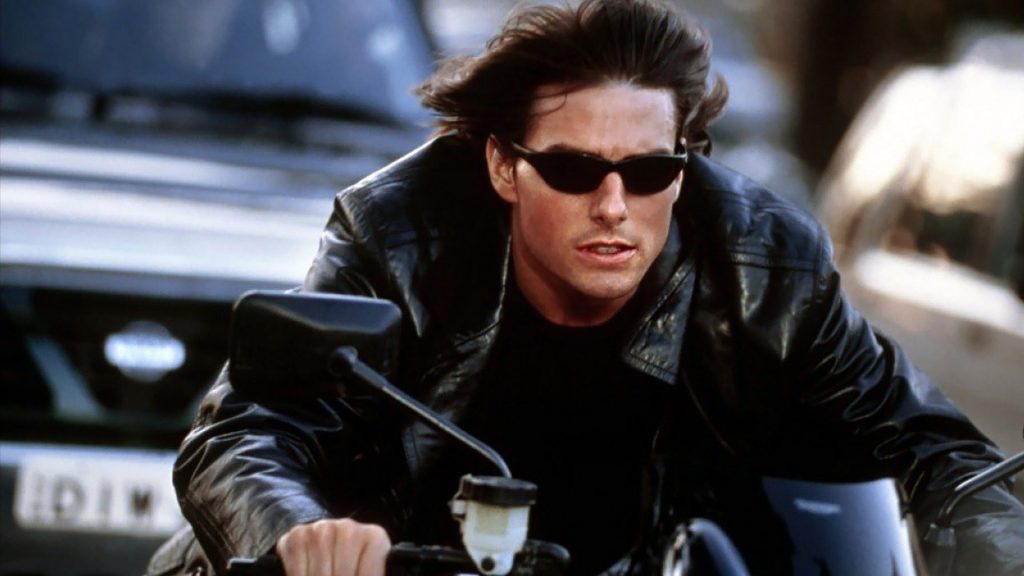
Mission: Impossible II (2000) is directed by John Woo and features a script from Robert Towne, Ronald D. Moore, and Brannon Braga. It stars Tom Cruise, Thandiwe Newton, Dougray Scott, Ving Rhames, Richard Roxburgh, Brendan Gleeson, Anthony Hopkins, John Polson, Rade Serbedzija, William Mapother, and Dominic Purcell. This sequel once again follows IMF agent, Ethan Hunt (Cruise), this time on a mission to locate a deadly, genetically modified disease known as “Chimera.” To retrieve the disease from Sean Ambrose (Scott), a rogue IMF with ties to his past, Ethan enlists the aid of the beautiful Nyah Hall (Newton), a master thief and Ambrose’s former muse. Even though the two quickly form a romantic bond, Ethan forces Nyah to go undercover as Ambrose’s long-absent lover. Struggling to balance his concerns for Nyah’s safety with his willingness to complete the mission to the best of his ability, Ethan finds himself faced with an impossible task of his own making. With the help of his close friend Luther Stickell (Rhames), Ethan sets out to stop Ambrose before he unleashes Chimera, but in a way that also allows him to save Nyah’s life in the process.
Compared to the original film, Cruise’s natural charisma and charm feel much more fitting. Instead of being presented as a newbie IMF agent who is oddly ten times more capable than his colleagues, the film follows an experienced and confident version of Ethan, which helps justify his hotshot attitude. Unfortunately, the script struggles to advance Ethan’s characterization in any meaningful way. It ultimately serves only to make the character feel like an American version of James Bond who grew up during and was heavily inspired by the extreme sports craze of the early 2000s. I appreciate that this is more or less the only installment in the franchise that portrays Ethan as a classic womanizer – one of the film’s more effective instances of emulating James Bond. The romantic exchanges between Ethan and Nyah consistently feature comically cheesy lines, such as “Damn… You’re beautiful.” Still, the dynamic ultimately works for two reasons: 1. It fits nicely alongside Woo’s trademark, occasionally silly tone. 2. Cruise and Newton generate palpable sexual and romantic tension.
Other than Newton, who’s perfectly cast, and Rhames, who’s funnier and more badass than in his first appearance, the supporting cast is mostly forgettable. Anthony Hopkins is a fun addition, but the film doesn’t do anything with his character. He mostly just feels like a big-name actor cast solely to sell a few more tickets – a theory supported by the fact that the character disappears from the franchise completely in subsequent sequels.
Unlike every other film in the franchise, this is the only installment that feels like a product of its time. John Woo’s silly, over-the-top, kung-fu-inspired approach to action was considered cool (I’m told) at the time of this film’s release, but has aged like room-temperature milk in the two and a half decades since. Although not intended to be, it sometimes feels like a satirical exploration of early 2000s action cinema when viewed through a modern lens. The fast-paced, electronic score gives the action an aura similar to that of a budget strip club, but made infinitely worse through the egregious use of slow-motion shootouts that only serve to display the characters shooting akimbo pistols straight at the camera simply because it “looks cool.” The movie appears to be more concerned with appearing cool than actually being cool, which would be the only explanation for Woo’s trademark use of white doves as a visual motif. I refuse to accept any explanation of their meaning because their inclusion, on its most basic level, just doesn’t gel with the established logic of the Mission: Impossible universe. Imagine if the ending to Mission: Impossible – Fallout (2018) culminated in a couple of random doves inexplicably appearing to fly through a fiery explosion. Sure, the doves aren’t as stupid in the context of the year 2000 as they are in the modern day, but they’re stupid nonetheless. I refuse to believe that people ever thought John Woo’s dove obsession was cool or even made sense.
Like its predecessor, the film provides a satisfying balance of bombastic action and more traditional, low-key spy fare. Unfortunately, both elements are a step down from the previous movie. As mentioned before, the action feels inappropriately silly for the franchise, but what’s worse is that it lacks one of the large-scale action set pieces that eventually become the franchise’s lifeblood. Thankfully, the moment-to-moment happenings are never dull, due in part to the inclusion of some fun twists and turns that take full advantage of the series’ lifelike rubber masks. Considering how many people tear off their faces throughout the story, it’s no surprise they hired the director of Face/Off (1997).
Overall, this is easily the weakest entry in the Mission: Impossible series. Still, when considering how consistent the franchise is, that’s not as harsh an insult as it initially seems. The script doesn’t have aspirations beyond looking cool and having fun, so it’s no surprise this is where the film excels. The problem is that the in-your-face tone and comically stylized action have aged faster than an unsealed, pre-sliced avocado. The film seemingly has no idea of which direction to take the franchise, so it makes sense that they just made it hip in a lazy attempt to appeal to the widest audience possible. It’s soulless, but it’s admittedly well-made, serviceably paced, and surprisingly funny (even if that’s not the intention). Even fans of the franchise should temper their expectations before seeing this; it feels out of place not only next to its predecessor but also every future installment. That being said, I’m sort of happy it exists, flaws and all. C+

 The Movie Matt