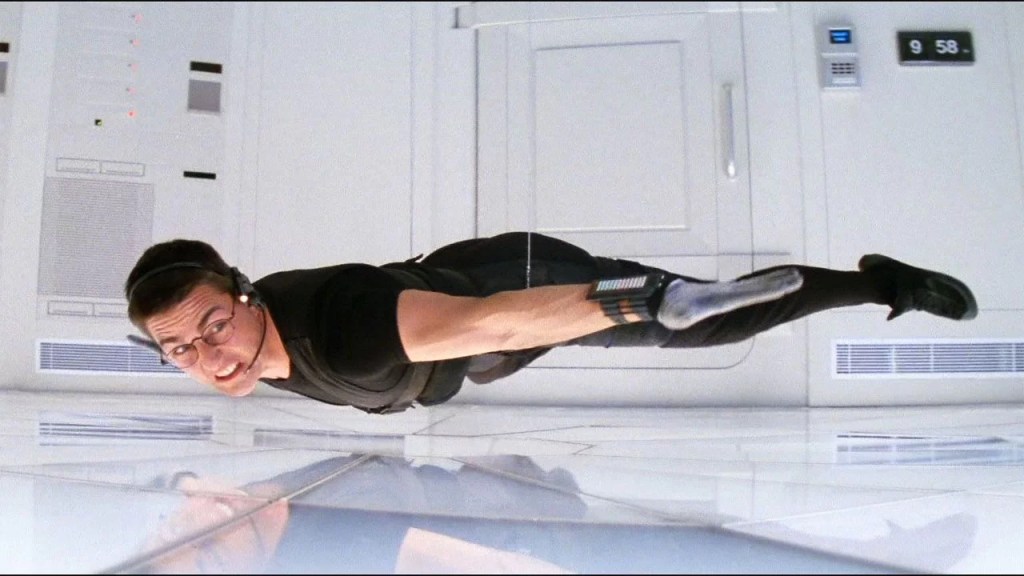
Mission: Impossible (1996) is directed by Brian De Palma and features a script from David Koepp & Steven Zaillian. It stars Tom Cruise, Emmanuelle Beart, Jon Voight, Henry Czerny, Jean Reno, Ving Rhames, Vanessa Redgrave, Rolf Saxon, Emilio Estevez, Kristin Scott Thomas, Ingeborga Dapkunaite, and Karel Dobry. Loosely based on the television series of the same name, which ran from 1966 to 1973, the film follows Ethan Hunt (Cruise), a highly trained member of the IMF (Impossible Mission Force), who is framed as a mole after his team is attacked and left for dead during a seemingly straightforward mission. Now on the run, Ethan is forced to form a ragtag team of disavowed IMF operatives to infiltrate CIA headquarters and retrieve information that could help exonerate him. With the odds stacked against him, Ethan’s antics quickly remind his superiors why they recruited him for the IMF in the first place.
Although Cruise injects Ethan with the natural charisma he’s made a career on, this is easily his least confident portrayal of the character. Hunt appears youthful and occasionally displays flashes of immaturity that help establish how inexperienced he truly is (for an IMF agent, that is). Unfortunately, this is undermined by the fact that Ethan is presented as an almost supernaturally intelligent spy who never makes mistakes and is always one step ahead. This would work if his supposed superiors consistently turned the tables due to their experience, but they’re written to be no more intelligent than the droves of criminals they supposedly make fools of regularly. He can’t be a rookie and the cream of the crop at the same time, so he ultimately just feels like a character who’s left intentionally open-ended so he can serve the story, at any given moment, in whatever ways it requires. Knowing how the franchise eventually develops the character makes this portrayal easier to accept. Still, I was surprised to find that Ethan starts off as a much less engaging character than I remembered. I suppose this makes sense considering De Palma’s intrigue-heavy approach to the material, but Ethan is the one character we’re never doubt, so what’s achieved by keeping his backstory and motivations so mysterious? I wish the script provided him with a bit more, but Cruise’s star power makes the character fun, and more importantly, human.
The supporting cast easily holds its own, featuring fun turns from Jon Voight, Jean Reno, and Henry Czerny. Upon this rewatch, it finally became clear why they chose to have Czerny eventually reprise his role in Mission: Impossible – Dead Reckoning (2023). On paper, this CIA director archetype is as dull as they come. Still, Czerny injects the character with a level of menace that consistently makes the viewer wonder if he’s straight up evil or just such a hard-ass that his behind could crush diamonds. Jean Reno feels right at home in this kind of action movie, providing a character who adds some necessary tension to the team dynamic. It’s a small role that would’ve been forgettable if played by a different actor, but Reno’s screen presence completely makes up for whatever the character lacks on paper. Ving Rhames’ introduction as Luther is one of the franchise’s best early successes. His fraternal chemistry with Cruise is immediately irresistible and serves as a strong source of fun in not only this film but throughout future installments in the franchise. Emmanuelle Beart is serviceable as Ethan’s untrustworthy, “will they, won’t they?” love interest, but the script never follows through on their romantic tension in a satisfying way. This undermines the effect of certain third-act revelations involving the character because Ethan’s connection with her never goes far enough to feel meaningful. Information/revelations/events meant to hurt Ethan don’t because, quite frankly, why would they?
Until the franchise eventually finds a consistent tone when Christopher McQuarrie takes over directorial duties with Mission: Impossible – Rogue Nation (2015), each installment sports a unique flavor strongly influenced by its given director. Brian De Palma, who remains the most celebrated and decorated director to tackle the franchise, provides a compelling vision that’s a far cry from its source material, but arguably superior in almost every way. Even though the films eventually stray from more traditional, intrigue-heavy spy elements in favor of large-scale action set pieces, this first installment works to point the franchise in the right direction. This is achieved not by perfecting a specific formula or setting the stage for a grand story that spans multiple sequels, but by focusing first and foremost on quality filmmaking. I don’t know if spawning a franchise was De Palma’s intention, but maybe that’s the point. It’s clear that he’s focused on making a fantastic standalone experience and therefore avoids even the subconscious pitfalls of franchise filmmaking. The best way to ensure a sequel is to make the first film as good as possible. The thing is, prematurely planning for a sequel usually doesn’t result in a strong script. The franchise doesn’t quite establish every aspect of its identity after this first installment, but it does set a high bar in terms of quality. If not for this precedent, I have a strong feeling the franchise wouldn’t have lasted the nearly 3 decades it has.
Although it never quite matches the scale of its sequels, the film features one of the franchise’s strongest opening scenes. The sequence immediately lends the movie palpable, life-or-death stakes and, to this day, remains one of the darkest moments in the franchise. The climactic action sequence, which is arguably still the most creatively conceived of the franchise, is a ton of fun but unable to reach its full potential due to some obvious technical constraints. It also stretches credibility too far in certain moments, a flaw that future action set pieces in the franchise easily avoid due to their commitment to practical effects.
Thanks to its dynamite pacing and skilled direction, I’d consider this a strong first entry for almost any franchise. It’s an exciting and original take on the spy genre that remixes its source material into something with much more dramatic weight. Even when the action takes a backseat, the film remains compelling due to its effective use of paranoia and distrust – a more tried-and-true approach to the spy genre than the franchise’s eventual focus on blockbuster action fare. Unfortunately, the convoluted and twisty plot requires unwavering focus to understand fully, and even then doesn’t fit together as nicely as one desires. It makes sense that the franchise eventually abandons this intrigue in favor of more grand-scale action spectacles, but it nevertheless provides this entry with a unique flavor. That’s one thing I love about this franchise: even the lesser (for lack of a better description) installments provide a unique take on the world of Mission: Impossible, and therefore never feel like redundant or unimportant additions. It’s not the best Mission: Impossible movie by a long shot, but it is a pretty great Brian De Palma film. Seeing it through that lens, it’s infinitely more impressive. That being said, I think fans of Tom Cruise, spy films, or 90s movies in general will thoroughly enjoy themselves. It’s clear the franchise has considerable room to grow, but this first entry is still an uncommonly strong foundation. B

 The Movie Matt