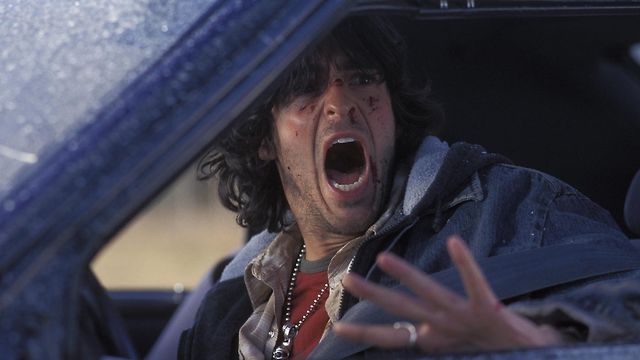
Final Destination 2 (2003) is directed by David R. Ellis and written by J. Mackye Gruber & Eric Bass. It stars A.J. Cook, Michael Landes, Ali Larter, Jonathan Cherry, Terrence ‘T.C.’ Carson, Keegan Connor, Lynda Boyd, James Kirk, David Paetkau, Justina Machado, Noel Fisher, and Tony Todd. The film follows a brand new cast of characters led by Kimberly (Cook), a typical college student who experiences a mysterious premonition that prevents her and a few seemingly lucky strangers from dying in a tragic highway accident. When the people she saved begin dying in what appear to be freak accidents, Kimberly and the remaining survivors realize that Death may have returned to correct its mistake. Seeking answers, they enlist the aid of Clear Rivers (Larter), the only known survivor of a similar occurrence. Learning that only life can truly defeat death, the group races to cheat death just one more time…
Even though most of these characters are as basic as they come (especially the two leads), they aren’t hindered by any of the awkward teen melodrama that plagues the first film. The characters here are far less developed, but it does feel like the focus on each individual is better balanced. This causes the two leads, A.J. Cook and Michael Landes, to feel entirely forgettable, but it adds a bit of substance to the various supporting characters. Compared to the first film, the leads are a huge step down, while the supporting cast is a clear improvement. Because they’re adults this time, their flaws feel a tad less forgivable, which makes them somewhat unlikable. The thing is, these flawed characters ultimately work because of the film’s commitment to a kind of dark comedy that thrives on irony. This helps to strike a nice balance of characters who are just compelling enough that we want them to survive, but also scummy enough that we’re able to have fun with the comedic/ironic nature of their deaths.
On the technical side, the film is a huge step up from its predecessor. The highway accident that begins the movie is still the franchise’s best opening disaster sequence, mainly because it’s the last installment committed to practical effects. Even though the carnage displays almost John Woo levels of absurdity, it always feels real because it looks real. It does what the franchise’s openings do best and makes the viewer deathly afraid of something they commonly experience. If someone you know ever refuses to drive behind a log truck, it’s a safe bet they’ve seen Final Destination 2.
The executions of the various Rube Goldberg-style deaths are improved/expanded upon, setting a high bar for future installments. Even though the deaths aren’t as unpredictable as the first film’s, it’s clear that this sequel isn’t interested in surprising us with who will die, but instead how they’ll die. For example, each sequence we know will end in death features multiple red herrings relating to how that death will occur. This diminishes the film’s more serious elements, but feels more appropriate for the newly adopted, darkly comedic tone. This sequel is aware that, like so many slasher films, its core audience comes first and foremost for the “carnage candy.” The film has a lot of “fun” with its deaths. Still, they never quite devolve into parody because their convoluted nature eventually wraps back around and amplifies the idea that one can never truly escape death. Like the first film, no one ever feels safe, even in the moments when slasher victims typically do.
It’s unsurprisingly derivative of the first film but better executed in almost every way. It maintains what worked so well about the first film, but also expands upon ideas that were only hinted at. That being said, the script is still extremely basic compared to most horror films. The characters are fun, but nothing more than simple archetypes we’ve seen countless times before. Unfortunately, my biggest problem doesn’t stem from the new cast but from how the script handles characters from the first film. The script lazily retcons the first film by revealing that Devon Sawa’s character died by getting hit with a falling brick. This is disappointing as a fan, but it would’ve made sense if the writers intended to start fresh with new characters. However, this isn’t the case once it’s revealed that Clear (Larter) is still alive. Knowing that Sawa’s character dies in the original cut of the first film makes me wonder if they wrote this film based on that ending. Clear’s inclusion feels like a mixed bag, but it adds some necessary connective tissue to the events of the first film. Other attempts to connect the two films are compelling but never fully developed enough to recontextualize our interpretation of Death’s design. To round things out, the script is also occasionally schlocky like B-slasher movies typically are. Side characters are sometimes absurdly crude, creepy, and mean in a way that can come across as unpleasant, but ultimately amplify the constant feeling of unease.
Other than a somewhat boring resolution, the film is extremely well-paced. As it moves along, the shocking deaths begin to occur at a faster pace, resulting in a rare third act that gains momentum instead of petering out. The way the characters eventually “defeat” death is disappointing, but the film thankfully ends with a scene that perfectly displays its near-perfect blend of self-aware comedy and unapologetic, tragic violence.
Overall, this feels like one of the toughest films I’ve ever had to review. On one hand, it displays all of the typical slasher movie pitfalls that cause many critics to describe the genre as “bad taste.” On the other hand, it’s a great example of what good sequels can achieve. It further develops some of its predecessor’s more interesting ideas, but it also makes a considerable improvement on the technical side of things. Despite its glaring flaws, I think it works as a lean, mean atypical slasher movie experience created by a team who deeply understand the genre and how this specific premise can be used to subvert expectations. If this isn’t your preferred genre, the film’s ability to occasionally present death as a comedic punchline will probably turn you off. Still, everyone else is sure to find this to be simultaneously fun, funny, and disturbing in equal measure. It’s not high art, but it’s definitely a high point for the franchise. B-

 The Movie Matt